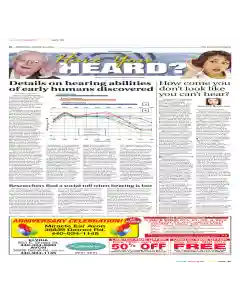
Early humans show chimp like hearing with savanna advantage
Anthropologists from Binghamton University analyze 2 million year old fossils from Sterkfontein Swartkrans and Sima de los Huesos using CT scans to map ear structures. Findings indicate Australopithecus africanus and Paranthropus robustus heard 1.0 to 6.0 kHz better than chimps, similar to humans at Sima de los Huesos, suggesting savanna adaptation and potential but not proof of language emergence.
MENTIONED IN THIS ARTICLE
Binghamton University
New York
Rolf Quamn
Sterkfontein
Swartkrans
South Africa
Science Advances
Quam
Binghamton
Sima de Los Huesos
Bones
Spain
Hearing loss linked to higher health risks in seniors
A Johns Hopkins led study of 1,100 plus seniors with hearing loss finds 32 percent more hospital admissions, 36 percent longer illness stretches, and 57 percent more extended mood problems over four years. Researchers caution association not causation and call for public health consideration.
MENTIONED IN THIS ARTICLE
Journal of the American Medical Association
Frank Lin
Johns Hopkins University School of Medicine
Hopkins’ Bloomberg School of Public Health
Lin
Hopkins
Dane Genther
My Hearing Loss Is Not Who I Am
Arielle Schacter, a 17 year old New York City student, counters myths about deafness in a 2011 column. She recalls questions about appearance, sports, and language, offers personal examples, and urges seeing hearing loss as part of a person not defining them.
MENTIONED IN THIS ARTICLE
United States
France
Habla Espanol
An IT
Arielle Schacter
New York City
Huffington Post
Also Mentioned on This Page
Detroit Rd
Elyria
E. Broad St
Avon

 This is just the beginning! Our collection holds over 300 years of history, including rare newspapers, obituaries, marriage records, birth records, and so much more—most of which you won’t find anywhere else!