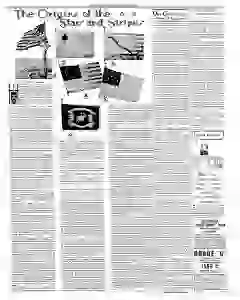
Origins of the Stars and Stripes in American history
This article traces the flag’s evolving origins from St George cross banners carried by Cabot and early explorers to pre revolutionary flags, the grand union and pine tree designs, and the gradual standardization of the Stars and Stripes. It notes key milestones including 1777 flag resolution, naval design changes, and the 1818 and 1912 arrangements, with references to figures like John Paul Jones and Captain Reid.
MENTIONED IN THIS ARTICLE
Elmo Scott Watson
Continental Congress
United States
North American
St. George's Cross
England
Giovanoi Cabot
John Cabot
North America
John Smith
Jamestown
Plymouth
Maass
Scotland
James
United Kingdoms
Jacques
New World
Washington
Philadelphia
Cambridge
Light Horse
Newark
N. J
Lee
Man- Tey
Massachusetts
Commodore Hopkins
Nancy
Henry Mosler
New York
Yorktown
Yale University Press
John Paul Jones
United Colonies
Congress
Marine Committee
Newburyport
Mass
Massachusetts Council
Marion
Culpepper
Georgia Rangers
Journal of Congress
Navy
Ranger
Jones
Europe
Samuel Chester Reid
Congressional Committee
Commodore John Rogers
Navy Commissioners
Navy Department
Army
Taft
Interstate Commerce Commission and the Rail Rate Fight Ahead
The Interstate Commerce Commission faces a tough period as railroads seek higher revenue while shippers demand lower rates. The article explains the commission’s broad powers over rates, through routes, and consolidation plans, noting limits on suspensions and the push toward four major eastern rail systems under a 1932 plan. It highlights historical expansions of authority from Mann Elkins to the Transportation Act and the enduring tension between carriers and public interests.
MENTIONED IN THIS ARTICLE
Interstate Commerce Commission
Commission
Aod
St. Louis
Denver
Congress
United States
Trion
Antidote for deadly gas tested in San Francisco case
A San Francisco man attempted death by carbon monoxide from car exhaust in a closed garage and was reportedly "out of this life" for about half an hour. He was saved by injections of methylene blue, an experimental antidote whose use in poison gas cases astonished physicians. The dye, more known as a textile colorant, appears to have revived him after standard oxygen and artificial respiration methods proved ineffective. Medical authorities caution that this single case does not establish a universal remedy and more trials are needed.
MENTIONED IN THIS ARTICLE
San Francisco
Golemnly
Los Angeles ‘Times
Friendship's Break Reveals Hidden Indiscretion
A promising friendship falters as one ally discovers the other speaks openly about private matters, eroding trust and testing loyalties. The incident underscores how discretion shapes long term ties and social standing.
Also Mentioned on This Page
United States Marine Corps
Federal Building
Chicago
Hack Miller
Western Newspaper Union
William Bruckart
Dr. Pierce
Dodge
Trafic
Fe B
Detroit
Jour Neishbors
Lockport Syrup Company
Lockport
Tse Postiast Nee Guild
Chica