Webster the Demosthenes of America remembered on anniversary
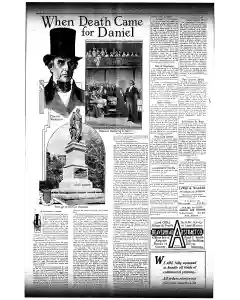
The article marks the 125th anniversary of Daniel Webster's birth and the 70th of his famed Hayne speech. It recalls his rise from a New Hampshire farm to Boston law, Congress, the Senate, and his defense of the Constitution. It notes his enduring legacy as a renowned orator and defender of union and liberty.
MENTIONED IN THIS ARTICLE
Daniel Webster
Webster
United States
Gamaliel Bradford
Americ
United States ‘Senate
Hayne
Nayne
Massachusetts
Boston
Coggerd
Lexington
Bunker
New England
Georgia
Republic
Liberty
Union
New Hampshire
Exeter
Dartmouth College
Fryeburg
Maine
Christopher Gore
Boscawan
N. H
Hzektfel
Tie
Portsmouth
Jeremiah Mason
Mason
Rockingham County
England
Rockingham
Henry Clay
House
Congress
Calhoun
Wilt in Alfalfa Linked to Cultivation Methods
Wallace's Farmer notes that alfalfa wilt spreads more in cultivated fields as soil disturbance injures roots and disperses disease germs. Without wilt, cultivation causes no damage, but when wilt is present, omitting cultivation reduces infection risk and weed allowance remains less harmful.
MENTIONED IN THIS ARTICLE
Wallace
Roughages Defined by Missouri Official and Henry Morrison
Weed Commissioner P R Schmidt cites Henry and Morrison to define roughage as the coarser high fiber feeding staff with lower digestible matter than concentrates. Roughages serve to carry livestock through winter feed idle animals supply carbohydrates and add bulk to mixed rations.
MENTIONED IN THIS ARTICLE
P. R. Schmidt
Missouri State Board of Agricuture
Henry and
Morrison
Pennsylvania growers reduce fruit disease with proper spray use
In 430 orchards where spray recommendations were followed fully disease dropped to 2.46 percent. Improperly sprayed or unsprayed orchards showed high disease rates: 6.8 percent in improperly sprayed, 80.2 percent in unsprayed. Omission of sprays caused 16.2 percent disease, substitute materials 11 percent, and poor timing 28.5 percent.
MENTIONED IN THIS ARTICLE
Pennsylvania
Stu
Plant Food Needed for Fast Garden Growth
Plants must have food and plenty of it for rapid growth. Commercial fertilizers don’t add humus but supply readily available plant food. For soils with humus but no manure, a 5-10-5 fertilizer is beneficial. Recommend a ton per acre or a pound per 20 feet of garden area.
Agricultural Squibs and Farm Notes from the County
Agricultural tips cover siloing fodder year round, growing cherries strawberries and raspberries at high altitude, and burning potato vines to reduce flea beetles. Liquid sprays outperform dusts for apple scab control, five-year review shows. County extension aids farmers in organized cooperation. Next year asparagus may improve with about 400 pounds of nitrate per acre after this year's harvest.
Virginia study on buried weed seeds and fast sprouting
The article notes several plants that emerged quickly after burial and cultivation, including wild morning glory and various weeds. It argues that plowing must occur before seed germination and explains why exposed seeds or buried soil can bring Kentucky bluegrass and clover to the surface, with white clover life potentially up to twenty years.
Time to Grow Alfalfa Sowing tips for spring and fall
The article advises sowing alfalfa in early spring or early fall to help seedlings establish before midsummer. Success depends on weather, with cloudy summers aiding spring sown crops and late summer sowing benefiting from favorable fall conditions. Favor spring sowing to fit land and give plants a strong start.
MENTIONED IN THIS ARTICLE
New Yorker
Self-Feeders for Hogs Boost Pig Growth and Efficiency
Self feeding proves a top method for growing and fattening pigs offering feed and labor savings plus weather protection and waste control. Five sections of 16 inches service about 30 pigs, ten sections about 80. Plans available from state experiment stations or the U S Department of Agriculture in Washington D C.
MENTIONED IN THIS ARTICLE
State Experiment Station
United States Department of Agriculture
Washington, D. C
Fighting pests in granaries to protect stored grain
Farmers face ongoing losses from rats and mice in grain stores. Clean granaries now, seal holes, and line with four inch hardware cloth to stop chewing. Proper bin cleaning also kills weevils and other pests hiding inside, says Drable Farnier.
Also Mentioned on This Page
Elmo Scott Watson
Harms
The
County Agricultural Extension Service
Lewis & Walker
P. O
Wyoming
Butte, Mont
Richard McCarthy
East Granite
Butte, Montana
Land Office
Asve Tne
Pearl I. Smith
Dillon
Montana

 This is just the beginning! Our collection holds over 300 years of history, including rare newspapers, obituaries, marriage records, birth records, and so much more—most of which you won’t find anywhere else!