Boundaries and Vastness of the United States Explored
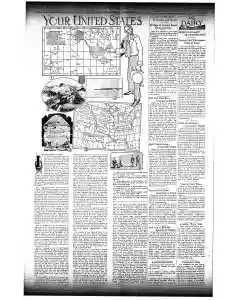
The article promotes Bulletin 817 by Edward M. Douglas from the U S Geological Survey. It highlights the nation’s size from pole to pole and across coastlines, notes the circle tour mileage of 17 936 miles, and contrasts highest and lowest points including Mount Whitney and Death Valley. It also surveys historic boundary quirks like Mason and Dixon and the Southwick Jog, plus maps and territorial changes through 1853.
MENTIONED IN THIS ARTICLE
Elmo Scott Watson
United States Government Printing Office
Washington
United States Geological Survey
United States
Edward M. Douglas
United States of America
Greenland
India
Point Barrow
Alaska
Rose Inlet
Antarctic
England
Pole
West Quoddy Head
Eastport
Maine
Great Lakes
Cape Alva
Wash
Pacific
Gulf of Mexico
Florida
Atlantic
Mount Whitney
Inyo
Tulare County
California
Death Valley
Inyo County
Southwick
Connecticut
Massachusetts
Panhandle
Missouri
Minnesota
Lake’ of the Woods
Pennsylvania
Maryland
Rose Island
Pacific Ocean
Shortage of young work horses and mules amid reduced foal production
The article notes a stark drop in horse and mule births from 1910–1919 to 1920–1929, leaving most on farms aged over ten. It warns prices will rise in five years and urges breeders to act now, forecasting mares bred today will be ready for work by 1985 and stressing the value of self-raised colts.
Bull Calf Ration Requires Alfalfa Roughage Balance
An agricultural note stresses alfalfa hay as essential in feeding six month old bull calves. It recommends a mix of barley or corn, oats, and bran, with home grown grains if bran is costly. For poorer hay, add tinseed meat 50 to 100 pounds. While grazing, 4 to 5 pounds of grain daily, increasing at weaning, plus constant salt and water.
Quail as a Remedy Against Weevils Debate
A Rural economist argues quail should be protected by law as a weevil control. He proposes penitentiary offenses for killing quail and distributing birds to infestations, claiming one quail can destroy many boll weevils in a day.
MENTIONED IN THIS ARTICLE
J. A. Robbins
Oklahoma Farmer-Stockman
Inoculation Key for New Legume Crops
The article notes inoculation is essential when growing alfalfa sweet clover peas or other legumes on land for the first time. Cultures can be sourced from the farm bureau or local dealer. Apply by thoroughly mixing seed with inoculant then combine with the remaining seed. Returns from legumes should cover inoculation costs.
MENTIONED IN THIS ARTICLE
Farm ‘Bureau
Cost of Milk and Butterfat Production
Weighing milk and testing fat content along with feed records lets breeders compute yearly costs per unit of milk and butterfat. Such records enable selecting efficient dairy cattle for breeding and faster development of superior producing lines. Poultry breeders face similar challenges in creating high egg producing flocks.
Agricultural Hints Focus on Storing Moisture for Futures
Agricultural hints stress storing moisture in summer and fall to shield future crop production. It argues it is cheaper to prevent disease and preserve soil moisture than to combat losses later.
Quality pasture sods improve through seeding and top-dressing
Ohio State University expert C W Gay explains pasture sods can rival other crops with proper re seeding, fertilizing, and cultivation. He notes grain feeding returns fertility, but manure must be evenly spread and not piled, to avoid harming grass. rolling and disking aid establishment. reseed bare spots and clip rank weeds. top dress in early spring. avoid grazing the same stock type on its own manure. cattle manure should go on corn ground. cross manures risk parasite transfer between species.
MENTIONED IN THIS ARTICLE
C. W. Gay
Department of Animal Husbandry
Ohio State” University
Gay
Luxuriant Pasture Increases Dairymen Profits In Kansas
The article argues lush pasture boosts dairy profits by saving labor and costs. Dairymen should use sweet clover seeded in oats for fall grazing and winter wheat or rye for early winter pasture. Sudan and brome grass offer dry weather forage, keeping cows fed nine months a year.
MENTIONED IN THIS ARTICLE
J. C. Nisbet Extension Dairyman
A. C
Sudan
Improve Dairy Prices Through Cow Culling and Quality Stock
Purdue University expert A Gannon argues dairy price relief comes from producers cooperating to cut herd size and replace low producers with high quality purebred cows. He says selling a few low producers to the butcher and investing in disease-free, high producing bloodlines can materially influence market and profits for dairy farmers.
MENTIONED IN THIS ARTICLE
A. Gannon
Purdue University
Gannon
Preventing Ropy Milk Through Clean Water and Udder Hygiene
Ropy milk causes yearly losses to the dairy industry and is more common in spring. Ensure drinking water and washing water are clean and fresh. Contamination comes from water and cows pastured near stagnant water. wipe flanks and udders with a damp cloth, especially in spring, and maintain year round hygiene.
Tuberculosis Testing Progress in New Hampshire Herds
Government records show New Hampshire making excellent progress in testing cattle herds for tuberculosis. Officials report strong results as testing expands across counties and farms.
MENTIONED IN THIS ARTICLE
New Hampshire
Also Mentioned on This Page
Lord Baltimore
Penn
Rhode Island
Supreme Court of the United States
Daniel, Webster
Rufus Choate
Choate
South Sea
Mar del Sur
Balboa
Virginia
Point Comfort
North Carolina
Tennessee
Kentucky
West Virginia
Delaware
South Carolina
Georgia
Alabama
Mississippi
Illinois
Indiana
Ohio
Carolina
Chesapeake Bay
New Republic
Ohio River
Wisconsin
Michigan
Louisiana
Louisiana Purchase
Oklahoma
Arkansas
Epee
New
Mexico
IASTA
Ocehn

 This is just the beginning! Our collection holds over 300 years of history, including rare newspapers, obituaries, marriage records, birth records, and so much more—most of which you won’t find anywhere else!