Dillon Examiner Editorial Address Instructions
The Dillon Examiner states that all letters pertaining to the editorial department or the business management should be addressed to THE DILLON EXAMINER.
MENTIONED IN THIS ARTICLE
Examiner
Dillon Examiner
Big Feeders in Beaverhead for Prospective Buyers
The State Bank issues information for buyers about large feeders in Beaverhead. Prospective buyers are advised to review details and terms related to the 11,025 unit inquiry.
MENTIONED IN THIS ARTICLE
Beaverhead
Bankhead Bill Promises Large Highway Allocation for Montana
Chief Engineer Pratt reports Montana could receive about 12 million dollars under a 600 million federal road fund if cooperation criteria are met. Amendments may shift Montana’s required share from 50 percent to about 26 percent, saving roughly 8 million for the state. The Salt Lake conference followed the Chicago meeting of western highway officials to define a clear policy for Congress.
MENTIONED IN THIS ARTICLE
Congress
Montana
Pratt
State Highway Commission
Salt Lake City
Western State Highway
Salt Lake
Chicago
American Association of State Highway Officials
Sanitary Board Tightens Montana Sheep Imports
The Montana Livestock Sanitary board issued orders to curb sheep movement from Idaho, requiring health certificates from U S veterinarians and disinfection of transport cars. Certificates must state no infectious disease and no exposure to sheep scabies, with specific conditions on district disease history and federal supervision.
MENTIONED IN THIS ARTICLE
Montana Livestock Sanitary Board
Montana
Idaho
United States Bureau of Animal Industry
Department of Agriculture
New Flour Mill to Start in February in Dillon
The Beaverhead Milling company plans to begin grinding flour about the first of February as machinery and heating plant are installed. Thousands of bushels of high grade wheat await operation and A. J. Foss of Wibaux Montana has arrived to manage the milling department.
MENTIONED IN THIS ARTICLE
Beaverhead’ Milling Company
A. J. Foss
Wibaux
Montana
Dillon
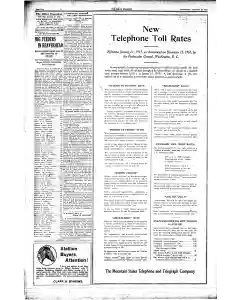
Station to Station Toll Rules In Telephone Calls
A historical note explains toll calls charged as station to station without a specific person. Rates use air line distance with five cents per six miles up to twenty four miles, then five cents per eight miles beyond that. Calls should use numbers if directory data exists, or provide the called subscriber's name and address to the operator.
Person to Person and Messenger Call Rates Described
The article explains that person to person calls incur a higher rate than station to station due to greater effort, with a day rate between points and a minimum charge of 20c, and no such call if station to station is under 15c. Messenger calls use the same day rate with a 25c minimum, payment required even if no conversation occurs, and are not accepted when the station to station rate is under 15c. Report charges follow the same general conditions as person to person calls.
Report Charge for Unreached Callers in Telephone Service
The report charge applies when the target is unavailable or uncontactable within one hour or when the caller is absent or refuses to talk after connection. It covers operating work and is about one fourth of the station to station rate. Minimum 10c, maximum $2.00.
Appointment Rate Rules For Time-Specific Calls
The appointment rate applies when a caller fixes a definite talk time for a person to person call. It runs about 50 percent higher than the station to station rate and is computed on the day rate between points. No appointment call is accepted when the station to station rate is below 16.5 cents. Report charges apply under general conditions for person to person calls.
Night Toll Rates Implemented for Station to Station Calls
Reduced night service rates take effect January 21 1919 from 8 30 p m to midnight at about half the day rate and from midnight to 4 30 a m at about a quarter of the day rate. The origin time governs the night rate and a minimum night charge of 25 cents applies. day rates apply if the night rate would be below the minimum.
Collect Calls and Reversed Charges in Person to Person Calls
The article explains collect calls or reversed charges are billed to the distant station where the call is completed and apply only to person to person calls. It outlines how such charges flow to the subscriber at the far end and the conditions under which they are collected.
Telephone Rates Display Lax Period Tiers Across Distances
The document outlines initial period rates for toll services between points 144 to 152 miles apart. Rates cover station to station, person to person, appointments, and messenger calls with time based adjustments. Additional charges apply for late night and overnight service windows.
Also Mentioned on This Page
The
State Bank of
Anderson & Johnston
Jackson
Arbour
Bray
J. H
Lakeview
Butte Butchering Co
Anee
Carroll
M. E
Inabit
John
Fox
Martin
Jardine
M. D
Jackson Wrens
Bristow
Jahnke Bros Jones
E. N
Wisdom
Jorgenson
Jorgen
Judge
John H
Polaris
Kramer
Joe
Jackson Lawrence
Ivide
Metlen
D. E
Armend
Montgomery
Morse
J. E
Meine
Chas. F
Morrow
H. W
Pierce
Mrs. A
Grant Peterson & Olson
Peterson
Sam
Jackson Ee
Pyle Bros Polaris
C. F
Dell Bic
Pendleton
Frank
Briston
Roberts
Grant
Getty
Roe
E. B
Bedrock
Shaw
Briston Ee
Sparrow
Spencer & Co
Jackson Simmons
H. D
Briston Cle
Stephen D. J
Spokane Cattle Co
Stewart Geo
Wisdom Asteive
Dirty Horse Sales Company
Clark H. Baskins
Pstrasion General
Washington, D. C
United States
Tate
PALAS
Mountain States Telephone and Telegraph Company

 This is just the beginning! Our collection holds over 300 years of history, including rare newspapers, obituaries, marriage records, birth records, and so much more—most of which you won’t find anywhere else!