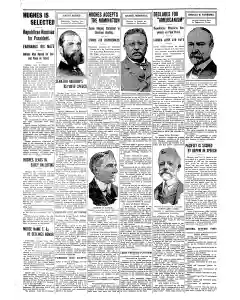
Hughes Is Selected Republican Nominee for President
Charles E Hughes was nominated for the presidency by the Republican national convention in Chicago. He resigned from the Supreme Court and issued a statement on issues of the day. Senator Fairbanks of Indiana was nominated for vice president. Hughes won on the third ballot with broad support and immediate acceptance.
MENTIONED IN THIS ARTICLE
Chicago
Charles Even Hughes
Supreme Bench
Woodrow Wilson
Charles Warren Fairbanks
Indiana
Hughes
Roosevelt
du Pont
la Follette
Lodge
New Jersey
Justice Hughes
Old Guard
Hughes Leads In Early Balloting At Republican Convention
Chicago June On the first two ballots at the Republican national convention Justice Hughes led the field gaining strength. He polled 25314 votes on the first ballot and 32814 on the second with 424 required to nominate. Roosevelt's top backers and other candidates increased modestly.
MENTIONED IN THIS ARTICLE
Chicago
Justice Hughes
Oregon
Florida
Roosevelt
Hughes
Charles W. Fairbanks
Coleman Dupont
Roosevelt Declines Progressive Nomination at Chicago Convention
At the Progressive convention in Chicago Theodore Roosevelt declines the nomination by telegram stating he is out of politics. The convention had announced his unanimous nomination as leader with John M Parker of New Orleans for second on the ticket amid disorder. Oyster Bay NXY June 10. Roosevelt also refused publicity requests for a new picture.
MENTIONED IN THIS ARTICLE
Auditorium
Chicago
Theodore Rooosevelt
Hughes
Coliseum
Robins
Roosevelt
John M. Parker
New Orleans
Oyster Bay
NX. Y
Theodore Roosevelt
Progressive Party
John M Parker
Sagamore Hill
Republican nominee for president Justice Hughes
The item notes Justice Hughes as the Republican candidate for president. It presents a concise political designation without additional dates or context from the source.
Harding Promotes Unity and Republican Principles at National Con
Senator Warren G. Harding of Ohio delivered a keynote at the Republican national convention in Chicago. He criticized the administration for rhetoric over resolution in foreign policy, faulted Mexican negotiations, urged a fraternity of American republics under the Monroe doctrine, defended national defense, and argued for protective tariffs and independence to the Philippines. He called for harmony, unity, and renewed Republican vigor, and urged the United States to assume influence and responsibility in international affairs.
MENTIONED IN THIS ARTICLE
Chicago
Warren G. Harding
Ohio
Harding
Democratic Party
Philippines
United States
Woman suffrage paths through Republican convention
In Chicago on June 10 the Republican convention shifted woman suffrage from rejection to a favored principle with a proviso that states decide. A Susan B Anthony amendment plank from a new women’s party was rejected, while the adopted plank aligns with NAWSA resolutions.
MENTIONED IN THIS ARTICLE
Chicago
Women's Party
Republican Party
National American Woman's Suffrage Association
Fairbanks Accepts Republican VP Nomination
Indianapolis June 12 Charles W Fairbanks issued this statement accepting the Republican nomination for the vice presidency He said he was not a candidate and asked withdrawal if nominated The convention adjourned before his dispatch arrived and he felt duty to accept the party s unanimous choice.
MENTIONED IN THIS ARTICLE
Indianapolis
Charles W. Fairbanks
Indiana
Hughes Accepts Nomination for President in Real Americanism Stand
Republican candidate Charles Evans Hughes declares acceptance by telegram to Harding. He pledges real Americanism, strong defense, and firm rights for citizens on land and sea, criticizes prior Mexico policy, and urges dignified diplomatic strength to restore American prestige and readiness.
MENTIONED IN THIS ARTICLE
Washington
Mexico
Roosevelt Addresses National Defense and Economic Policy
The colonel outlines thorough efficiency in all service branches, warns against militarism, and calls for strong defense. He urges fair tariff adjustment, labor interests, honest business, expanded foreign trade, and prudent transportation policy to sustain prosperity and public protection. He pledges civil service excellence and united, patriotic effort.
MENTIONED IN THIS ARTICLE
Congress
Republican Platform Calls for Strong Navy and Unified Nation
Chicago June 10 The Republican platform endorses a powerful navy and a large standing army to defend American interests globally and to train citizen soldiers. It praises government industry cooperation, supports woman suffrage with state control, criticizes Wilson Mexico policy as weak, and backs tariff reform, literacy tests for immigrants, child labor laws, and liberal compensation for ships in ocean trade.
MENTIONED IN THIS ARTICLE
Republican Party
Mexico
Europe
America
Charles W. Fairbanks as Hughes Running Mate on Republican Ticket
The platform asserts opposition to government ownership of vessels and pledges a strict neutral stance with full rights on land and sea. It attacks Wilson's foreign policy as phrased performance and calls for a consistent foreign policy, national defense, regulation of transportation and consolidated corporations, and safer working conditions.
MENTIONED IN THIS ARTICLE
Republican Party
Europe
Wilson
Lodge Presents Platform at Republican Convention
Chicago June 10 The principal developments in the Republican convention include adoption of the platform as reported by the resolutions committee led by Senator Lodge and a Roosevelt demonstration when his name was first raised. Lodge read the Philippine plank supporting the McKinley Roosevelt policy and the gallery demonstration followed, with some delegates joining on the floor.
MENTIONED IN THIS ARTICLE
Chicago
Resolutions Committee
Senator Lodge
Roosevelt
Cenator Lodge
McKinley
Pacifist Is Scored by Depew in Speech
Chauncey M. Depew, before the Republican national convention, condemns pacifism and warns that a mollycoddle policy risks United States entry into a world crisis. He links the current stance to 1856 ideals and independence, cites the Lusitania tragedy as a turning point, and imagines defense by trained troops and Ford cars.
MENTIONED IN THIS ARTICLE
Chicago
Chauncey M. Depew
United States
Progressive party platform outlines defense and social reform
The Chicago dated June 10 broadcasts the Progressive platform: strong national defense with a navy, a 250000 man regular army, citizen soldiery by national arm training, women's suffrage, social and industrial justice, resource conservation, protective tariff system, a permanent expert tariff commission, and unwavering loyalty to America. The document vows to work with any leader meeting national needs.
MENTIONED IN THIS ARTICLE
Chicago
Progressive Party
America
Also Mentioned on This Page
Fairbanks
Senator Harding
Suecome
American Press Association
Henry Cabot Lodge
Depew
National Defense

 This is just the beginning! Our collection holds over 300 years of history, including rare newspapers, obituaries, marriage records, birth records, and so much more—most of which you won’t find anywhere else!