Crotalaria as a soil builder and other farm notes
Special article notes Crotalaria striata as a promising South regional legume for soil building and forage, grown in Florida since years at the Florida Experiment Station with 125 tons of seed planted this spring. It highlights peanut hulls as a potential source of cellulose for rayon, warns against fraudulent livestock remedies, and cites Department of Agriculture actions.
MENTIONED IN THIS ARTICLE
South
United States
Department of Agriculture
Florida Experiment Station
Florida
Moore
Mississippi
South Carolina
America
Ice Cream Industry and Cottonseed Meal News Notes
O E Reed cites about 4000 ice cream factories in the United States producing over 1.75 billion pounds in 1928. A New Orleans chemist group reports cottonseed meal rich in vitamin G aiding pellagra prevention, with future food use contingent on removing toxins and converting it for human consumption. Land values in southern states held in March, with declines in several states tied to poor years, while cotton price movements since 1920 influenced southern land values and recovery.
MENTIONED IN THIS ARTICLE
Dolly Madison
James Madison
O. E. Reed
Bureau of Dairy Industry
United States
Georgia
Department of Agriculture
New Orleans
South
Department
Texas
Oklahoma
Louisian
Mississippi
Alabama
Kentucky
Tennessee
Florida
Arkansas
North Carolina
South Carolina
Chlorate as Weed Killer Gains Attention in Agriculture
Agriculture authorities report chlorates effective against stubborn weeds such as Wild Morning Glory and Canada Thistle with 4,000,000 pounds used last year. Calcium Chlorate offered for dry and wet applications, with rates from one to six pounds per area and a residual soil effect lasting six months to a year in the north. Citizens urged to combat the Weed Thief by applying chlorates to protect farms and neighbors.
MENTIONED IN THIS ARTICLE
Mason-Dixon Line
Uses for Cotton Seed Hulls and Byproducts
Scientists report cotton hulls yield xylose a non fattening sugar not absorbed by consumers. Hulls are also advised as poultry litter due to high absorbency lightness and softness, offering a versatile agricultural byproduct.
Corn Belt Land Values Rise and Coastal States Face Decline
The report notes land values rising in the Corn belt while the five coastal states from North Carolina to Alabama see declines. Southern states west of the coast show weaker crop prospects with North Carolina projecting about 1.9 million bushels, and South Carolina around 977 thousand. Alabama expected near 1,000 bushels per acre, reflecting light crops last year.
MENTIONED IN THIS ARTICLE
North Carolina
Alabama
South Carolina
Bama
Also Mentioned on This Page
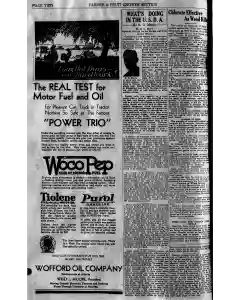
TRIO
Tidene
Pennsylvania
Woco
Wofford Oil Company
Atlanta
Wiley L. Moore
E. G. Moore
Food and Drug Administration

 This is just the beginning! Our collection holds over 300 years of history, including rare newspapers, obituaries, marriage records, birth records, and so much more—most of which you won’t find anywhere else!