What Old Newspapers Actually Reported About America's Most Haunted Places
Old newspapers covered America's most haunted places long before ghost hunting shows did. Here's what they actually reported, and what researchers can still find today.
Historical newspapers documented many of America's most famous haunted locations through original news coverage, obituaries, legal notices, and features. The Myrtles Plantation in Louisiana, the Villisca ax murder house in Iowa, Waverly Hills Sanatorium in Kentucky, and Eastern State Penitentiary in Pennsylvania all have searchable newspaper records going back to their most significant historical moments. NewspaperArchive includes death notices naming Waverly Hills patients, original 1912 coverage of the Villisca murders, 1977 reporting on Eastern State's abandoned state, and feature articles about the Myrtles Plantation's history. Researchers with family connections to these locations can search by institution name, family surname, county, and date range to find records that go well beyond what tourist accounts provide.
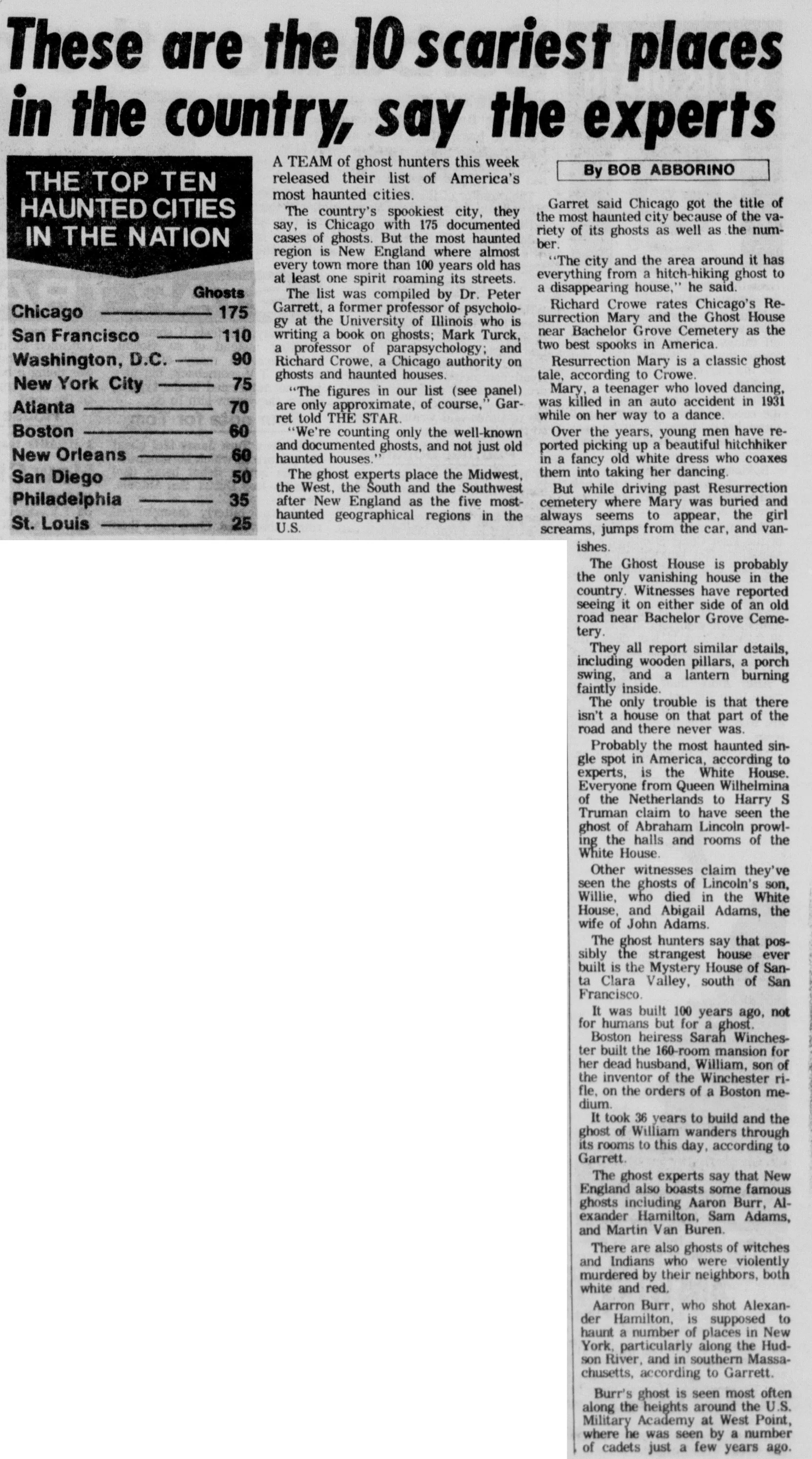
For decades, newspapers across the country have been tracking haunted places, listing ghost counts, and sending reporters into crumbling asylums and abandoned prisons to file firsthand accounts. Long before ghost hunting became a cable television staple, local papers were covering these stories with the same seriousness they gave to politics and weather.
That history is searchable. And if one of these places connects to your own family story, the newspaper record around it may tell you far more than the ghost tour ever could.
Quick Answer
Historical newspapers documented many of America's most famous haunted locations through news coverage, features, obituaries, and legal notices. Searching NewspaperArchive can surface original reporting on these places, along with death notices, patient records, and local coverage that connect real people and families to these sites.
The Myrtles Plantation, St. Francisville, Louisiana
The Myrtles Plantation was built in 1796 by General David Bradford on land in what was then Spanish West Florida. Bradford had fled Pennsylvania after his role in the Whiskey Rebellion and settled on roughly 650 acres north of Baton Rouge, naming the property Laurel Grove. The plantation passed through several families over the following century, and stories of unexplained sounds, apparitions, and photographs with unidentified figures accumulated alongside it.
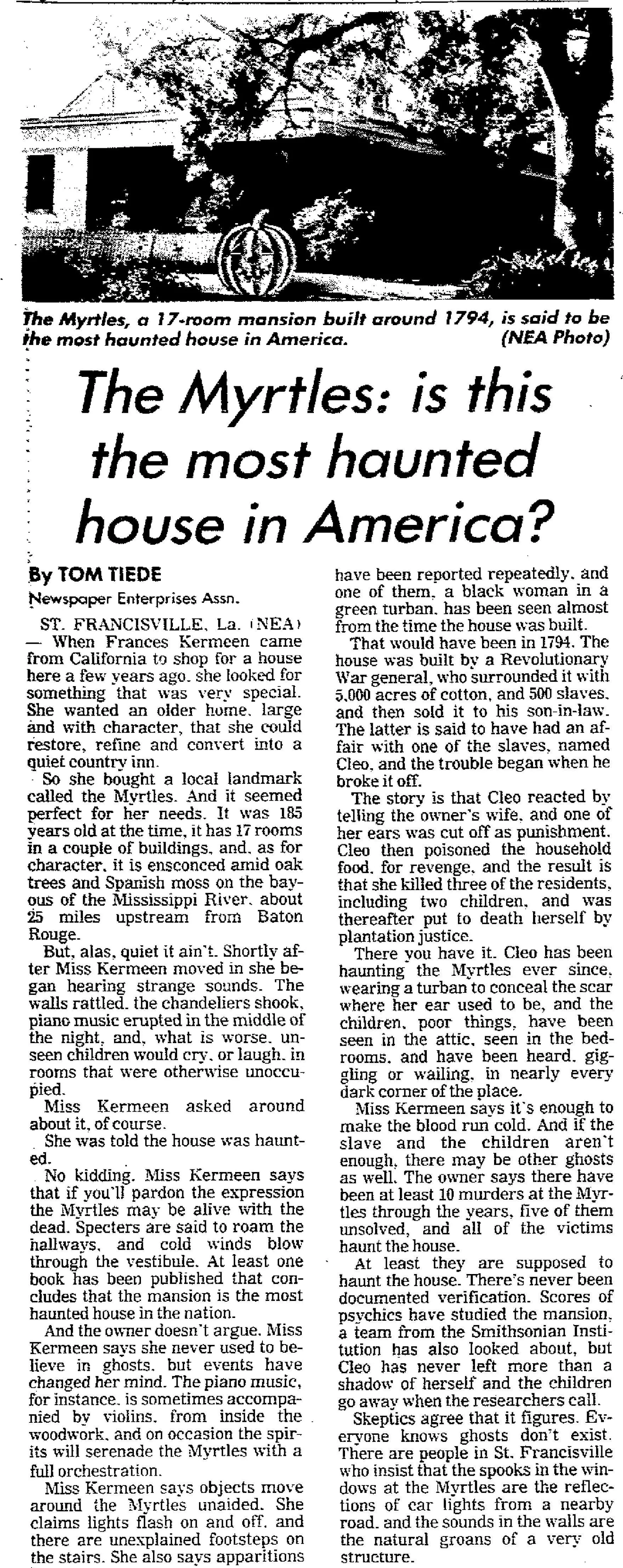
By the time Frances Kermeen purchased the property in the 1970s, the Myrtles had already built a reputation that preceded her. The newspaper feature "The Myrtles: Is This the Most Haunted House in America?" captured her account of moving into a house that wasted no time making itself known. Walls rattling, piano music in the night, unseen children laughing in empty rooms. Whether you find those accounts credible or not, the plantation's documented history is genuinely layered. Ten deaths are associated with the property, though records confirm only one murder, that of William Winter, who was shot on the front porch in 1871.
The most famous legend centers on Chloe, an enslaved woman said to have poisoned a birthday cake and killed two of the Woodruff children and their mother. Historians have found no documentary evidence to support this story, and it is widely considered folklore rather than fact. What is documented is the long human history of the property, the families who owned it, the enslaved people who worked it, and the many deaths that occurred there from disease and accident across more than two centuries.
If the Myrtles connects to your research, try searching the plantation name alongside St. Francisville and West Feliciana Parish. Louisiana newspapers from the late 1800s through the mid-1900s sometimes included travel features, legal notices, and estate coverage that named families and landowners in the region.
The Villisca Axe Murders, Villisca, Iowa
On the night of June 9, 1912, someone entered the home of Josiah Moore in Villisca, Iowa, and killed eight people in their sleep. Josiah and Sarah Moore, their four children, and two young guests, Ina and Lena Stillinger, were all found the next morning with severe head wounds from an axe. The murders have never been solved.
Newspapers across the Midwest covered the story within days. By June 12th, reporters were in Villisca filing dispatches about the investigation, the mounting theories, and the chaos of a town overrun with detectives and curious strangers. Iowa Governor Carroll offered a $500 reward for the capture of the killer. Coroner's inquests were held. Suspects were questioned and released. The funeral cortege stretched fifty carriages long.
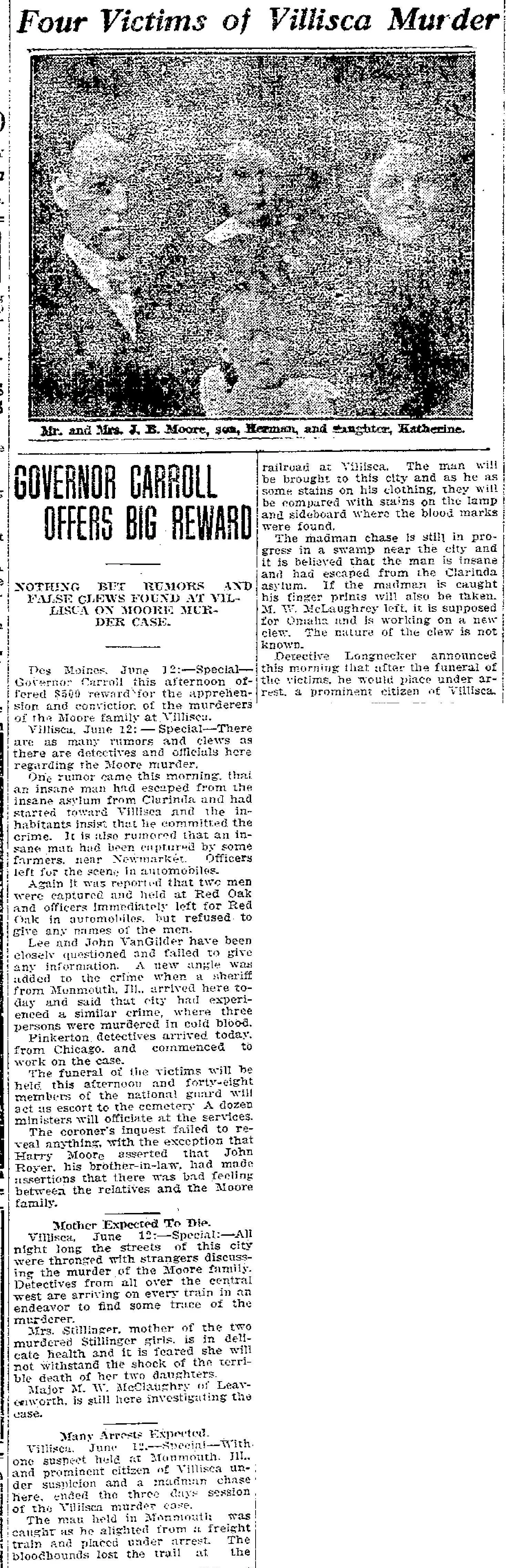
The Moore family, the Stillinger girls, and many of the people named in the investigation have newspaper records worth searching. Family members who gave statements to reporters, relatives who attended the funeral, neighbors who testified at the inquest, all of them appeared by name in the coverage. If your family has roots in Montgomery County, Iowa, or in the surrounding counties of that era, this case produced an unusually detailed newspaper record for a small-town community.
To this day, no one was ever convicted of the murders. The house still stands in Villisca and is open for tours. The mystery has remained unsolved for more than a century.
Waverly Hills Sanatorium, Louisville, Kentucky
Waverly Hills opened in the early 1900s as a tuberculosis hospital on the outskirts of Louisville. At the height of the tuberculosis epidemic, it was one of the largest facilities of its kind in the country. Thousands of patients were admitted. Many of them died there.
The newspaper record around Waverly Hills is not ghost stories. It is obituaries.
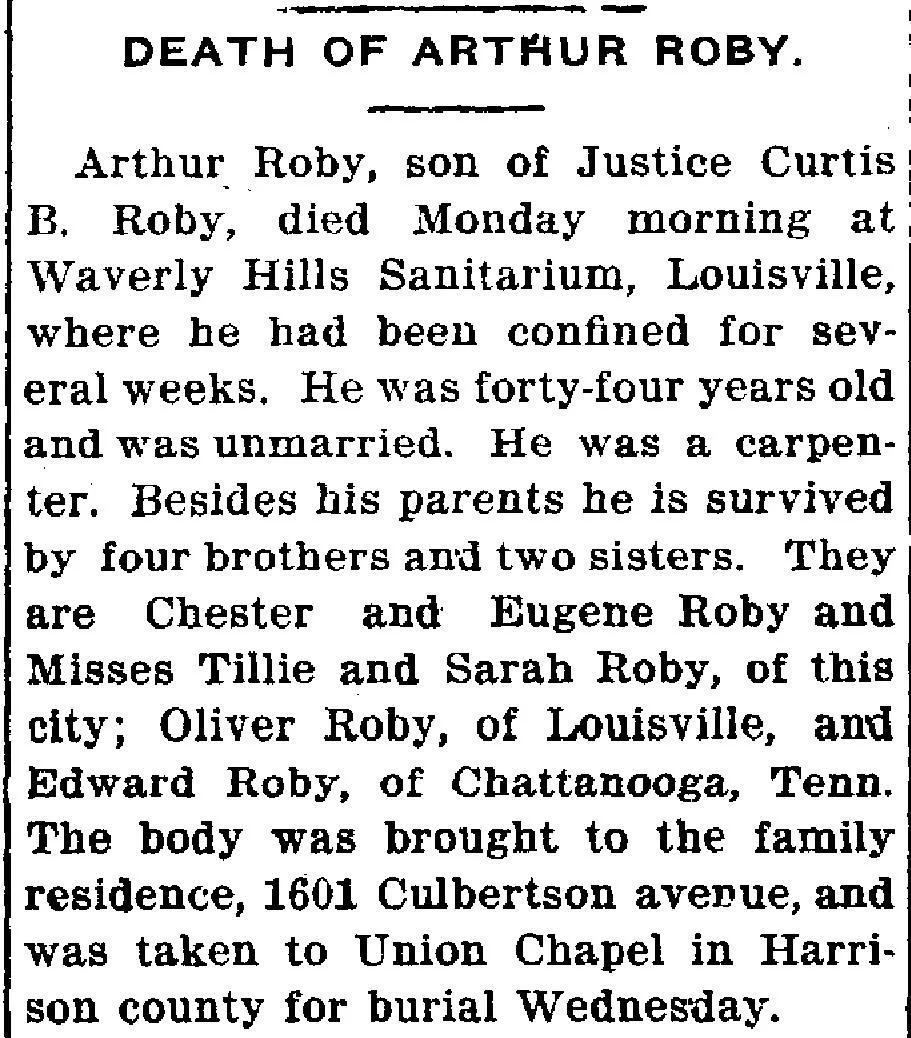
A search for Waverly Hills turns up death notices and obituaries naming patients who spent their final weeks or months at the hospital. These are real people with full lives visible in the record. Arthur Roby, a 44-year-old carpenter, died at Waverly Hills Sanitarium after being confined there for several weeks. He was survived by his father, Justice Curtis B. Roby, four brothers across Louisville and Chattanooga, and two sisters. His body was taken to the family home at 1601 Culbertson Avenue before burial in Harrison County. Claude Leroy Campbell, born in Washington County, Indiana, in 1896, died at Waverly Hills Hospital on June 26, 1919, at age 23. He left behind a wife, two small children, a mother, sisters, and brothers. He had been a tuberculosis patient for nearly two years.
These notices are not unusual. Hundreds of families in Kentucky and the surrounding states have an ancestor who passed through Waverly Hills during those decades. If yours might be among them, searching the hospital's name alongside the family surname may surface a death notice, an obituary, or a brief item that places them there.
The building closed as a tuberculosis facility in 1961, after antibiotics made the disease treatable. It has since become a well-known destination for ghost hunters and paranormal tours, largely because of its history and the sheer number of deaths that occurred within its walls. The legends around the place are numerous. What is not in dispute is that thousands of people died there, and that many of their families left a documentary record in the newspapers of the time.
Eastern State Penitentiary, Philadelphia, Pennsylvania
Eastern State Penitentiary opened in October 1829 as what many considered the first true penitentiary in the world. Designed by British architect John Haviland in a wagon-wheel layout, it was built on the Quaker principle that solitary confinement, paired with honest labor, could reform a criminal rather than simply punish one. Each cell had its own small exercise yard, a skylit ceiling, central heat, and a private entrance. When it opened, it was the largest and most expensive public building in the United States.
The system did not hold. By the 1920s, the prison was badly overcrowded. The solitary model was officially abandoned in 1913. Willie Sutton and Al Capone were among its more famous residents. Sutton and eleven other inmates tunneled 97 feet through the prison and escaped through a manhole on Fairmount Avenue in 1945. Most were quickly recaptured. Sutton was not.
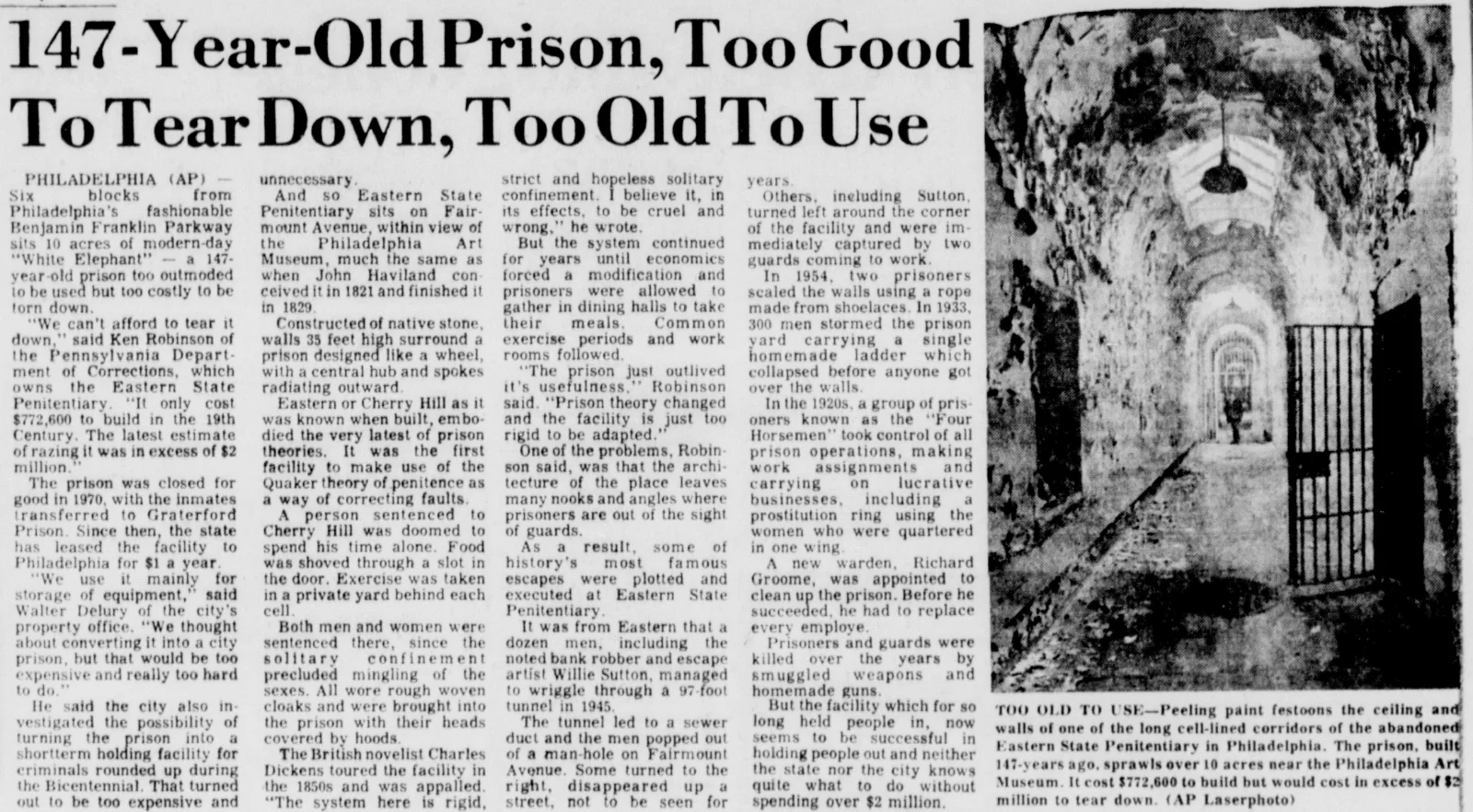
The prison closed in 1970. Within a few years, Philadelphia was trying to figure out what to do with a 10-acre structure that, as the 1977 Evening Sun put it, was "too good to tear down, too old to use." The article, published when the building had sat empty for several years, captured the particular problem of a landmark no one knew what to do with. The cost to raze it was estimated at more than $2 million. The cost to rebuild it for modern use was similarly daunting. It sat.
In 1994, Eastern State opened to the public for daily tours. The building now operates as a museum and hosts a well-known Halloween attraction called Terror Behind the Walls each fall.
For family historians, Eastern State is worth searching for a different reason. The prison kept detailed records, and newspaper coverage of the institution was consistent for more than a century. Inmates, escapes, deaths, and sentences were regularly covered in Philadelphia-area papers. If an ancestor was incarcerated at Eastern State at any point between 1829 and 1970, there is a reasonable chance that a newspaper record exists. An 1877 article noted that the prison's early mug shot book dated to 1904, and its death ledger from 1834 was still on site. Records like those, when they surface in digitized newspaper pages, can add meaningful detail to a family history that official records alone might not provide.
What Newspapers Can Tell You That Ghost Tours Cannot
The places on this list became famous for their hauntings. But every one of them also has a newspaper record built from real events and real people.
The tuberculosis patient whose obituary named Waverly Hills as the place of death. The Iowa family whose portraits ran alongside a governor's reward notice in June 1912. The Pennsylvania prisoner whose escape made a brief item in a Philadelphia paper. The Louisiana plantation whose deed and ownership history ran through legal notices in West Feliciana Parish papers for more than a century.
Those records are searchable. If any of these places connects to your family, a name, a county, and an approximate decade are enough to begin in NewspaperArchive.
Part 2 of this series covers six more locations, including the Lizzie Borden house, the Stanley Hotel, and the Winchester Mystery House, along with the newspaper records that connect real people to each one.
Frequently Asked Questions
Can I find records for people who died at Waverly Hills Sanatorium? Yes. NewspaperArchive includes obituaries and death notices from Louisville-area newspapers that named Waverly Hills as the place of death. Searching the hospital name alongside a family surname and an approximate date range is a good starting point.
Are there newspaper records from the Villisca ax murder investigation? Yes. Newspapers across Iowa and the Midwest covered the case extensively beginning June 10, 1912. Coverage named family members, witnesses, suspects, and investigators. Iowa newspapers are a logical first search.
How do I search for an ancestor connected to a specific historic location? Start with the location name, the county, and the approximate years. Broaden or narrow from there. For places like Waverly Hills or Eastern State, try searching the institution name directly. For events like Villisca, try the family name alongside the town and year.
Does NewspaperArchive include small-town Iowa and Kentucky papers? Yes. NewspaperArchive is especially strong in small-town and rural newspapers across the United States, including papers from the Midwest and the South. Many of these papers named ordinary people in ways that larger city papers did not.
What if I search and find nothing? Try name variations, initials, and nearby counties. OCR errors in older papers can affect search results. Widening the date range by a few years on either side sometimes surfaces records that a narrow search misses.