The Lowry Bale Invention Draws Cotton World Attention
Ginners and planters show strong interest in the Lowry Bale invention as a notable breakthrough in cotton handling. Reports indicate widespread curiosity among manufacturers and agricultural associations during this period.
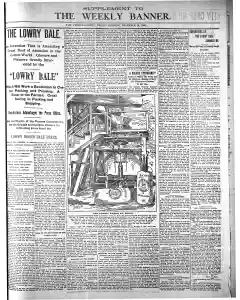
Lowry Bale Revolutionizes Cotton Packing and Pressing
The Lowry Bale promises to reform cotton packing and pressing, offering a boon to farmers by cutting packing and shipping costs and improving efficiency across the supply chain.
Numberless Advantages the Press Offers and Planters Plans
The article outlines aims of the Planters Compress Company and the Georgia and Carolina Planters Company. It notes the press as a tool to promote their business interests and public awareness, with emphasis on industrial advantages and regional economic impact.
Lowry Presses Offer New Cotton Bale Compression
The Georgia and Carolina Planters Company forms to deploy the George Lowry press for compressing cotton. The press produces 250 pound bales with 47 pounds per cubic foot density, enabling easier handling, reduced storage and freight costs, and potential savings in shipping to Liverpool. The system eliminates screwing and cuts tare, promising higher net returns for mills, ginners, and planters.
MENTIONED IN THIS ARTICLE
LOWRY
Planters seek Lowry bale standard to lift South cotton proceeds
The Georgia and Carolina Planters Company and The Planters Compress Company push a standard Lowry bale to raise farmers’ cotton proceeds by 35 million. A leased press actually converts square bale to round bale for shipment to Liverpool and Europe, with 500 presses planned across cotton states under a 50 cent per bale royalty and $500 advance refundable from initial bale royalties.
MENTIONED IN THIS ARTICLE
South
Planters Company
Lowry
Liverpool
Continent
Georgia and Carolina Planters Company
Planters Compress Company
Demand for the Lowry bale at advance prices
Northern mills have offered to pay 1 4 cent per pound more for cotton in bale form. Augusta firm Inman & Co. will bid 45 cents per 100 pounds more, or $2.25 per 500 pounds, for bale cotton. The Lowry machine is distinct from the Besgonnette process, with no relation between companies.
MENTIONED IN THIS ARTICLE
Lowry Press
Kyentor
Lowry
Himsel
Liverpool
Augusta
South Atent
Auguste
Messrs. Inman & Co
Planters Company
Besgonnette
American Cotton Company
Kaiserglocke Bell and Other 1900s World Notes
The German emperor orders 10 000 kilograms of French cannon metal for the Kaiserglocke to ring in Speyer's Church of the Protestant. The Royal Agricultural Society of Westernland bans docked tails from horse shows, likely ending the practice across the Atlantic. Empress of Germany buys 25 pound per yard white silk brocade from Lyons, valued at 20 pounds per yard. France’s Godin urges more corridor third class carriages for long fast trains by 1900. Carnegie as a politician may face a party-line test while Mark Hanna wields party power.
MENTIONED IN THIS ARTICLE
Kaiserglocke
Speyer
Royal Agricultural Society of Wneland
Atlantic
Germany
Lyons
Godin
Exterminate Cut-Worms in Cabbage Bed Recipe
Instructions for mixing Paria Green with wheat bran and sweetened water to form a dough. Small tablespoon portions placed around each plant claimed to be successful in controlling cut-worms in a cabbage bed.
Advantages of the Lowry bale summarized
The Georgia and Carolina Planters Company promotes the Lowry Press as a revolution in cotton handling. It claims higher cotton value, independent markets at stations, reduced bagging and storage costs, lower insurance, and doubled storage capacity. The plant near Augusta demonstrates gins and presses. visitors may learn details at 801 Broad Street, Augusta.
MENTIONED IN THIS ARTICLE
Ibs
Ladina
South
Lowry Press
Easil
Lowry
Osnaburg
Georgia
Carolin
Augusta
PANY
Bhoad Stireht
Usly, Ga
Humorist Style Evident in Savannah Editor’s Veto Tale
A Savannah News critique uses a Charleston editor’s humor to illustrate his style. It cites a satirical advertisement about a missing wife from James Island and a clumsy letter from a reader, noting dialect and spelling as part of the humor. The piece ends with a proverb on independence from farming.
MENTIONED IN THIS ARTICLE
Charleston News and Courier
Savannah News
News and
J. Rooks
News and Courier
The
Cullan Oman
Mary
Jerry
Mack
Also Mentioned on This Page
Lowry Bale
Planters Compress Co
Georgia and Carolina Planters Co
Lowry Round Base Press
West Vir
George Lowry
Chicago
Georgia and Carolinanters Company
Plantera Compress Com
North Carolina
South Caro
Southern
the Lowry Press
Severa
New England
Europe
Lowey Bale
Georgia & Carolina Planters Company
New York
Bremen
Carnegie
Andrew Carnegie
Mark Hanna
Ci2n
Cinnati Enquirer
Maj. Hempkin

 This is just the beginning! Our collection holds over 300 years of history, including rare newspapers, obituaries, marriage records, birth records, and so much more—most of which you won’t find anywhere else!