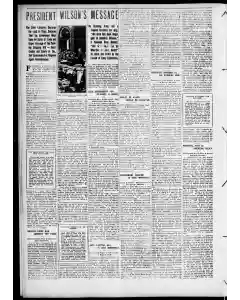
President's final message to Congress signals wartime resolve
The speech, delivered at the start of the Sixty third Congress, emphasizes a unified national duty, wartime achievements, and the need to face future challenges without partisanship. It reflects on the war's impact on the nation, the record of Congress, and the responsibility to continue constructive work in the new term.
MENTIONED IN THIS ARTICLE
Wison
Baes
Cine
Liem
Call to mobilize US resources for national service and power
The speaker urges immediate readiness to use and distribute American resources including ores forests and water powers. He laments delays in developing merchant marine and releasing waters within the national domain and calls for swift passage of measures to exploit navigable waters for power and national production.
MENTIONED IN THIS ARTICLE
Attock
House of Representatives
Senate
Philippines Self Government Urged in Senate Debate
President urges immediate passage of a measure granting greater self government to Filipinos. He emphasizes expanding transportation and maritime means to support trade with American neighbors, insisting infrastructure must precede and enable commerce. The address links liberty, justice, and steadfast national resolve to anticipated reforms.
We Need Ships We Have Not Got Them
A speech laments U.S. unpreparedness to mobilize resources and urges rapid development of the merchant marine, noting the nation has erred in stunting its shipping capacity and now lacks sufficient ships to serve itself and mankind.
MENTIONED IN THIS ARTICLE
United States
Amien
Ready to Help as War Disrupts European Trade
The speaker warns war disrupts trade and production in Europe and fears hardships for its people. The United States must prepare to assist, offering manifold services and support as Europe faces unprecedented needs. The call reinforces national readiness and generosity.
MENTIONED IN THIS ARTICLE
Europe
Ham
Morer
America Faces New Markets for Trade
The article argues the United States must build up merchant marine capacity to access rising opportunities in Central and South America and other European markets. It stresses that Europe and Britain have long supplied imports, and American ships should open wider trade routes to these regions.
MENTIONED IN THIS ARTICLE
Senate
Philippines
America
Europe
Central
South America
Great Britain
Gates of Trade Must Be Opened Yet Again
The government should open gates of trade to ensure transportation at reasonable rates even if initially unprofitable. It must act to attract private capital, then withdraw once carriage becomes profitable and capital is engaged.
MENTIONED IN THIS ARTICLE
Congress
United States
Olyedo
Great Britain
Peliher House
Ates
Trie
Ambiguous Fragment Reflects Policy Rhetoric and Aid
The text seems a fragmented historical note discussing hoster and makeshift measures, pollen of wae aid conservation, and a stance toward western country and its people. It mentions legislation benefiting the people and a belief in free development. The garbled source limits precise facts.
Congress vows completion of water power and rural credit measures
The article records a speaker urging Congress to finish water power plans and allied rural credit reforms. It stresses public rights, opposition to monopolies, and hopes for reasonable rate transfers to stimulate industry while maintaining protections.
Shipping Bill Prompts Government Action Debate
The text discusses the importance of a shipping bill, government openness to private capital, and a debate on when public action should occur to avoid hindering profitability. It references sessions, legislation, and the balance between state control and private investment.
Alaska Coast Survey Demands Immediate Attention
A speech urges full survey and charting of Alaska coastlines. It warns current vessels and equipment are inadequate and that lack of survey risks ships and crews in rough Arctic waterways. The speaker stresses national stakes and state readiness for expanded mapping.
Government economy urged in decisive budget speech
The speaker urges strict economy in government expenditures, arguing spending must reflect the people’s needs and businesslike efficiency. He calls for a systematic reorganization to secure savings, noting even large sums may be small relative to total outlays but worthwhile.
President Opposed to a Large Standing Army
A speech argues against a large peacetime army and urges defense by citizen training and diplomacy. It asserts the United States should remain peaceful, self possessed, and committed to friendship with all nations while maintaining readiness if necessary. It favors voluntary drill and local militia development without mass conscription.
MENTIONED IN THIS ARTICLE
Pateall
America
Navy Policy and Our Peaceful Global Role
The speaker argues for a strong navy as defense not aggression and pledges a stable, peaceful policy. Experts’ naval choices should remain prudent and nonprovocative, guiding power to sustain freedom, trade, and constructive wisdom for all nations now and in the future.
MENTIONED IN THIS ARTICLE
Manila
Sens
Jis
Nation’s budget calls for prudent spending and accountability
The speaker urges careful study of expenditures to maximize returns and efficiency. Every dollar of appropriation should be clearly accounted for and spent only on legitimate government undertakings, avoiding vanity projects or benefits for a few. The nation’s generosity depends on remembering who funds these costs.
MENTIONED IN THIS ARTICLE
Gow
Beime
Trained Citizenry for Defense in National Policy
The text urges dependence on a citizenry trained and accustomed to arms during national peril. It advocates encouraging training as discipline valued by youth and calls for strengthening state national guards within constitutional obligations and government policy.
Also Mentioned on This Page
Wilsun
American Press Association
Alaska
Aleekon
Owem
Dad Priettors
Thia
Lfe

 This is just the beginning! Our collection holds over 300 years of history, including rare newspapers, obituaries, marriage records, birth records, and so much more—most of which you won’t find anywhere else!