Early Education in Indiana Frontier Schools
The first regular school likely in Vincennes in 1793 by Father Rivet marked the start of formal schooling after American control. Frontier children were taught at home by circulating teachers, then in log cabins with masters for three months a year, with schools built near springs and run on home discipline and scarce resources.
MENTIONED IN THIS ARTICLE
Indiana
Vincennes
Father Rivet
Orange County
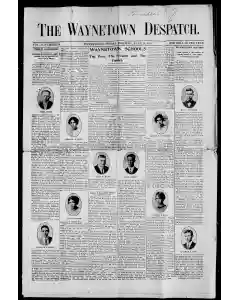
Wayne Township Seniors of 1913 Face Last Old School Year
The Wayne Township High School seniors of 1913, ten members, reflect on the end of the old building era and the start of a new regime. The piece notes the 1909 cohort of thirty six, the gradual loss of students, and the enduring value of study despite hardship.
MENTIONED IN THIS ARTICLE
Wayne Township
History of Montgomery County by Laurence R. Rivers
Montgomery county in the Wabash valley is bordered by Tippecanoe Clinton Boone Hendricks Putnam Parke and Fountain par. It covers 504 square miles with Sugar creek as the main waterway and hosts early mills and a famed woolen factory. First settlers include William Offield in 1821, the county court formed 1823, and a 1825 case of Jesse Keyton. A pioneer tornado and log homes mark frontier life before Crawfordsville grew.
MENTIONED IN THIS ARTICLE
Eliakam Askion
Main Street
Keyton Café
Joshua Baxter
Reginald Butt
Samuel D. Maxwell
William Miller
George Miller
Samuel Wilhite
John Stitt
William Mount
John Ramsep
Edward Nutt
Abraham Miller
Isaac Miller
John Lay
Joseph Cox
Nathan Huntington
William Burbridge
James Stitt
Peter Smith
Court House
Sugar Creek
Crawfordsville
William Nicholson
Maysville
Ken
Montgomery County
Wabash River
Tippecanoe
Clinton
Boone
Hendricks
Putnam and Parke
Fountain
Parke
Walter Sies
Collett
Harney
Brown’s Valley
Ladoga
William Offield
Offield Creek
Jane
Jonas
Mary
John Lopp
Scott Township
James Blevins
John McCullough
Black Creek
Mayfield
Noggle
Jacob Call
Vincennes
John Wilson
Jacob J. Ford
Henry Ristine
James Dungan
Richard M. McCafferty
James Scott
Robert Craig
Samuel Brown
Elias Moore
Wilson Claypool
Joseph Hahn
Samuel McClung
William B. Mitchell
John Farlow
John Toliver
Toliver
Jesse Keyton
Cavereel
Waynetown History Highlights Local Growth and War Service
Charles L. Zuck recounts Waynetown’s early layout from 1829, with the first church and school, Civil War mobilization led by Company D of the Sixty‑third Infantry, and postwar railroad boosts in 1869. Lodges such as Odd Fellows, Good Templars, Knights of Pythias, and Red Men followed, shaping a thriving inland town.
MENTIONED IN THIS ARTICLE
Waynetown
Middletown
Old School Baptists
Old Grave
Sons of Temperance
Masonic Lodge
Church Street
Vine Street
Edmund W. Berry
Jlacksmith
Lincoln
Jim York
Sherman
Gettysburg
Crawfordsville
Billy” Philips
Indianapolis, Bloomington & Western Railway
Indianapolis
Danville
Odd Fellows
Good Templars Lodge
Knights of Pythias
Also Mentioned on This Page
Virgil M. Hayes
Eingland
Scotland
Ireland
New Orleans
Vanderburg
Cound
John Malone
Jackson County
Owen Davis
Spencer County
Zip Coon
Thomas Ayers
Switzerland County
Virgil Hayes
Laurence R. Rivers
Nellie E. Bunnell
Lucy G. Switzer
Waynetown Schools
Waynetown High School
The
Leslie W. Hays
Terre Haute
Whitlock Springs
Deer's Mill
Mose Rush
Paul Harvey
Waneta L. Bard
Waynetown History
Charles L. Zuck
Ray D. Thompson
Charles E. Zuck

 This is just the beginning! Our collection holds over 300 years of history, including rare newspapers, obituaries, marriage records, birth records, and so much more—most of which you won’t find anywhere else!