Gard to Take Effect June First Eighthy Two
The GARD law or regulation will commence operation on June 1, 1882, and apply to relevant parties. Officials announce its phased implementation starting that date.
MENTIONED IN THIS ARTICLE
GARD

 This is just the beginning! Our collection holds over 300 years of history, including rare newspapers, obituaries, marriage records, birth records, and so much more—most of which you won’t find anywhere else!
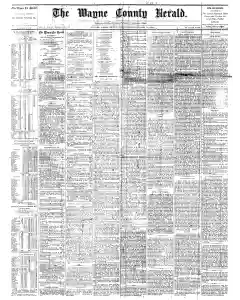
This newspaper page contains 24 articles. Subscribers can read the full text of each article.
Newspaper
Wayne County Herald
Location
Wooster, Ohio, United States of America
Date
Oct 14, 1882
Page
1
The GARD law or regulation will commence operation on June 1, 1882, and apply to relevant parties. Officials announce its phased implementation starting that date.
Local notices from Wooster Ohio list multiple fraternal orders with meeting nights and locations including Red Men Hall and Odd Fellows halls. Names include Ebenezer Lodge, Wooster Council, Rising Star Lodge, Uncas Tribe, Masonic bodies and canaan grange with regular meeting days and times. Also advertises attorneys at law offices, banks, and a nurseryman with fruit trees and seeds.
Fragmented OCR lists multiple names and roles such as MC Roucks Wallace Treasur e via Sapee and J O Norgstine. It mentions executive committee and directors including CALVIN ARMSTRONG Vick Presipest and others with unclear affiliations.
Postage free subscription terms state 100 per year in advance. If not paid within one month, rate increases to 1.25. Clubs of 19 receive one free copy. When the subscription expires, an X will be marked on the paper.
A collection of local notices and advertisements from Wooster Ohio catalogs services and businesses. It lists hotel rates public notices and announcements, shop offerings and professional listings with prices and addresses in a period voice. It includes anecdotes about employment ethics and integrity.
A compact listing of evangelical and Presbyterian church services across multiple denominations. Includes times for morning and evening worship, midweek prayer meetings, Sunday school, and youth gatherings. Names of pastors and street locations noted for First Presbyterian, Trinity M E, Church of God, United Presbyterian, English Reform, Bethany Baptist, and others.
The fragmentary text shows a narrator debating whether a disease is medical or moral, mentions tobacco as a cure, and recalls a long journey for solace. It references a weekly paper and men who cannot afford readers, hinting at social hardship and addiction.
A fragmented poem-like passage contemplates wealth, health, labor, and fate. It hints at risk and remorse, contrasting toil with gain and pondering who truly pays for worry and wrongs. The text weaves archaic imagery and disjointed phrases into a cautionary reflection.
Mrs. Smithers plants herself before an upholsterer lecture and, convinced of her inexpert taste, remakes her home. She replaces portraits, carpets, and furniture to match a new ideal, triggering her husband’s discomfort and a doctor’s intervention. The tale ends with a country retreat and a return to normalcy as the couple rebuilds.
Reading furnishes the mind with the materials of knowledge but thinking makes them ours. Merely cramming with collections does not nourish. we must chew over ideas to gain true understanding.
A reflective piece arguing for early character formation and the lessons of experience. It discusses moral development, the dangers of bad habits, and the belief that youth should cultivate enduring traits through diligent effort and guidance.
The passage argues hospitality goes beyond costly displays. It urges hosts to focus on heart, sincerity, and intellectual warmth over material wealth. Emerson is cited, emphasizing hospitality as a genuine, welcoming act that serves friends and strangers alike through kindness rather than expense.
A fragment concerns inward struggles during a pause in conversation. It speaks of the soul peering at temptation and the strong who keep silent under pain, awaiting a judgment day and the ascent toward heaven or Sagi as read in a book.
A historical guide presents two grafting wax mixtures: a summer resistant blend of three parts resin three parts beeswax two parts oil and a cheaper version four parts resin two parts beeswax one part tallow. The process calls for melting then cooling in cold water to shape, with adjustments for temperature and a cloth wrap method for nursery grafting.
The article argues for a locomotive airship transporting many people at speed, comparing it to boats and trains. It notes advantages such as lower initial cost, no harbors, reduced seasickness, and avoidance of ground-based liabilities, while weighing risks like wind, envelope rupture, and potential machinery failure, concluding balloons could be safer and more pleasant despite wind dependence.
An advertisement notes a full line of power presses and mercantile stationery. It promises reasonable charges and prompt, neat, accurate service. The listing emphasizes borders and faces of type and presses in stock.
A historical medical note describes a patient treated with wormwood and horehound tea, pills, plasters, hot bricks, goose oil, salts, and various folk remedies. The account mentions an elderly woman removing plasters, mustard applications, and multiple external treatments before bedtime. The passage ends with a chorus of thanks and gratitude.
The fragment discusses horse ailments from temperature changes and over-exertion with home remedies and bleeding techniques. It then shifts to a notable claim by Mr Alexander Atlas about electric tides in telegraph circuits and end with a quote on shaping character by effort.
A New York Times letter notes public misbeliefs about Mocha coffee and reveals 1870 era coffee production figures. It questions grocers for selling pure Mocha while consumers cannot verify accuracy and highlights Brazil and East Indian shares in 1870 output.
A playful survey of goats in folklore and nature notes from the Boston Post describes the animal as omnivorous and fond of letters, noting terms for its sexes, worldly habits, and zodiac symbol. It mixes anecdotes with historical references and humorous commentary about goats and their quirks.
An American traveler recounts arriving in Liverpool and facing ticket and booking confusion at the railway depot. A polite but firm British official resolves the mix up after questions about being booked and the proper station procedures. The episode ends with a light exchange over understanding and a drink.
The British government supports shipping and the merchant fleet has grown to about 16,000,000 tons valued at $500,000,000 with gross annual earnings of $225,000,000. Combined world tonnage of other nations totals about 11,000,000 tons. Britain now accounts for roughly three-fifths of global steam tonnage, a shift from earlier declines in sailing capacity.
An architect who built a new city hall for a western town fled to Canada after leaving word with friends to stay away until the affair cooled. The next day a high tide of rumor swept the town, and his friends urged him to return as the controversy was said to be blown over.
The speaker recalls a pale figure in the almanac art surrounded by animals and asks if observers noticed his gaunt form and empty stomach. He adds the man once edited a newspaper and did not receive advance subscription payments.
We want people to find what they are looking for at NewspaperArchive. We are confident that we have the newspapers that will increase the value of your family history or other historical research. With our 7-day free trial, you can view the documents you find for free.
People find the most success using advanced search. Try plugging in keywords, names, dates, and locations, and get matched with results from the entire collection of newspapers at NewspaperArchive!
You can also successfully find newspapers by these browse options. Explore our archives on your own!
Browse by location and discover newspapers from all across the world.
Browse by date and find publications for a specific day or era.
Browse old newspaper publications to find specific newspapers.