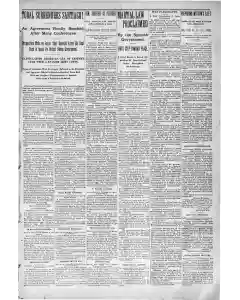
Toral Surrenders Santiago Ending Eastern Cuba’s Defeat
Spanish general Toral agrees to surrender to the United States and send troops back to Spain. Commissioners will meet to arrange terms and transport for the Fourth Corps. Officials note isolation of yellow fever cases and plan to reinforce forts while Porto Rico shipping is arranged. Local ports and ferries face careful fever safeguards.
MENTIONED IN THIS ARTICLE
Santiago
Toral
United States
Guantanamo
Caimera
Guaya
Santiago de Cuba
Sagua
Tas Palmas
Acerraderos
Accerradores
Sagna
Palma
Suarren
Move Fever Patients From Cuba To Dry Tortugas
Bush orders transferred all yellow fever cases from ships from Santiago to Dry Tortugas. Garrison of colored troops given 24 hours to move to Key West. Dr Wyman to reestablish quarantine at Tortugas and receive cases. No vessel may touch any harbor without quarantine at Tortugas. a cable is being laid to Key West.
MENTIONED IN THIS ARTICLE
Cuba
Army
Marina Hospital
Key West
Wyman
Santiago
Irene incident not heard of in Berlin officials say
Berlin AP correspondent reports German government has no official or unofficial knowledge of Trene’s interference with insurgents at Subichay or the faction taken by Admiral Dewey. No confirmation of reported events or actions is available at this time.
MENTIONED IN THIS ARTICLE
Berlin
English Gunners credited for Dewey victory in London dispatch
London dispatch reports Cun ningham Graham former parliament member who wrote insulting articles to Americans says Admiral Dewey s squadron owed its gunnery to Englishmen lured from China service by promises of 500 monthly He urges Parliament to address the matter.
MENTIONED IN THIS ARTICLE
Graham
Dewey
London
Cunningham Graham
Westminster Gazette
St. James
Admiral Dewey
Invasion of Porto Rico Detailed for Embarkation
General Brooke has gone to Washington for final orders on Porto Rico invasion. The expedition is arranged and details prepared for embarking. Troops will depart Tampa within a week, with only two immune regiments from New Orleans and Galveston remaining in Cuba.
MENTIONED IN THIS ARTICLE
Fivery
Brooke
Washington
Porto Rico
Santiago
Tampa
War Department
Cuba
New Orleans
Galveston
Beginning of the End in Madrid After Santiago Fall
A Madrid dispatch quotes Interior Minister Capdepon acknowledging cabinet members favoring peace while warning the problem remains difficult. In Madrid circles the fall of Santiago is seen as the beginning of the end of the war.
MENTIONED IN THIS ARTICLE
Madrid
Santiago
Interior
Senor Capdepon
Tofay
Shafter Happy as Twenty Thousand Spanish Prisoners Go Home
Advices from Santiago via Kingston report Spanish reverses in eastern Cuba complete. Santiago fallen, eastern end of the island surrendered, General Toral agreeing to surrender terms after a personal interview with General Shafter and General Miles. About 18,000 to 20,000 Spanish troops taken, 10,000 in Santiago, the rest at Guantanamo and eastern towns.
MENTIONED IN THIS ARTICLE
Santiago
Kingston
Cuba
Toral
Shafter
Miles
Acerraderos
Las Palmas
Palmas Soriana
Alcantara
Sagua ‘le Tanamo
Cape Maysi
Guantanamo
Spain
General Shafter
Ton
Associated Press
Washington
Governing Santiago Seen as Central Issue After Surrender
Attention from Washington concentrates on Santiago as thousands of square miles of Cuban soil with a port and harbor near its center come under military control. The immediate plan assigns military authorities to govern both the city and surrounding country, with permanent status decisions deferred until surrender details are finalized.
MENTIONED IN THIS ARTICLE
Omelita
Santiago
Washington
Santiago City
Adula at Savannah Prize Ship Captured by US Forces
Savannah report says Lieutenant E. A. Anderson and a seven man prize crew from the Marblehead brought the British steamship Adula, Walker, into port as a prize for the US court. Adula, seized June 29, was found without cargo and previously chartered to evacuate refugees from Santiago and Manzanillo by Spaniard J. R. Solis. Eleven lighters bound for Santiago, in tow of tugs, were swamped off Cuba with no known fatalities. They were from Mobile, New Orleans and Charleston, intended for General Shafter’s supply transfers ashore.
MENTIONED IN THIS ARTICLE
Anderson
Savannah
Tlieutenant
E. A. Anderson
United States
Marblehead
Adula
Nnsater
United States Court
Guantanamo Bay
J. R. Solis
Santiago
Manzanillo
Shafter
Cuban
War Department
Cuba
Mobile
New Orleans
Charleston
General Shafter
Spain Moves Toward Peace Amid War Powers Decree
The Official Gazette reports a royal decree suspending constitutional rights across Spain to quell unrest while negotiations for peace appear underway. Fronted by Sagasta and ministers, the plan includes a plebiscite option for Cubans and retention of Puerto Rico and the Philippines, with strict censorship and new limits on public gatherings and publications.
Porto Ricans Alarmed by Expected American Attack
Advices from San Juan de Porto Rico report great alarm among residents. They fear an American attack on the port and say inhabitants are fleeing inland, leaving the city and suburbs largely deserted.
MENTIONED IN THIS ARTICLE
San Juan
St. Thomas
San Juan de Porto Rico
War Paragrap hs A Daily Occurrence Summary
Spain has one chance to sue for peace before Commodore Watson’s fleet crosses the Atlantic. Cervera’s defeat prompts Blanco near self harm. Captain Charles Clark named chief of staff to Watson’s expedition. Clark retains command of the Oregon. Head money of about 200000 dollars to officers and sailors who destroyed Cervera’s fleet under the law. Units I K L First New York prepare for Hawaii. Siboney burned for sanitary reasons. Madrid believes New York Oregon and Texas head to Spain. seaports tightening. Santiago surrender negotiated, eastern Cuba included, Spanish army to Spain. Wheeler recommends officers for gallantry in cavalry. Santiago capitulation protections discussed for crew safety. Secretary Alger doubts Spain wants prisoners returned. transport with Spain requires agreement. Volunteers may wear state uniforms until worn out. Florida and Fanita landings at Palo Alto July 3 after skirmishes. Miles avoids controlling negotiations, honoring Shafter. San Juan inhabitants flee. Spain’s fall praised in English papers. war nearing end described as fortunate. Seven Spanish prisoners die en route to Portsmouth on Harvard. Irene incident drawn into London Times and German press. no official denial. Dewey’s tribute to Chinese sailors noted. citizenship debate suggested. Cadiz excited by Watson squadron. Porto Rico expedition preparations underway. Madrid declares martial law.
MENTIONED IN THIS ARTICLE
Oficial Gazette
Madrid
Spain
France
Sagasta
Decreas
General Corren
United States
Cuba
Porto Rico
Philippine Islands
Manila
Santiago
Don Carlos
Weyler
Canaries
Watson
Atlantic
Cerverna
Blanco
Charles Clark
Clark
Oregon
Cervera
First
New York Regiment
San Francisco
Hawaiian Islands
Siboney
New York
Texas
Satiago
Wheeler
Carrom
Sumner
Wood
Wessels
Lebord
Wint
Hawes
Hartman
Andrews
Beckham
Dorsett
Garlington
West
Dickinson
William Astor Chanler
Steele
Reeves
Alger
War Department
Florida
Key Weat
Palo Alto
Miles
General Shafter
San Juan
Santiago de Cuba
Harvard
Portsmouth
N. H
Preparations for Watson Fleet Aimed at Spain Mission
A Washington report states Commander Brownson of the auxiliary cruiser Yankee met Secretary Long to arrange the voyage carrying a large ammunition cargo for Commodore Watson's squadron. The Yankee sails from Norfolk to Santiago to load shells for battleships and cruisers, delaying movement as rearming and recoaling proceed.
MENTIONED IN THIS ARTICLE
Washington
Brownson
Yankee
Long
Watson
Spain
Norfolk
Santiago
Commodore Watson
Admiral Sampson
Sampson
Navy Department
Shafter Congratulated by McKinley and Alger
Messages sent to General Shafter near Santiago thank him and his army for the Santiago victory. President McKinley praises the brave troops and notes hardships and sacrifices. Secretary Alger extends gratitude to the command and assures God bless you all. Wording reflects official war communication and honors the wounded.
MENTIONED IN THIS ARTICLE
Provident
Father of Mercies
William Mckigney
Mason Gexenan Saavren
Front
Santiago
Playa
R. A. Atorr
Rifles and Ammunition Turned In In Santiago De Cuba
Adjutant General Corbin releases Shafter dispatch from Santiago July 17 reporting about 7,000 rifles and 600,000 cartridges turned in that day. Harbor area shows six inch modern guns, two batteries of mountain guns, and a battery of fifteen old bronze guns, with disarming continuing tomorrow and prisoner lists pending.
MENTIONED IN THIS ARTICLE
Santiago de Cuba
Corbin
Shafter
United States Army
Santiago
Washington
Fever Experts for Cuba Lead Twenty Five Men to Santiago
Major Sommers and twenty five men of the Second Tennessee leave Camp Alger for Cuba to run the yellow fever hospital at Santiago. Sommers is a veteran fever specialist who treated about 1500 patients during the 1878 79 epidemic. The accompanying soldiers are yellow fever immune and will join the regular army hospital service.
MENTIONED IN THIS ARTICLE
Sommers
Camp Alger
Santiago
Thomas O. Sommers
Second Tennessee Regiment
Cuba
Regular Army
Also Mentioned on This Page
Shatter
Nelson A. Mimes
Conba
Irene
Crank
Gen. Shafter
the Peninsula
London Times
National Gazette
Germany
State Department
Cadiz
Mayo

 This is just the beginning! Our collection holds over 300 years of history, including rare newspapers, obituaries, marriage records, birth records, and so much more—most of which you won’t find anywhere else!