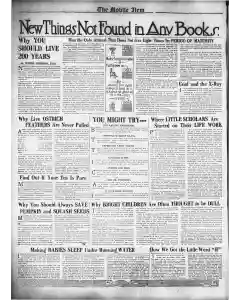
Why You Should Live 200 Years
A treatise argues humans could live about two hundred years based on animal longevity, adjusting for childhood. It cites growth ages, life spans of livestock, and universal life laws driven by diet water air and exercise. It notes civilization reduces apparent longevity when counting under six and emphasizes general rules apply to humans as to other animals.
MENTIONED IN THIS ARTICLE
Neer
Man’s Health Crisis Arising From Diet and Longevity
The article argues man should live 200 years if physiology and nutrition science progressed. It laments neglect of self-health amid advances in science, notes three life laws: nutrition, motion, and oxidation, and blames faulty feeding and reliance on secondhand foods. Emphasizes role of mothers in understanding food chemistry and cites Dr J H Mason Knox on child mortality from curable diseases due to improper feeding.
MENTIONED IN THIS ARTICLE
J. H. Mason Knox
Washington
United States
Knox
X rays may settle old coal formation question
A French science note suggests X rays could reveal three ash types in coal. Foreign windborne ash, mineral plant matter, and minerals from decomposition form distinct components, aiding understanding of coal veins and formation.
Why Live Ostrich Feathers Are Never Pulled
The article explains ostrich feather farming in South Africa, noting white feathers are not pulled but cut to grow back, while black and drab plumes are removed. It describes hooded birds and crate-like coops, feather preparation tricks, and the shift from wild hunting to domesticated ostriches with large export growth.
MENTIONED IN THIS ARTICLE
South Africa
Tea testing methods reveal adulterants under microscope
A Washington Bureau of Chemistry tester Miss Read identifies two simple checks to detect adulterants in tea. One method uses black paper to spot talc added for shine. the other uses white paper to reveal weight-adding adulterants under a microscope.
MENTIONED IN THIS ARTICLE
ISS
Alberta Read
Bureau of Chemistry
Washington
America
Uncle Sam
Miss Read
SAVE PUMPKIN SEEDS FOR RAT AND MOUSE CONTROL
A historic note promotes using pumpkin and squash seeds as bait to attract and trap rats and mice. The seeds are touted as irresistible to rodents, drawing them to traps and potentially eradicating infestations if used correctly, with a warning against poisons.
Quick Home Hacks for Wood, Glass and Cloth
Advice for easy nailing through hard wood by using a soap layer to prevent splitting. A strong mix of Epsom salts and vinegar can frost bathroom windows, finished with varnish. To revive shiny serge, lightly sand the surface to roughen the nap without causing holes.
Cleaning Ivory Knife Handles With Lemon Salt
Rub ivory knife handles with half a lemon dipped in salt to whiten. After treatment rinse in cold water and dry thoroughly.
Ayenne Pepper Used To Rid Cupboard Of Mice
The article advises inspecting shelves and sealing each hole with a rag dipped in water then Cayenne pepper to deter mice. It presents a simple home remedy by distributing pepper at entry points.
Cleaning oil paintings with simple household methods
The article advises wiping the surface with a damp cloth, rubbing with dry cotton wool, then polishing with a silk handkerchief. It suggests using a washed peeled potato cut in half to aid cleaning.
Shoe Remedy for pinching boot and stocking
A simple home remedy suggests placing a drop of sweet oil on the stocking at the pinch and another on the outside of the boot at the same spot. The oil softens the leather and helps it to stretch for comfort.
Swiss Schools Train Children to Fit Lifelong Roles
The article contrasts Swiss education with American methods, noting Switzerland's emphasis on guiding children to suitable occupations. It describes teachers as lifelong professionals, well compensated with housing and gardens, and highlights the social status of teachers alongside mayors and clergy. It mentions teachers moonlighting as choir leaders and community organizers, and shows four years of elementary instruction followed by specialized tracks for technical, university, or business paths.
MENTIONED IN THIS ARTICLE
Switzerland
Alps
Bright Children Often Thought Dull By Slight Deafness
Article discusses how mildly deaf children are misjudged as dull in classes. Dr Helen Macmurchy recommends front-row seating, lip-reading training, and simple hearing tests for teachers and parents to identify and support mildly deaf students and outlines four steps for deaf education.
MENTIONED IN THIS ARTICLE
The
American School Hygiene Association
Helen Macmurchy
Toronto
Macmurchy
Water lullaby for babies in Simla shocks English officers
In Simla India mothers lull infants by directing a stream of spring water onto their heads while they rest on earth pillows along building roads. English officers report the method peaceful and effective with quiet, well behaved children. Mothers claim it strengthens both mind and body.
MENTIONED IN THIS ARTICLE
Simla
India
The Origin of the Word If in English History
A brief survey traces the word If from Old High German Iba meaning on condition, with the dative Iba or Ipa as its ancestor. Earlier Anglo-Saxon GIF/Gifan theories claimed Give that but newer research cites Saxon and Germanic forms as the true root of our small conditional word.
Also Mentioned on This Page
Eugene Christian
F.S.D
Ypea
Cou
Enne Pepper

 This is just the beginning! Our collection holds over 300 years of history, including rare newspapers, obituaries, marriage records, birth records, and so much more—most of which you won’t find anywhere else!