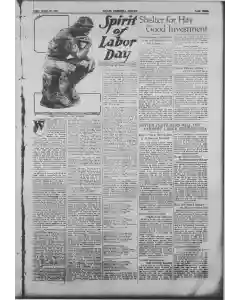
Spirit of Labor Day Celebrates Dignity of Work
The piece traces Labor Day's origins from the New York Central Labor Union in 1882 to its broad legal recognition. It cites Samuel Gompers and editorials emphasizing the dignity of labor, collective organization, and responsibility of workers to sustain progress. It highlights quotes about the toilers' role in society and the moral value of practical toil.
MENTIONED IN THIS ARTICLE
Elmo Scott Watson
New York City
American Federation of Labor
District of Columbia
Territories
United States
Samuel Gompers
Compress
American Federationist
America
Compact Organization of American Labor
Gompers
John P. Frey
Ohio State Federation of Labor
Thornton Oakley
Shelter for Hay Good Investment
Walter G Ward advises farmers on building hay shelters to reduce spoilage. He describes pole construction, recommended dimensions, and cost-saving tips, noting that roofs are the major expense and suggesting open lower walls to limit spoilage. Plans are available through Kansas State Agricultural College offices.
MENTIONED IN THIS ARTICLE
Walter G. Ward
Kansas State Agricultural College
Ward
Farm Bureau
Kansas
Manhattan
Pele
Control Cabbage Pests With Lead Arsenate Dust
Farmers can curb cabbage worms and aphids using a dust of 15 parts powdered lead arsenate to 100 parts hydrated lime. The mixture is safe for food use, but requires repeated applications, especially as heads form. If cabbage aphids are present, add 1 percent nicotine to the dust for dual protection.
Better Fertilizers Could Slash Farmers Costs Across Acres
Rutgers soil chemist A W Blair argues higher grade fertilizers boost plant food per ton, cutting material hauled and freight. A 5-10-5 mix yields more plant food per 500 pounds than 4-8-4, saving 1,000 pounds of material per farm. Heavy soils benefit from improved conditioning. improper fall plowing risks erosion.
MENTIONED IN THIS ARTICLE
A. W. Blair
New Jersey State College of Agriculture
Rutgers University
Suckering Corn Costs and Questionable Gains
Research from Cornell University by H G Thompson after five years finds suckering sweet corn offers no yield or quality gains for non-sucker heavy varieties and adds 3 to 8 dollars per acre in costs for many varieties. It may even harm yields during drought or extreme heat.
MENTIONED IN THIS ARTICLE
H. GC. Thompson
Cornell University
Fall Plowing Benefits in Various Situations
The text discusses fall plowing and its effects on soil fertility, noting benefits when winter is open and rains are heavy to wash moisture into soil. It argues fertility is not lost to evaporation, with moisture retention and end soils left intact.
Moisture for Young Trees Before Winter
Evergreens and young trees need ample moisture before winter. If they dry out, spring growth may be slow or trees may die. Water deeply around roots, then mulch with straw or manure outward from the trunk to guard against mice and wind drying.
Haul and Spread Manure on Clover or Grass Sod
Manure loses value daily, so haul and spread fresh. Ohio station shows eight tons of manure spread on clover sod in December or January yields a $42 crop increase, while the same amount spread in April or May in the yard gives $35.
MENTIONED IN THIS ARTICLE
Ohio
Cholera Prevention Emphasized Despite Corn Price Outlook
The article notes cholera prevention remains essential this year even with uncertain corn prices and hog markets. It warns farmers about insurance costs and urges proactive steps to protect pig herds amid ongoing agricultural risks.
Also Mentioned on This Page
Toilersa
Workers of America
Longfellow
Mimn
Kodin
Charles Stelzle
Toller
Totler
Pluto
Earth
Titan
Pete
Labor Day

 This is just the beginning! Our collection holds over 300 years of history, including rare newspapers, obituaries, marriage records, birth records, and so much more—most of which you won’t find anywhere else!