The Election Process Update From League of Women Voters
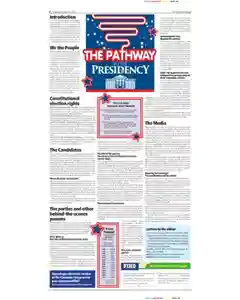
A note explains the presidential election process as the largest political event in U S history, beginning after the prior vote and continuing until voters cast ballots. The LWV produced this copy as an update to its Choosing the President guides.
MENTIONED IN THIS ARTICLE
Uss
League of Women Voters
LWV
We the People vote the power of the people
The article argues that American voters determine presidential outcomes, not candidates, parties, or media. It asserts voting as the great equalizer, giving everyone a single vote with power to shape issues from jobs and taxes to health care and war decisions.
MENTIONED IN THIS ARTICLE
U.S
Pathways to the Presidency in U S Elections
The article explains how campaign pathways build grassroots enthusiasm, staffing, and literature distribution for presidential campaigns. It notes the role of party supporters, independents, and outside groups in elections and the impact of the 2002 BCRA on funding and donor disclosure.
MENTIONED IN THIS ARTICLE
The
Christian Coalition
Aflcio
American Medical Association
Tea Party
Four Amendments Protecting Voting Rights
Summary of key U S voting rights: Fifteenth Amendment prohibits race based denial of suffrage from 1870, Nineteenth Amendment bans sex discrimination in voting from 1920, Twenty Fourth Amendment forbids poll taxes in federal elections from 1964, and Twenty Sixth Amendment allows those eighteen and older to vote from 1971.
MENTIONED IN THIS ARTICLE
United States
Congress
The Path to the Presidency and Candidate Backgrounds
The article explains how presidential candidates are the focus of campaigns and shape messages, fundraising, debates, and outreach. It notes candidates often come from offices like governors or lawmakers, and outlines constitutional requirements while acknowledging the historical dominance of white men and limited women and minority nominees.
MENTIONED IN THIS ARTICLE
U.S. Senate
House of Representatives
Campaign machinery behind the USS presidency
Discussion notes how political parties and allied groups aid candidates. Democratic and Republican parties fund ads organize volunteers and boost voter turnout on Election Day for USS campaigns.
MENTIONED IN THIS ARTICLE
Uss
Early History of U S Political Parties
The Constitution has no mention of political parties and the framers opposed them. Yet opposition faded as parties offered practical cooperation between the executive and legislative branches, aiding policymaking and signaling clearer choices to voters.
MENTIONED IN THIS ARTICLE
Britain
Vote with others: share information and ride to polls
Encourage discussing candidates and local issues to help informed choices. Suggest checking on family and neighbors needs and arranging transportation to the polls. Emphasize not voting alone and making a plan to accompany someone to vote.
Two Party System Drives American Politics Over Time
The passage traces the evolution of the American party system from early factions to the modern two party framework. It notes Democrats as the more progressive party since the 1930s under FDR and Republicans as favoring limited federal roles, lower taxes, and defense spending, while addressing reproductive rights and gun control. It also describes party organization, national committees in Washington, and the rise of professional, full time party operations with substantial fundraising by the DNC and RNC, citing 2012 figures.
MENTIONED IN THIS ARTICLE
Republic
Franklin Roosevelt
Washington, D.C
Democratic
Republican National Committees
DNC
RNC
Media's changing role in shaping presidential election coverage
The article notes traditional media remain key news sources for candidates and issues but face growing distrust. It highlights new technologies and social media as alternative information channels. Radio talk shows internet and 24 hour cable news expand access, enabling rapid, global responses to events.
Media Coverage as Campaign Battlefield in US Elections
The article notes traditional media remain crucial for presidential campaigns, with newspapers and network TV shaping frontrunners through exposure and polling. It explains money and poll ratings attract favorable coverage, while surprise gains and strong visuals can draw ratings and buzz from audiences.
MENTIONED IN THIS ARTICLE
United States
Letters to the Editor Guidelines for The Chronicle Telegram
The Chronicle Telegram asks for letters under 250 words with signatures full address and phone for verification. Submissions may be edited for length and clarity and can be sent by mail fax or email to the editorial page editor.
MENTIONED IN THIS ARTICLE
Chronicle-Telegram
Elyria
Chroniclet.com
Also Mentioned on This Page
Beyond
NBC
WSJ
Www
Statistical Abstract of

 This is just the beginning! Our collection holds over 300 years of history, including rare newspapers, obituaries, marriage records, birth records, and so much more—most of which you won’t find anywhere else!