Scrambling presidential primaries reshape the 2000 race
The 2000 campaign begins a one day set of primaries on March 7 with California and New York among ten states voting. California's move up to early vote shifts leverage, costs rise, and late starters face long odds as Gore and Bush lead early, yet the race remains unpredictable.
MENTIONED IN THIS ARTICLE
Washington
California
New York
Town
New Hampshire
Pete Wilson
Wilson
Robert F. Kennedy
Bob Dole
Clinton
Christie Whitman
New Jersey
Iowa
Jimmy Carter
al Gore
Texas
George W. Bush
Schroeder Victory Promises Change in Germany’s Leadership
An editorial notes Gerhard Schroeder’s win as Germany’s chancellor, replacing Helmut Kohl after 16 years. It highlights Schroeder’s pragmatic social democratic platform of more jobs, less welfare, and lower taxes, contrasting with Kohl’s strong record on reunification and Cold War policies. The piece praises Schroeder’s shift toward reform and greater European collaboration, while acknowledging Kohl’s principled, influential tenure.
MENTIONED IN THIS ARTICLE
Gerhard Schroeder
Germany
Schroeder
Helmut Kohl
Kohl
Social Democrats
U.S
West Germany
Scripps Howard News Service
The
Christian Democrats
Social Democratic Party
Oskar Lafontaine
Bonn
Franklin Delano Roosevelt
Europe
Winston Churchill
Charles de Gaulle
United States
Bill Clinton
Boris Yeltsin
Berlin Wall
Berlin
Reichstag
Federal Republic of Germany
East
Rhine
Ludwigshafen
Walter
Christian Democratic Union
Konrad Adenauer
Heidelberg University
State
Rhineland-Palatinate
European left sees wave after Schroeder victory
World reaction centers on Gerhard Schroeder's election win ending Helmut Kohl's 16 years in office. Italian Deputy Prime Minister Walter Veltroni calls Schroeder center left, aligning with Blair and Jospin to push unemployment into European talks. Vladimir Zyuganov credits a leftward shift. WSJ Europe labels Schroeder a pragmatic split-the-difference leader. Schroeder affirms Franco German unity as EU core and plans a visit to France within 10 days.
MENTIONED IN THIS ARTICLE
London
Gerhard Schroeder
Helmut Kohl
Italan
Prie
Walter Veltroni
Schroeder
Tony Blair
Lionel Jospin
Blair
Jospin
Europe
Veltroni
Gennady Zyuganov
Wall Street Journal Europe
Clinton
Germany
France
European Union
Horst Teltschik
Kohl
Reagan
Bonn
Washington
Mikhail Gorbachev
Kremlin
Soviet Union
West
Gorbachev
Joseph Goebbels
Berlin Wall
Mitterrand
Britain
Margaret Thatcher
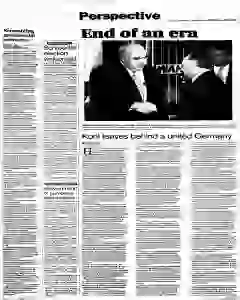
Kohl Leaves Behind Germany United and Reunified
Helmut Kohl, called the Eternal Chancellor, steps down after 16 years as Germany’s leader. He reunified Germany, pushed for a united Europe, and faced economic strain from East-West integration, while guiding Bonn through the Berlin Wall’s fall and reconciliation with allies.
MENTIONED IN THIS ARTICLE
Kohl
Germany
Moscow
Gorbachev
Also Mentioned on This Page
Newspaper
Badr Ave
Keizo Obuchi
Koh
Patricia Clough
Franz Josef Straus
Helmut Schmidt
Liberal Free Democrats
Schmidt
Francois Mitterrand
Bush
Thatcher
Noewepa

 This is just the beginning! Our collection holds over 300 years of history, including rare newspapers, obituaries, marriage records, birth records, and so much more—most of which you won’t find anywhere else!