Grafting Trees Among Horticulture Practices
A straightforward guide explains grafting as taking a dormant wood section from a bearing tree and inserting it into another plant. It notes best timing after leaf fall but before deep frost, selecting about six inch slips from mature wood and tying them in a bunch for growth.
Grafting From Start to Finish for Fruit Trees
A practical guide to cleft grafting including stock and scion prep, timing tips for plum cherry pear and apple, tool list from chisel to grafting wax, and steps to ensure air and moisture exclusion for successful union. Focuses on spring sap flow, mild weather grafting days, and precise insertion for snug bark contact.
Value of Wood Ashes for Fruit Trees
Wood ashes from wood and brush are valuable as a supply of potash fertilizer for fruit trees. Spread ashes under peach trees in winter, even on snow, to improve growth and help apples bear more regularly. Keep ashes away from the trunk and scatter them at a distance suited to tree size.
American Apples Dominant World Grower
The United States leads global apple production with widespread cultivation across states. While Europe and other continents grow apples, the U S ranks highest. Cold regions in the country yield the best crops, and immigrants historically spread seeds widely.
MENTIONED IN THIS ARTICLE
America
Europe
Australia
New Zealand
United States
Outstanding Apple Orchard Claim Returns High Net Profit
J O Marke of Hood River district Oregon touts a remarkable harvest from a two acre Spitzenburg orchard yielding 183 boxes No 1 apples from 150 five year old trees. First grade fruit brought 57075 dollars while second grade covered all expenses, leaving net profit as stated.
MENTIONED IN THIS ARTICLE
J. O. Marke
Hood River
Oregon
Spitzenburgs
Making Bone Meal From Bones and Wood Ashes
A brief note describes placing bones in a barrel with an equal amount of wood ashes and moisture. The mixture breaks down quickly to a fine powder, yielding an excellent fertilizer for gardens.
Ready to Spray Orchard Defense in Winter
Winter spray preparations urged for all orchardists to protect trees from insects and fungi. Advocates cite proven benefits by leading growers, warn delays reduce effectiveness, offer spray outfits with complete instructions for winter use.
Lining Up Trees With a Board Device
A Prairie Farmer illustrated device for orchard planning uses a four to five foot board, notched ends and a centered hole. Stake positions mark trees, pin the board, drop a tree into a hole, then use the notch to align successive trees, ensuring consistent spacing along a base line.
Picking Fruit and Early American Orchard History
The article discusses future business in apple orchards, notes protective measures like cloth bags and homemade lye soap to combat San Jose scale, and explains how frost affects crops. It highlights the winter apple’s demand and mentions oranges not native to America, planted by Spaniards at St Augustine about 60 years before the Pilgrims arrived.
MENTIONED IN THIS ARTICLE
San Jose
America
American
St. Augustine
Fla
Massachusetts
The Christmas Tree Scare
Forester Gifford Pinchot argues that Christmas tree cutting poses negligible risk to future forests compared with fires and wasteful lumbering. He notes suitable trees grow in open areas, not old forests, and urges wiser cutting and growing methods rather than bans.
MENTIONED IN THIS ARTICLE
Department of Agriculture
Gifford Pinchot
Garden beds reshaped for efficient planting
The old idea of beds in the garden is out of date. Plan to have straight rows across or lengthwise of the garden because it is more convenient for using the seed drill, hand cultivator, or horse cultivator.
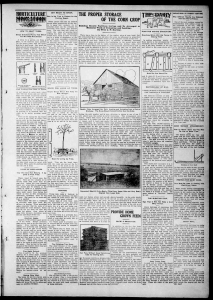
The Proper Storage of the Corn Crop
Analyzes historical corn storage methods and advocates improved cribs, elevation, and ventilation. Warns against kiln drying and rain exposure, promotes sidehill cribs for sloped ground, and urges keeping corn dry to preserve quality and value for markets and international trade.
MENTIONED IN THIS ARTICLE
Boards of Trade
Home Grown Feeds Favor Natural, Cheaper Nutritive Balance
The article argues home grown feeds can displace purchased concentrates as a cheaper natural option. It emphasizes feeds aligned with animal nutrition, avoiding commercially manipulated by products. Dr Voorhees of New Jersey is cited noting nature provides balanced nutrients in rain fed feeds, while manufacturers remove nutrients causing unbalanced blends.
MENTIONED IN THIS ARTICLE
Dr. Voorhees
New Jersey
Plan for Making Stanchions as Shown in Illustration
Prairie Farmer describes constructing adjustable stanchions. Bars A and B move at the top and bolt to cross pieces C and D, with adjustable heights at BF and GH. Locks I and II notch into the bars to hold position, X marks the stanchion open or closed.
MENTIONED IN THIS ARTICLE
Saya
Bacteria in Milk and Public Health Limits
A historical note explains milk bacteriology, citing laws in eastern cities limiting bacteria per cubic centimeter. It describes Oklahoma findings of 462,600,000 bacteria per cm3 in aged milk, seasonal variations, and the difference between harmless and disease-causing organisms while stressing cleanliness and legal limits to protect milk quality.
MENTIONED IN THIS ARTICLE
Oklahoma
Itley
The Bleating Calf on Coteau Farm
A dairyman describes calves that bleat continuously revealing restlessness rather than hunger or thirst. He explains they require attentive care like a trained nurse, but if unrest persists they are treated as a burden and sold as a canner if no better option exists.
MENTIONED IN THIS ARTICLE
Coteau
Keep Young Cows for Peak Milk Output
Advice on selecting dairy cows focuses on youth, age four to five years, and the next four years of productive use. Emphasizes a large udder and balanced teats, storage capacity, and a well-developed milk vein entering via a sizable opening to ensure robust milk production.
Variations in Cream Testing
A discussion of factors causing cream test variation in separators. Variation sources include separator speed, feeding rate, rinse water amount, butterfat content, and screw adjustments. Changes in milk flow alter cream fat yield. flushing water can shift cream percentage by several points.
Farm and Home sketch shows hay and grain rack for cows
A farmer writes that a hay and grain rack aids feeding by placing hay in a space and pouring grain in a second section, allowing cows to eat both feeds together. The article notes the rack’s arrangement and its practical benefit for dairy care.
Racks Held In Place By Strips In Manger
Dairymen report that racks in the manger are secured by 2x5 strips running lengthwise. They note the hay may be made of slats and will thus be easier to clean, and many find the device satisfactory for upkeep.
Protein for Dairy Cows Reduces Feed Costs and Increases Profit
Investigations show dairy cows tolerate lower protein in dry matter. Reducing protein lowers ration costs while maintaining output. A diet with more corn silage and less cottonseed meal boosted profit, and even a ration below standard protein saved money. An 80 day trial saved significant feed costs through this change in rations.
Dairy Tips for Connecticut Dairies and Stock Investment
A Connecticut dairy note highlights 20 percent returns on dairy stock and offers practical advice. It stresses proper milking timing, calving readiness, and handling bulls as dangers. It suggests diet improvements like ground wheat and accurate care of cows, water, grass, and salt.
MENTIONED IN THIS ARTICLE
Connecticut
Tim
Cows differ in milk production across wide range
The passage notes cows vary from 3,000 to 12,000 pounds of milk per year. It questions farmers’ acceptance of keeping a cow yielding about ten pounds daily for 300 days, implying substantial inefficiency and urging consideration of higher-producing cattle.
Also Mentioned on This Page
Te Neerinary
Prof
C. P. Hartley
W. J. McSparran

 This is just the beginning! Our collection holds over 300 years of history, including rare newspapers, obituaries, marriage records, birth records, and so much more—most of which you won’t find anywhere else!