Wasp colony politics: sisters starve brothers to favor future workers
Cornell researchers report that female paper wasps deprive resident males of food by stuffing them head first into nest cells and biting them to death while males occasionally escape to mate. The study, analyzed from 26 hours of videotape, notes workers share more genes with sisters than brothers, suggesting a genetic incentive to favor future female workers.
MENTIONED IN THIS ARTICLE
Philip T. Starks
Cornell Unversity
Emuly S Poe
Cornell
Endicott
Nature
Sky watch and ancient skull findings headline
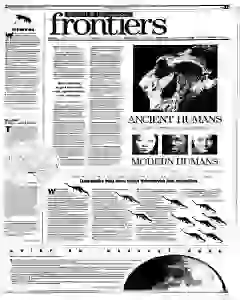
A sky watch note describes Saturn as a bright planet in Pisces visible all night around Oct 18. Separately, a Nature report by John Noble Wilford notes a 14 million year old skull found in Africa by a multinational team, suggesting diversity within early human relatives and caution against splitting fossils into new species from minor variations.
MENTIONED IN THIS ARTICLE
Saturn
Africa
Nature
Scientists debate new skull variant in Australopithecus boisei finds
A fossil skull unearthed in Konso Ethiopia by Gen Suwa and colleagues resembles A boisei but mixes cheekbone and jaw traits with forms seen in A robustus and Aethiopicus. Researchers argue variation across geography, not a new species, reflecting lumpers versus splitters in paleoanthropology.
MENTIONED IN THIS ARTICLE
Boisei
Ethiopia
Kenya
Tanzania
Konso
Gen Suwa
University of Tokyo
Berhane Asfaw
Raft Valley Research Service
Tim D White
Unversity
Saturn's Rings Widen View as Earth Passes Ring Plane
Astronomer notes Earth's 1996 transit through Saturn's ring plane reduced ring brightness making Saturn fainter. Over five to six years the view widens to reflect more sunlight. Mythology ties Saturn to Chronos, time god, as the planet arcs the sky in a slow thirty year cycle. A vertical map aids observation, accurate for late evening times as noted by Dr. KL Franklin.
MENTIONED IN THIS ARTICLE
Earth
Saturn
Chronos
Alan J Fnedman
New York
Joe Rae
Hayden Planetarum
American Museum of Natural History
Pengee
Rao Sand
Long neck dinosaurs may have driven extinction in twilight zone
Fossil finds from Emery County Utah illuminate a historic gap 145 to 65 million years ago. Sauropods dominated early North American ecosystems and potentially cleared forests, shaping plant and animal evolution while linking Asian ancestors to later dinosaur lineages.
MENTIONED IN THIS ARTICLE
Ashington
Italy
Asia
Tachard ©. Cifelli
National Academy
Southern Methodist University
Utah
Cirelli
North America
Cifel
Amercan
Cifelli
Cifell
Also Mentioned on This Page
New York Times News Service
Sky Watch
John Noble Wilford
Ene Delson
City University of New York
KL Franklin
Hayden Planetarium
NY Times N
Twilight Zone
the Associated Press
New York Times Naws Service

 This is just the beginning! Our collection holds over 300 years of history, including rare newspapers, obituaries, marriage records, birth records, and so much more—most of which you won’t find anywhere else!