Boston researchers reveal hidden eye health risks
Boston scientists warn that many adults may have undetected eye problems such as glaucoma due to infrequent eye exams. They note years of neglect can disrupt sleep cycles as internal rhythms lose alignment, risking progressive vision loss.
MENTIONED IN THIS ARTICLE
Sears
Creisler
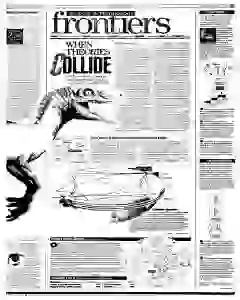
Antipodal volcanism linked to dinosaur extinction theory
A new theory posits a speeding asteroid impact on Earth created antipodal volcanic activity that amplified warming and mass extinctions about 63 million years ago. Researchers cite Mars and Earth studies, simulation results, and a continuing cautious stance from experts, noting the hypothesis remains unproven but intriguing.
MENTIONED IN THIS ARTICLE
Space
David A. Williams
Ronald Greeley
Anzona State University
Journal
Mars
Tlellas Plena
Alba Patera
the Sand
National Laboratory
Albuquerque
Nal
San Francisco
Mark B. Boslough
Joan T. Hagstrum
US Geological Survey
Menlo Park
Cali
Hagstrom
Yucatan Peninsula
Earth
Byatt
Sulfuric acid scenario offered for dinosaur extinction
A new theory suggests a global sulfuric acid veil from Chicxulub impact may have driven decades of darkness. Scientists note the asteroid likely vaporized sulfur, releasing over 100 billion tons of sulfur dioxide, creating a brimstone pall that could have doomed the dinosaurs.
Anonymous remailers enable nameless internet messaging
The article explains how anonymous remailers function to obscure sender identity. About 20 to 25 remailers operate worldwide as a public service, assigning IDs and stripping author traces before forwarding messages across the global network.
First White Dwarf Revealed From Sirius Companion Discovery
Historical note recounts Friedrich Bessel’s astrometric binary finding around 1844 naming Sirius as the star with an unseen companion. Alvin Clark sighted the companion in 1862 as he tested an 18.5 inch lens, revealing high temperature and density. This marked the first white dwarf recognized by science.
MENTIONED IN THIS ARTICLE
Fredrch Bessel
Linus
Bessel
Alvin Clark
Digital signatures protect message authenticity online
Disguising techniques let criminals forge identities, but digital signatures provide verifiable author identity and message integrity. A sender creates an encoded list with a private key and the recipient uses a public key to decrypt and confirm content. This ensures the message came from the claimed sender and was not altered.
Also Mentioned on This Page
Boston
Scient
William J. Broad
New York Times News Service
Ilarom Usnes
Himd
Metator
New York Times News Servnce
Gulf of Mexico
Mexico
Pacific Ocean
I News Service
Antipode
Krinany
KL Franklin
Ementus
The
Hayden Planetarum
Wt Science and Tecmeten
Cnvnet Information
Willam Stallings
G.ge
NY Times News Service

 This is just the beginning! Our collection holds over 300 years of history, including rare newspapers, obituaries, marriage records, birth records, and so much more—most of which you won’t find anywhere else!