Newberg Graphic Early 1916 Sugar Weather Note
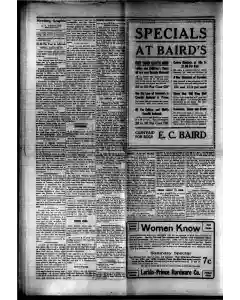
The Newberg Graphic from February 1916 notes possible tapping of sugar trees if the weather remains favorable. The item reflects the paper’s local weather bulletin vibe and seasonal farming note.

 This is just the beginning! Our collection holds over 300 years of history, including rare newspapers, obituaries, marriage records, birth records, and so much more—most of which you won’t find anywhere else!
This newspaper page contains 24 articles. Subscribers can read the full text of each article.
Newspaper
Newberg Graphic
Location
Newberg, Oregon, United States of America
Date
Feb 10, 1916
Page
4
The Newberg Graphic from February 1916 notes possible tapping of sugar trees if the weather remains favorable. The item reflects the paper’s local weather bulletin vibe and seasonal farming note.
Tax season arrives soon yet ranchers remain hopeful and cheerful after a restful spell. They anticipate an opening for early spring work as they chafe at the待 business lull and prepare for new duties.
Shiloh Post G A R and W R C announce a Lincoln birthday program on Saturday afternoon at 644 Fellows hall. The event welcomes public attendance and reform address by Rev. Charles C. Whitley.
Dr. E Ay Romig recalls years in the Philippines as an army surgeon and declares he has no sympathy with Congress plans to turn the islands over to natives. He cites what he witnessed to argue that the United States should retain control to prevent future dangers.
George E. Hardy of the Portland Chamber of Commerce invites all men to attend the Laymen Missionary Conference from February 13 to 16. Register at the club headquarters and use the building as headquarters during the conference. Prominent international speakers will participate in a convention of great interest.
Congressman Cary of Wisconsin rails against prohibition calling it a menace to society and government as he introduces a resolution to move the U S capital to Milwaukee. DC dry legislation cited as alarm trigger.
Locals at Wood-Mar Hall on Friday night heard several strong speeches urging support for a lyceum course next season. Voters feel this year’s lineup was the best yet in Newberg and want the standard maintained.
The article notes strong community support for lyceum events and urges signups for the 1916 17 season. It describes audience reactions at Wood-Mar Hall, including spontaneous laughter from a responsive section that boosts entertainers.
Residents report travels and family news. Mr and Mrs Alva Heater welcome a baby boy born February 7 in Springbrook. Rev J L Glascock expected to start revival services February 15 amid Spokane work and travel delays.
Miss Alethia Shaw returns home from Portland. Mr. and Mrs. Moste Sleeper hosted relatives Sunday. Mr. and Mrs. R. H. Rich visited Mr. and Mrs. Charles Sallee. The Carter family learned their daughter Mrs. Nels Nelson had a light diphtheria attack. Mr. and Mrs. J. T. Carter entertained Mrs. Clar lsa Carter Hazel Randall and Mr. and Mrs. FP Wanless.
Rag carpet and Faeevee works attributed to Joseph Stephens discussed at an unnamed residence. The fragment references David in a likely domestic context without clear event details or dates. The limited text prevents full identification of participants or actions.
A Leslie's Weekly excerpt warns of druggists exploiting trust in medicines. It notes white powders made from sugar and pink powders colored to mimic love potions, sold to all social classes. Indians travel long distances to purchase these powders.
The article notes extreme heat in Korea with claimed readings of 160 degrees in shade aboard a boat near Busreh. Missionaries report nights staying above 125 degrees, while Arizona is cited for comparisons. It describes arid seas, vast fans, and harsh winters affecting Bedouin life and travel stories.
The ancient academy of Plato stood a mile north of the Cypilum gate in a Athens suburb. It belonged to Academus, featured walls walks groves and fountains and hosted Pilato teaching his philosophy for fifty years. After 348 B C Plato died and the academy faded in fame though its beauty persisted for centuries.
A reflective excerpt contrasts a broad margin of leisure with rushed modern life. It urges observing universal hours rather than incremental time, warning that haste degrades both life and dining, and cautions against overreliance on will and public opinion instead of personal genius.
The article notes a wedding rite where marriageable girls dress in red petticoats on fate days. White borders signal 100 francs per year and yellow borders denote 1,000 francs per year as portions the father is prepared to give his daughter.
A century ago a coal mass at Brule France caught fire and has burned since, creating a smoldering mound with a genuine crater at the summit.
The Baltimore American notes a paradox as prosecutors present a counterfeit note case to the grand jury and a true bill is returned, indicating enough evidence for indictment. The remark underscores the unusual twist in the proceedings.
A moral note reflects on the best human sentiment to end the day, urging reconciliation and inner peace before lying down. The saying emphasizes forgiveness as a guardian against lingering wrath and insomnia.
A historical recount describes a grand ship built for Hiero of Syracuse. The vessel reportedly featured tiled decks, a Venus dining room, and an upper deck gymnasium with gardens. It cites Archimedes involvement and ancient shipbuilding on Mount Emma.
In the Malay peninsula Perak lawyers report little business as a modi slows activity and court schedules show a quiet legal scene with scarce filings and proceedings.
The article notes that some water birds fear water when young and must be taught to swim. It highlights the black necked swan as one that learns from its parents, with young swans called cygnets hatched in a nest the parents build.
A Philadelphia North American note describes a mother swan guiding her babies from a shore ride across a pond. The cygnets fear the water at first, then gain confidence, discovering their webbed feet propel them as they imitate their parent.
The article notes postmen in ancient Israel under King Hesekiah about 700 years before Christ. It cites First Chronicles and Chronicles describing messengers with letters traveling swiftly through Ephraim and Manasseh, delivering letters from sender to recipient in rapid relay.
We want people to find what they are looking for at NewspaperArchive. We are confident that we have the newspapers that will increase the value of your family history or other historical research. With our 7-day free trial, you can view the documents you find for free.
People find the most success using advanced search. Try plugging in keywords, names, dates, and locations, and get matched with results from the entire collection of newspapers at NewspaperArchive!
You can also successfully find newspapers by these browse options. Explore our archives on your own!
Browse by location and discover newspapers from all across the world.
Browse by date and find publications for a specific day or era.
Browse old newspaper publications to find specific newspapers.