Try 7 days of FREE access to billions of articles

Start Free Trial

New York Times in New York, New York

We have 11,141,790 pages in New York

View this page and access billions of articles with a 7-day free trial.

Start Free Trial

This is just the beginning! Our collection holds over 300 years of history, including rare newspapers, obituaries, marriage records, birth records, and so much more—most of which you won’t find anywhere else!

Start Free Trial

Cancel anytime, risk free

Not what you were looking for? Search our billions of articles

Advanced Search

Articles on This Page

This newspaper page contains 3 articles. Subscribers can read the full text of each article.

Newspaper

New York Times

Location

New York, New York, United States of America

Date

Aug 01, 1908

Page

24

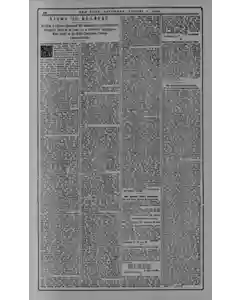
Views of Readers in New York Times on Latin and Esperanto

A reader letters column debates Romanism Latinism versus modern reform movements. Arcadius Avellanus defends Latin’s enduring value and criticizes Esperanto and Neo Latinists, arguing Latin remains vital for science, law, and education. Other letters discuss classic heritage, Goethe, Cicero, and republican ideals.

New York Times Saturday Review of Books Fodio Catacombs Rome Italy Spain France Portugal Germany Socrates Plato Aristotle Zeno Democritus Epicurus Hungary Europe Bismarck Sedan Cicero Gaul Africa Justinianus Caesar Virgilius Horatius Ovidius Livius Petronius Apuleius Lucretius Carus Seneca Varro Cato Palladius Columella Vegelius New York Arcadius Avellanus Bar Harbor

Origin of Joaquin Miller quotation cited in letters

Readers respond on the source of the sentiment in Joaquin Miller’s lines about what the dead can hold. Martial and Rollin are referenced, with epigrammatic musings on money, gifts, and what endures. Letters from Plainfield and New York discuss the quotation’s priority and echoes in epitaphs.

Emily Noble Joaquin Miller Earl Edward Wickliffe Lincoln Gettysburg Goethe N. K. Funk New York New York Times Saturday Review of Books Joaquin ‘Miller Martial Nero Domitian Trojan Rollin Plainfield, N. J Peter Cooper Duke McCallum Converse Cleave Elth

Mecklenburg Resolutions and the Declaration Plagiarism Debate

Eugene G. Gay argues that similarities between the Mecklenburg Resolutions and the Declaration of Independence may reflect common Liberty doctrines rather than direct copying. He cites Rousseau, Locke, Buchanan, Knox, and Scottish influence, noting regional factors and the era’s shared political language. He suggests Jefferson’s phrasing could arise independently among thinkers of the time.

New York Times Saturday Review of Books Mecklenburg Jefferson Hoyt Moore North Carolina Adams Rousseau John Locke Dutch Republic George Buchanan John Knox Knox Mary Stuart Buchanan Pennsylvania Virginia Bucharean Scotland

Also Mentioned on This Page

Ingersoll Hubbard Gibbon Courtney A. P. Winston St. Louis
Search Courier

Search the New York Times Today with a Free Trial

We want people to find what they are looking for at NewspaperArchive. We are confident that we have the newspapers that will increase the value of your family history or other historical research. With our 7-day free trial, you can view the documents you find for free.

Not Finding What You Were Looking for on This Page of The New York Times?

People find the most success using advanced search. Try plugging in keywords, names, dates, and locations, and get matched with results from the entire collection of newspapers at NewspaperArchive!

Looking Courier

Browse Newspapers

You can also successfully find newspapers by these browse options. Explore our archives on your own!

By Location

By Location

Browse by location and discover newspapers from all across the world.

Browse by Location
By Date

By Date

Browse by date and find publications for a specific day or era.

Browse by Date
By Publication

By Publication

Browse old newspaper publications to find specific newspapers.

Browse by Publication