Cards of Thanks and Obituaries Rates
The Herald notes that Cards of Thanks cost 50 cents each while obituaries are priced at one dollar per obituary. A poetry charge of five cents per line applies.
MENTIONED IN THIS ARTICLE
Addi- Bona

 This is just the beginning! Our collection holds over 300 years of history, including rare newspapers, obituaries, marriage records, birth records, and so much more—most of which you won’t find anywhere else!
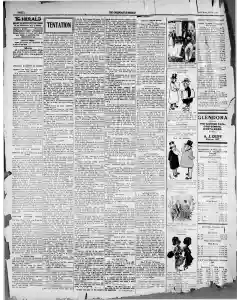
This newspaper page contains 18 articles. Subscribers can read the full text of each article.
Newspaper
Greencastle Herald
Location
Greencastle, Indiana, United States of America
Date
Jul 02, 1921
Page
2
The Herald notes that Cards of Thanks cost 50 cents each while obituaries are priced at one dollar per obituary. A poetry charge of five cents per line applies.
Japanese wary of numbers that sound like death in phone listings. Luck favored by odd triplets and numbers like 753 tied to Shinto birthdays. 42 and 4 percent avoided, often reserved for officials. full numerals used rather than abbreviations. time may bring shorthand when counting aloud.
A Popular Science Monthly excerpt notes the puffer fish inflates when sensing danger. In a New York Aquarium test, puffers in a tank with two inch size inflated instantly, becoming nearly spherical and resistant to larger fish attempting to swallow them.
An inventive musician has created an apparatus to play violin and piano simultaneously. A violin bow is held by a wire attached to an upright at shoulder height, mounted on a wheeled base. The violin rests from the piano by a brace with a through hole for the arm to tune the strings while the bow is operated by the left foot and the right hand strikes piano chords.
A medical student jokingly boasts about a patient in the ward upstairs who is cross-eyed and tearful, claiming they have treated her for bacteria. The exchange highlights playful wordplay among students in a hospital setting.
Gratia a young girl meets Augarde a worn woman in black and hears of a gilded life with a knight. Gratia resists luxury yet agrees to leave nature for a redemptive hard fate. Years later Gratia returns in blue as another sorrowful woman recalls vanity and loss.
A compact vignette portrays a clever East Side worker infiltrating a political crowd where a professional talks on graft and wealth in office. The exchange turns humorous as a landlady's blunt defiance and a sly social critique reveal tensions between money, power, and virtue.
The piece argues the Guam government cannot raise enough revenue under American to fund essentials like schools and sanitation. It cites Spanish rule collectives and a current cost of living rise, urging authorities to address chronic underpayment and governance.
A circus trainer explains why animals fear others and why camels deter horses. He notes horses tremble at camel scent and dogs fear big cats, while dogs show no fear before tigers but tremble before pumas or leopards. Observations from the Philadelphia Bulletin.
A correspondent contrasts terms for sexes noting a duke remains a man unless called a gentleman with emphasis. Women shift from lady to woman only with adjectives, as a London Chronicle remark reflects.
A collection of brief notes: a famed general links erect posture to delayed aging and liver health, a London Chronicle window cleaner finds a rest spot in a ship bathroom, Belgian factory turns black smoke into fuel via a petroleum absorber, and a humorous quip about a husband returning from visit with his wife reacting to his family.
Mahlstick argues Dauber treats art with extreme seriousness sacrificing wife and family and risking hardship for his craft, provoking a sharp life comment on obsession.
A young writer asks if a poet could dash off inspirations on his cuffs. The editor replies that very few poets can afford cuffs. A man seeks free information about why Nquor makes his nose red. The M D explains the reason as due to drinking it.
The Washington Star notes Miss Cayenne asking if the guest enjoys music and to skip Mr Bliggins singing. The Philadelphia Ledger records Miss Brage and Mr Hansom visiting last Tuesday evening and a reply about absence. A garbled line questions if the governor’s remarks were spontaneous, suggesting deliberate intent.
A Georgia Tech device records road wear using a spring loaded toothed wheel that taps irregularities and transmits variations to a rolling paper inked by a pencil. The light instrument can be drawn over roads to assess wear over time.
A fragment quotes a young man shaped by age twenty five and a young woman who must adjust her silhouette to fashion's whims. It contrasts thrift, noting saving money is wiser than spending wildly.
A sequence of times appears in the page segment, listing 2 25 a m 6 28 a m 9 16 am 1 57 p m 2 46 p m 6 35 pm 9 10 p m. The OCR fragment provides no clear event or person. it reads like a time log or schedule excerpt from a larger article.
OCR text shows scattered times such as 1:55 am 10:00 am 12:49 pm and 5:53 pm with several early morning entries. The fragment references Monon North telephone timings and a series of inconsistent stamps including 2:32 am and 8:25 am with noted dashes and unusual punctuation.
We want people to find what they are looking for at NewspaperArchive. We are confident that we have the newspapers that will increase the value of your family history or other historical research. With our 7-day free trial, you can view the documents you find for free.
People find the most success using advanced search. Try plugging in keywords, names, dates, and locations, and get matched with results from the entire collection of newspapers at NewspaperArchive!
You can also successfully find newspapers by these browse options. Explore our archives on your own!
Browse by location and discover newspapers from all across the world.
Browse by date and find publications for a specific day or era.
Browse old newspaper publications to find specific newspapers.