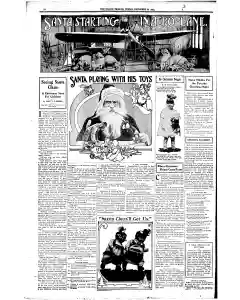
Seeing Santa Claus Seeing Santa Claus A Christmas Story
A 1913 Christmas feature describes a child's encounter with Santa Claus, capturing holiday wonder and seasonal customs through a family friendly vignette.

 This is just the beginning! Our collection holds over 300 years of history, including rare newspapers, obituaries, marriage records, birth records, and so much more—most of which you won’t find anywhere else!
This newspaper page contains 12 articles. Subscribers can read the full text of each article.
Newspaper
Dillon Tribune
Location
Dillon, Montana, United States of America
Date
Dec 26, 1913
Page
2
A 1913 Christmas feature describes a child's encounter with Santa Claus, capturing holiday wonder and seasonal customs through a family friendly vignette.
A grandmotherly figure Aunt Madie recalls a humble Christmas past with her father Fred in a warm home. Donald asks about Santa while the tale reveals a scarecrow disguised as Santa as a lesson in giving and comfort, ending with a note on Christmas gifts and kindness.
In southern states holly is chiefly used for Christmas trees. The tree is abundant in forests and boys often earn Christmas money by cutting and selling them in larger towns. Cedar, mistletoe, and fir are less common or difficult to gather.
Citizens and banks push the treasury for bright coins as holiday demand rises. Last year $25,000 in halves, quarters and dimes was washed and brightened by the treasury department, and this year requests are even greater.
Christmas evergreens for U S homes mainly originate in northern New England, Michigan, Wisconsin, and Minnesota with some from farther south. Holly comes from New England and the Alleghenies, mistletoe from southern regions, and ground pines grow in shady forest floors nationwide.
The article traces the Christmas box tradition from its charitable origins to its later perception as a right and nuisance. It notes the English bor ing day after Christmas and describes British museum boxes with green glaze and money slits for gifts.
The spug movement named from the Society For the Prevention of Unnecessary Giving spreads as members increasingly refuse or limit gifts. Origin traced to a Chicago based organization and has grown rapidly in recent years.
A collection of humorous riddle questions and punchlines about birds, spendthrift and pillow, ark animals, candles, hands, wigs, owls, elderberry and lemon aid. The quips rely on wordplay and punning twists.
The piece traces how many Christmas customs originated with Germans, noting their early emphasis on gifts and especially the Christmas tree. It links German traditions to Victorian England, attributing the spread of general Christmas gift giving to Prince Albert and Queen Victoria in the mid 1800s.
A narrated poem about a child who secretly uses a Christmas tree as a summer gift in defiance of rules. The speaker recalls teachers warnings that trees are for good children while describing family members decorating, eating popcorn, and distributing gifts at night. The tone is rebellious and playful with vivid imagery of wax candles and colored wax.
The article lists old beliefs about people born on Christmas Day. It notes luck varies with weekday of birth, assigning traits from Sunday to Saturday including nobility, strength, wisdom, and wealth.
Ethel questions Mr. Kelly about his calls while Clarice plans to tell him to stop after Christmas.
We want people to find what they are looking for at NewspaperArchive. We are confident that we have the newspapers that will increase the value of your family history or other historical research. With our 7-day free trial, you can view the documents you find for free.
People find the most success using advanced search. Try plugging in keywords, names, dates, and locations, and get matched with results from the entire collection of newspapers at NewspaperArchive!
You can also successfully find newspapers by these browse options. Explore our archives on your own!
Browse by location and discover newspapers from all across the world.
Browse by date and find publications for a specific day or era.
Browse old newspaper publications to find specific newspapers.