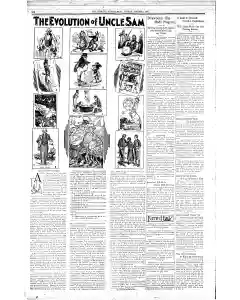
Evolution of Uncle Sam in American cartoons across ages
The article traces Uncle Sam from early depictions by F. Bellows to Thomas Nast, with later influences by Gibson and Cesare. It notes English and Spanish American war era cartoons varying in tone, and explains Nast’s growth of the figure into a dignified national symbol. It also highlights John Erskine’s novel presenting Uncle Sam as a character with inner traits and domestic life.
MENTIONED IN THIS ARTICLE
Uncle Sam
United States
John Bull
Sam
Samuel Witsoan
New York
Indiana Union
Troy
N.Y
Dia
Merriam
Ind
Uts
Samuel Wilson
Brother Jonathan
Muyhands
Americnan
Nocomle
FL Bellow
Min
Bellow
Thomas Nast
Mr Nast
Bull
Bobbs-Merrill Company
John Erskine
F. Bellow
Oscar Cesare
New York Evening Post
Rollin Kirby
New York World
J.H. Cassel
Charles Dana Gibson
Nast
Abraham Lincoln
Lincoln
Ancle Sam
England
Spain
Italy
France
J. H. Cassel
Iunuy
America
Mr. Erskine
Howe
Strawberries Progress Driven by Transportation and Trade
The USDA notes strawberries shifted from local to year round availability due to fast transport and refrigeration. Acreage rose from 93,420 in 1920 to 183,680 projected this year, with New York Chicago Boston Philadelphia and Detroit as top markets. Strawbridge cites hybrid origins from wild meadow berry and cultivated varieties, with market expansion since 1800 and 1860.
MENTIONED IN THIS ARTICLE
United States Department of Agriculture
Bureau of Agricultural Economies
J. W. Strawbridge
United States
Consumpton
New York
Chicago
Boston
Philadelphia
Detroit
Delaware
Montreal
Canada
Strawbridge
Department of Agriculture and Technical Bulletin
Inoculate Alfalfa for High Returns
Inoculate alfalfa seeds only one day before sowing or the morning prior and sow in the afternoon if possible. The inoculating bacteria are killed by sun. keep treated seed shaded until planted and mix with soil quickly to avoid sun exposure.
Farm Notes Urge Fall Prep for Garden and Orchard
Fall cleanup helps prevent insects and diseases next spring. Feed bees sugar syrup before weather turns cold. Many vegetables can be stored for winter if kept in proper conditions. Fall plowing or listing improves spring crops on grain stubble. Plan woodlot thinning during winter and store winter squash and pumpkins carefully to avoid frost and bruising. Store sweet potatoes in a warm, dry place with steady temperatures.
Easy to Extend Garden Usefulness for Winter Storage
Home economics guidance from New Brunswick suggests extending the garden season by storing tomatoes and root vegetables. Harvested vines hung in a cellar provide late ripening fruit. sound dry produce stores best in sand or racks with good ventilation. Planning ahead with larger purchases from producers saves money and increases family vegetable variety through winter.
MENTIONED IN THIS ARTICLE
Home Economics Department
State College of Agriculture
New Brunswick
Silo Walls Tight for Filling in Fall
Silo filling season nears and townsfolk are urged to inspect and repair silos. Foundations should be pointed up, silos straightened, hoops tightened, and walls sealed against air and water. Experiments at Town State College tested cement wash and asphalt paint showing them effective and economical.
MENTIONED IN THIS ARTICLE
Town State
New Year for Poultry Begins November First
The new year for poultrymen starts November 1. Spring pullets should be in winter quarters and well started for the year. Begin flock records now and track every expense and income including feeds repairs stock purchases eggs sold and poultry sold.
MENTIONED IN THIS ARTICLE
Yrid
Sweet Clover For Green Manure Urged By Illinois Expert
University of Illinois agronomist C. M. Lindley advises sweet clover as a green manure only in its first year or when a seed crop or pasture justifies a second-year stand. He notes clover can yield about 150 pounds of nitrogen per acre, enough to support a 100 bushel corn crop, and warns against late second-year plowing as nitrogen is largely from early spring growth and not atmospheric fixation.
MENTIONED IN THIS ARTICLE
C. M. Lindley
University of Illinois
Linsley
Pear Psylla Threatens Amans District Pears
Pear psylla injures pear trees by nymph feeding on tender growth, draining juices needed for wood, leaf, and fruit development. Leaves develop brown spots, yellow, and drop, causing defoliation and poor fruit quality, with damage possible by July 1.
MENTIONED IN THIS ARTICLE
Amans
Also Mentioned on This Page
Elmo Scott Watson
Your
Best Markets

 This is just the beginning! Our collection holds over 300 years of history, including rare newspapers, obituaries, marriage records, birth records, and so much more—most of which you won’t find anywhere else!