Moscow's 50th anniversary shows bold Soviet building shift
Ada Louise Huxtable surveys Moscow's spring scene and the 50 year push to industrialize housing. She notes vast new apartments and 32 story towers alongside restored churches, the rise of prefab reinforced concrete, and a new contemporary skyline challenging old Stalin era mass housing.
MENTIONED IN THIS ARTICLE
Council of Mutual Economic Assistance
Soviet Union
Gosplan
Gorky Street
Kremlin
Moscow
Garth Huxtable
The
New York Times
Council of Mutual Assistance
East Germany
Poland
Hungary
Rumania
Bulgaria
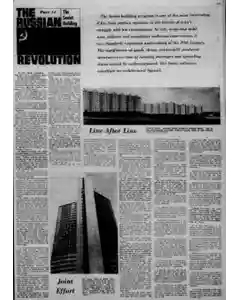
Line After Line western standards improving notice ably
A discussion on improving building surfaces and styles highlights factory-bonded mossac or marble chip finishes over raw concrete. Distinctive Soviet large scale prefabrication is noted with emphasis on upgraded proportions and details. Dr A Allan Bates of the National Bureau of Standards summarizes the Soviet achievement.
MENTIONED IN THIS ARTICLE
A. Allan Bates
Office of Industrial Standards
National Bureau of Standards
Soviet Housing Boom Redefines City Living For Millions
A Soviet postwar drive to solve housing shortages uses large scale prefabrication and mass production. The state controls land and construction with cooperatives representing about 20 percent. By 1965 ninety three million square meters built with 70 to 85 percent industrially produced, and 1966 70 expected. Suburbs surround Moscow with uniform 5 to 16 story blocks and vast green spaces. The result is sterile but orderly, reflecting a pride in standardization and regimentation over individualism.
MENTIONED IN THIS ARTICLE
Soviet Union
United States
U.S
Institute of Town Planning
Moscow
Siberia
Black Sea
France
Sweden
Denmark
Henry Ford
Cheryomushki
Also Mentioned on This Page
Ada Louise Huxtable
Decatur Daily
New York Times News Service
Bolshoi Theater
Alexander Gardens
Russia

 This is just the beginning! Our collection holds over 300 years of history, including rare newspapers, obituaries, marriage records, birth records, and so much more—most of which you won’t find anywhere else!