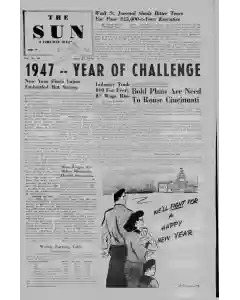
Year of Challenge as Labor Faces New Threats in 1947
The year ahead tests organized labor against a hostile Congress intent on revising the Wagner Act and curbing strikes. CIO leader Philip Murray seeks peaceful wage gains, while deficits from 1946 show profits swallowing wage raises. Strong union solidarity defines the era as Taft presides over labor policy.
MENTIONED IN THIS ARTICLE
Congress
Robert A. Taft
Cincinnati
Senate Labor Committee
National Association of Manufacturers
United States Chamber of Commerce
Philip Murray
CIO
Industry Took Ten Dollars From Every One Wage Rise
A suppressed CIO document obtained by Federated Press argues that for each dollar raised in workers wages industry captured over ten dollars from consumers. The CIO Wages Research Committee found manufacturing costs rose 2 percent from April 1945 to August 1946 while average hourly earnings increased, indicating a disparity between wage gains and price increases.
MENTIONED IN THIS ARTICLE
Washington
Federated Press
CIO
National
Nathan
Bold plans urged to lift Cincinnati to livable growth
Councilman urges bold financing and master planning to address policing health and recreation as Cincinnati faces crowded streets limited parking and poor housing. He notes voters rejected a real estate tax hike, stressing the city needs money to attract industry jobs and improve livability.
MENTIONED IN THIS ARTICLE
Cincinnati
Bitter tears for $45,000 a year Wall Street executive
Wall Street Journal profiles a west coast executive earning about 45 000 a year as burdens of rising living costs bite into middle class life. The subject, a president and general manager with a family of five, notes frugal living and a household allowance under review amid inflation. The piece cites government housing data and contrasts veteran family needs with corporate earnings.
MENTIONED IN THIS ARTICLE
Wall St. Journal
Mr. X
The
Wall Street Journal
Journal
Wages Fall Short of Health Budget For Four Months
Washington reports based on the Heller study that U S production workers’ weekly earnings fell short of the minimum health budget for four monthly periods. In September 1945 the budget was 62 dollars while earnings were 40.87. January 1946 60.52 vs 41.15. May 1946 61.65 vs 42.51. October 1946 70.52 vs 45.83.
MENTIONED IN THIS ARTICLE
Washington
U. S
University of California
Heller
Weekly Earnings by Industry from 1945 to 1946 Decline
From A National Wage Policy for 1947 by Robert R Nathan Associates. The table lists average weekly wages in Jan 1945 and Oct 1946 across industries such as Petroleum Coal Products Lumber Retail Stores and Canning. The article notes overall production workers saw a drop over two years with increases only in lower paid sectors.
MENTIONED IN THIS ARTICLE
CIO
Robert R. Nathan Associates
Nathan
Also Mentioned on This Page
Anati
Mber
Robert Nathan
By Travis K. Hedrick
Councilman Reports
Miriam Kol
New York
San Francisco
Ated Press

 This is just the beginning! Our collection holds over 300 years of history, including rare newspapers, obituaries, marriage records, birth records, and so much more—most of which you won’t find anywhere else!