American Ideal Shifts Toward Peace After Armistice
After the armistice the American public shows waning interest in militarism and a move toward civil life. Soldiers and students in training lose enthusiasm for military topics, with libraries reflecting a shift to practical living books and civilian pursuits.
War Department Delays Policy On Future Military Plans
The War Department has not announced an official policy as public opinion remains unsettled. A draft bill to Congress is being prepared by Chief of Staff March and senior officers, with no terms disclosed. Britain’ s demand to end conscription features in debate, while American policy may shift only if Europe abandons standing armies.
MENTIONED IN THIS ARTICLE
War Department
March
Army
Congress
General Staff
World Peace Congress
Great Britain
Europe
America
Chateau Thierry
St. Mihiel
France
Sedan
A Short-Sighted Policy in Wilson's Peace Mission
The piece condemns partisans who attack Wilson's Versailles effort as election politics. It argues most Americans prefer a lasting world peace over partisan gain and cites Henry Clay as valuing principle over office. It frames the peace alliance as vital beyond U.S. politics and urges support for humanity's progress.
MENTIONED IN THIS ARTICLE
Wilson
United States
Versailles
Henry Clay
Real Republican Leaders Defend Wilson's Fourteen Points
A column cites real Republican leaders backing President Wilson’s fourteen points and opposing attacks as Wilson sails for France. Taft defends the program and Mann denounces any action to embarrass America, while a few rank and file Republicans remain divided on supporting France.
MENTIONED IN THIS ARTICLE
Republican Party
Wilson
France
Taft
Mann
Sendamenens
la Satinite
New York
Clemenceau
Two Statesmen Forge Virtually Imperfect Accord
The two republics representatives concluded a conference showing an essentially imperfect agreement on all points yet noting that the United States and France shared similar ideas on the key issues to be discussed between the nations.
MENTIONED IN THIS ARTICLE
United States
France
London Thinks on Democracy at Peace Conference
The piece argues that Wilsonian policies at the Paris peace conference push for a radical democracy far stronger than 1815’s democracy. It warns that European statesmen may fail to halt its spread, despite hopes in America that negotiators can stop the shift. It credits President Wilson as a wise, steady leader guiding democracy forward.
MENTIONED IN THIS ARTICLE
London
Europe
New World
Vienna
America
Paris
Baker urges fair treatment for home service soldiers
Secretary of War Newton D. Baker writes to Miss Hellen Winne, director of the Soldiers, Sailors and Marines club, asking that comedians avoid ridiculing those who stayed home. He praises overseas heroes and calls for equal recognition of all who served the country, urging the club to promote a non discriminatory spirit and support for home front personnel.
MENTIONED IN THIS ARTICLE
Baker
Soldiers, Sailors and Marines Club
National League For Woman’s Service
Madison Avenue
New York City
Miss Winner
Sailors
Marines
United States
America
Unidentified victims crowd at morgue in Paris
A Paris morgue houses unidentified crime victims as detectives warn about visitors who gaze at the corpses amid the grisly curiosity of killers. The narrative shifts to milestones, noting the world’s oldest woman at 134 in Posen and reflections on Napoleon, Waterloo, and early galvanic electricity discoveries.
MENTIONED IN THIS ARTICLE
Paris
Posen
Europe
Frederick the Great
United States
Report on Bureau of Standards War Work Highlights
Director of the Bureau of Standards reports extensive wartime activities in science and technology. The piece notes 306000 tests, new laboratories, industrial research, standardization, and collaboration between physicists and engineers to support military and peacetime manufacturing.
MENTIONED IN THIS ARTICLE
Bureau of Standards
Department of Commerce
Bureau
United States
Bureaun
America
Industria
Ce Aes Union
Ween
Bureau of Stan
Education and World Outlook for Peace Through Study
A call for the United States to study European and Asiatic nations intimately to shape peaceful global leadership. The piece argues universities must teach world philosophy and psychology, covering China, Japan, Russia, Africa, America, and more, to form informed opinions on a League of Nations and lasting peace.
MENTIONED IN THIS ARTICLE
United States
League of Nations
Fonike
Novicow
Europe
Holco
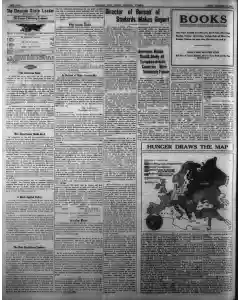
Hunger Maps Europe Showing Famine Risk Across Nations
The map indicates that aside from Ukraine, only countries with steady marina trade and shipping access can avert widespread hunger until the next harvest. Germany and other western European states rely on American aid to maintain food for dense cities as famine looms in regions like Bohemia Serbia Roumania and parts of Greece and Armenia.
MENTIONED IN THIS ARTICLE
Europe
Ukraine
Commission For Relief
Belgium
Germany
England
France
Netherlands
Portugal
Bohemia
Serbia
Also Mentioned on This Page
Teer
Mandolph Lauion
Fenpeses
Bater
Navy
Army Training Corps
Newton D. Baker
Hellen Winne
Army and Navy Register
Waterloo
Metropolia
Bureau of Stadards
J. B. Lawler
Union Pacific
Tafiueom
Euch
Washington
Republic
Cmes
Earth
Royal Road
Hunger
Becky Bra
Tefyez
Africa
Logan's Book and Curio Store
Lincoln Highway
Plains Hotel
the National Bank

 This is just the beginning! Our collection holds over 300 years of history, including rare newspapers, obituaries, marriage records, birth records, and so much more—most of which you won’t find anywhere else!