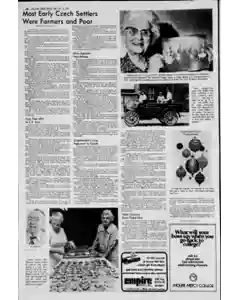
Early Czech settlers in Cedar Rapids shaped by farming and growth
The piece traces 1850s Czech arrival along the Iowa and Cedar Rapids area, noting families like Ligr Poster Korab and Sosel who learned English and helped settle the community. It cites census figures, land purchases, and the shift from beets to corn, with social life including St. Wenceslaus and Ctenarsky Spolek Reading Society fostering culture and education.
MENTIONED IN THIS ARTICLE
Joseph Sosel
Prague
Sosel
America
Brewer and Wick
Linn County
Ligr
Ely
John Poster
Paul Korab
Western
John Witousek
Jacob Polak
Karel Jonas
Wisconsin
Thomas Korab
Kirkwood Boulevard
Seventy-sixth Avenue
Martha Kralik
Thomas
Martha Eleanor Griffith
Town Journal of History and Politics
Mora
College
Putnam Township
Vaclav Rieg
Kralik
Europe
Cedar Rapids
Pokrok
Liin County
U.S
Iowa
Thomas Paine
Joseph Hajek
Freethinkers
St. Wenceslaus Church
St. Mary’s Church
Immaculate Conception
Frana
Protivin
St. Mary’s
Francis Chmelar
St. Ludmila’s Catholic
Florian Svrdlik
St. Wences
Vaclav Hlavaty
Ctenarsky Spolek
the Reading Society
Reading Society
Organizations Long Important to Czechs
Fraternal lodges and insurance have long aided Czech communities in Cedar Rapids. Notable groups include CSPS now CSA, Western Fraternal Life, Sokol Assn, Catholic Workmen, Kamensky society, and Matice Skolska. The Czech school at Hayes street, and women’s groups like Anna Naprstek’s association, keep heritage alive. Sokol membership remains strong with 160 men and 200 women.
MENTIONED IN THIS ARTICLE
New York City
Cesko-Slovanska Podporuski Spolka
CSPS
CSA
Czechoslovac Society of America
Cedar Rapids
Csps Supreme Lodge
Chicago
Edward Kuba
Second Street
Federation of
Kuba
Western Fraternal Life Assn
Zcbj Lodge
Sokol Assn
Sokolice
Sokols
Reading Society
St. Wenceslaus Church
Kamensky Society
South Side
JCD
Association of
Old World Apron Dance Fades From Czech Celebrations
Mrs Drahovzal recalls the apron dance fading about 35 years ago as women now work alongside men. Czech sources note the dance did not require an apron and featured waltz and polka with an accordion. St Ludmila parish tried to revive it 15 years ago but the custom faded again. Be seda remains in Sokol social affairs and the dance includes a minuet style with folk dances and dracky.
MENTIONED IN THIS ARTICLE
St. Ludmila's
Marie Wokoun
Fifteenth Street
Also Mentioned on This Page
The
Sun
Iowa River
Johnson County
Johnson
Linn Counties
C.R
Fourth Avenue
Third
Seventh Streets
Austria
Bohemia
Union Army
Jerome Vostrovsky
Fort
Cedar Valley Times
Greenhorns
Drahovzal
Joseph Pazour
Sokol
Anderson
Bohemian Brass Band
T.B. Hlubucek
Vesele Vanace
Sokol Hall
Charles Kopecek
Hattie Svec
Victoria Drive
J Street
Joseph
Czechoslovakia
Penick and
Ford
Wingert-Lockwood
Wingert and Sons
Veselé Vanotni
Svdtky
Stastny Novy Rok
Czech
Empire
First Avenue
Mount Mercy College