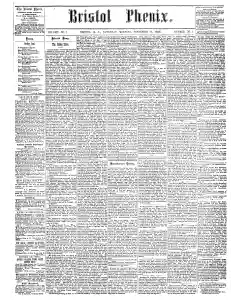
Phenix Building Note at 9 Hope Street Bristol
The item lists the Phenix Building at 9 Hope Street Bristol with R L C A Greene as editor and proprietor. The short notice names the property and the local publisher responsible for the page.
MENTIONED IN THIS ARTICLE
Phenix
Hope Street
Bristol
R. L
C. A. Greene
Scatter Seed and Hope Amid the Crowded Ground
The fragment speaks of sowing despite uncertainty and failure. It invokes a simple creed to scatter seed even as winds blow and Rome falls, noting flowers and blades appear in unlikely clefts and on stony ground.
MENTIONED IN THIS ARTICLE
Rome
Belected Btorp and the Galley Slave of Toulon
A narrator recalls a striking tale aboard a galley where a respected youth, once a public official, is jailed for forged documents. His lover Amine, a seamstress, reveals their romance and vow as she disguises herself to sustain his chance of liberty. They share a telegraphic routine of sending work and visits.
The Fountain of Youth and Youthful Spirit
A reflective piece argues against aging as a rigid fate. It praises inner vitality, child like trust in God, and living fully despite time. The author urges letting go of past burdens and future anxieties to preserve youthful plasticity and enthusiasm. A closing anecdote cites a man who thrives by minding his own business and letting others be.
MENTIONED IN THIS ARTICLE
Julius
France
Tie
Paris
Ile
Lisving
Uncle
Julus
Toulon
Norne
Humility as Path to Peace and Friendship
A reflection on living harmoniously with others through a humble opinion of oneself. The text warns that clinging to dignity damages friendships and breeds unhappiness, while gentleness and humility foster peace.
Only a Trifle Helps the Poor Widow
A baker, Simpkins, reflects on aiding a sick widow named after Harry Watkins with bread on a small budget. The woman visits three times weekly, sewing income limited, and the baker notes that what seems like a trifling sum sustains several families daily. He ponders the unseen good from minor charitable gifts.
MENTIONED IN THIS ARTICLE
Simpkins
Harry Watkins
Harry
Orie
Temper and Happiness as Keys to Child Behavior
The article argues temper often stems from unhappy circumstances rather than bad nature and that a cheerful atmosphere, sympathy, and proactive prevention reduce outbursts. It warns against scolding, promotes healthy habit and joy, and praises the beauty of nature as moral guidance. It ends urging value in seeing beauty in buds and children.
Sir Walter Scott on the worth of the poor speakers
The quote reflects Scott praising the heart and spirit of poor and uneducated people. He asserts stronger moral insight from their sincere remarks under hardship than from classic religious texts.
MENTIONED IN THIS ARTICLE
Sir Walter Scott
Be Gentix Gentle Persuasion Over Coercion
Be Gentix notes violence defeats its own ends and coercion cannot win respect. A gentle word, kind act, and good natured smile can work wonders and influence minds. In the home, harsh speech harms children who should be corrected mildly yet firmly for lasting salutary results.
Bible verse misused to defend selfish love says scholar
The passage argues that a misinterpretation spreads from 1 Tim the author claims the phrase is not biblical and warns that charity begins at home by honoring parents. The critique highlights how appetites and affection are rationalized to justify self interest.
Watches and Meddling Monarchs in Retirement
In a fragment from a history piece, Charles A. retires to St Justa after abdication and spends his time attempting to make many watches keep perfect time together. He laments wasting his life trying to make others share his religious views, acknowledging his own failings.
Romantic wartime courier delivers rebel testimony inside beef cart
A Richmond Times correspondent recounts how Lincoln obtained General Leo’s sworn statements from a rebel Congress committee. The plan used a covert cart route carrying a beef barrel to a planter’s house, with a rider hidden beneath the meat and a brief cavalry dash to recover the package.
MENTIONED IN THIS ARTICLE
Richmond
New York Times
Leo
Congress
Butler
Lyox
Peel
Gian Pre
Committee of Congress
Seaside Mosses Craft From Low Tide Finds
A fragment describes collecting mosses and beach treasures at low tide after full moon. It advises picking items that resemble nothing, preserving them in salt water, sorting with a needle, then pressing between pasteboards to dry. It notes effort and questions making mosses a living trade.
Dark Rome Habits and Ocean Vastness Highlighted
In a period prose style, the piece contrasts ancient Roman bedtimes with modern dawn rituals and notes that many nations share the habit of darkness. It also ponders the Atlantic Ocean’s immense scale with figures on depth, volume, and energy, ending with Bishop Norne praising newspapers as moral teachers.
MENTIONED IN THIS ARTICLE
Tur
Rowan Bev Tinae
Rome
Mediterranean
Athens
Egypt
Palestine
Avia Minor
Numa Pompilius
Tarquinius
Benevolence as the supreme human aim in creation
A reflective passage extols benevolence as the noblest goal of life. It advocates shaping conduct to please the Creator by yielding the greatest good to fellow beings.
Sheriff’s Ghost Payment Ends Printer’s Worry in Old Essex Tale
In a Newburyport Herald tale, Sheriff Philip Bagley promises to pay arrears but dies before morning. The editor jokes the obituary printed before his payment, then Bagley appears alive to demand his money. The incident ends with the sheriff paying the printer before his later real death.
MENTIONED IN THIS ARTICLE
Mycall
Newburyport Herald
Essex
Philip Bagley
Mycalls
County of
Bagley
Herald Office
Shariff
Umbrella mix up causes blushes in Mehitable Merit
Mehitable Merit, a 39 year old, awaits a visit from Solomon Periwinkle and begins to fear a heart matter. He asks about a possession of hers and she realizes she has his umbrella. After a brief awkward exchange, she admits the umbrella mix up and returns it, ending the intrusion.
MENTIONED IN THIS ARTICLE
Portina Tre
Merit
Solomon Periwinkle
Abo
Miss Merit
Sislomonn
Solomon
Mehitable
The Goose Case that Fooled a Jury in Baton Rouge
A Louisiana jury faced a goose theft trial where the defense attorney delivered an epic faltering appeal. The accused finally confessed, exclaiming I did steal um but I didn’t eat um as the Major’s eloquence collapsed and the jury released him.
MENTIONED IN THIS ARTICLE
Baton Rouge
Darkey
Mjor
Goose
Guinea
Supreme Court
A Conscientious Witness in Newburyport Court
In the Newburyport Police Court Judge M presiding a man faced arraignment for assaulting and maltreating a plaintiff. A conscientious witness for the plaintiff testified after promising to tell the truth that he could not say he saw the defendant kick the plaintiff but noted the defendant took away his foot three times.
MENTIONED IN THIS ARTICLE
Newburyport
Expressive verse found in album last leaf
A note in Paris journals records an expressive stanza penciled on the final page of an album. The lines urge Milton to rhyme no more Watts to lie in the tomb and Shakspeare to stand behind the door, arguing for space for poets.
MENTIONED IN THIS ARTICLE
Paris
Milton
Watts
Shakspeare
Also Mentioned on This Page
Bristol Phenix
George Cooper
Bailey
Phbotine
Thames Street
Piface& CO
P.O
United States Internal Revenue
First District
Providence
Rhode Island
Bristol County
Acts of Confess
Wm. P. Freehorn
First National Bank of
Warren
Wm R Taylor
L. B. Frieze
Z C. Rennie
United States
Weybossat Street
R I
Henry B. D Coggeshall
Eall
Irs. Simmons
State Street
W Reynolds
BOM
Oka
Suy 18 Library Committee
Gee Buos
Huntington
Long Island
Cucasuan Bros. & Co
Woolbridge
New Jersey
Augilimo
Crossman Bros
N. J
Crossman Bros. & Co
Superior
Grossman ,Bros. & Co
Ey Woodbridge
Whitney’s
GEO. Tilley
Bradford Street
New Lamp Chimney Co
Brown
WM. B. Paylor
Thia
Miljly
Jutus
Amine
Chance
Altho
Van
Convita
America
Agaliey Lave
Nkidd

 This is just the beginning! Our collection holds over 300 years of history, including rare newspapers, obituaries, marriage records, birth records, and so much more—most of which you won’t find anywhere else!