Evening harmonies drift through sacred nature
Poem by Mes.h Gardner describes evening scenes and stars, the night bird, and the soul’s ascent. It contrasts tranquil valleys with heavenly visions, laments earthly grief, and ends with spiritual longing as darkness settles and morning returns.
The Three Roses in a Swiss Lake Chalet Tale
An elder recalls a summer at Clarens near a lake where three childhood friends, Sibdille Rose Grahame and Rose Fonnereau, shared adventures. They mourn a proscribed patriot, visit graves, and later reunite with a doctor who reveals the Roses remained in memory. Rose Fonnereau marries into a Swiss castle, loses her husband on a perilous Alpine trek, and guards the estate as widow and matriarch with the Roses nearby.
MENTIONED IN THIS ARTICLE
Tera
Thia
Padieu
Chilion
William Tell
Clarens
Separte m
Mary
London
Riva Seville
Raise Fonnereau
Rose Grahame
Anne
Rose Foonereau
Rosa Fonnereau
Switzerland
Rose Fonnereau
Rose
Alps
Babe
Aer
Talso
Frank
Marie
Jonath
Thad
Proserit
A Swiss Pig Week and Rose Stamffer’s Return
A narrator recalls a moonlit visit to Rose Stamffer in Switzerland where a pig slaughter becomes a comic ordeal. The scene features Rose’s hospitable family, a dramatic attempted kiss, and the narrator’s awkward but affectionate reunion with his former fairy. The piece closes with a ponderous aside from The Scientific American on earth growth.
The Unseen Hand in War and Providence
A reflective exam of fortune in battles, arguing that victory and defeat hinge on chance and guidance from a higher order. The author contends that dismissing providence reduces the divine to a mere spectator and undermines prerogatives of the Almighty.
Beauty and sorrow in nature’s enduring solace
The passage reflects on beauty in faces, flowers, fountains, and statues. It argues that grief heightens beauty as affections for nature in adversity soothe wounds, ease sorrow, and offer hope, guiding the heart toward a home beyond decay and death.
Two Gods Face Two Stronger Forces in a Parable Exchange
When Themustocles journeyed to Andros to demand a loan, he proclaimed bringing two gods with him, force and persuasion. The reply boasted two stronger gods, want and impossibility, turning the bargaining into a philosophical standoff.
MENTIONED IN THIS ARTICLE
Themustocles
Andros
The Fruitful Orchard of an Aged Man
An eighty year old man explains to a visiting youth that lifelong effort and planting in youth yield present happiness and vigor. He guides the youth to his orchard to reveal tall trees heavy with fruit, illustrating his secret to a fruitful old age as a gift from above.
MENTIONED IN THIS ARTICLE
Geron
Krummacher
War as Punishment and the Case for Revolt Against Peace
The author argues peace is not inherently desirable amid global disorder and asserts punishment serves as a divine and social lesson. He compares political rulers to loving parents who discipline temperately, claiming nations too require sanctions to uphold natural laws.
MENTIONED IN THIS ARTICLE
Europe
Pickling Cucumbers in Brine and Vinegar Boats
Fresh cucumbers are placed in weak hot brine for 24 hours then covered with boiling vinegar. After three days they become ready for use and will keep long if the process is repeated to remove surface scum.
MENTIONED IN THIS ARTICLE
J’luughman
Goopy Listeners and the Value of Hearing Others
Sydney Smith argues many listeners misuse conversation to display superiority rather than gain knowledge. He stresses weighing others opinions improves understanding, noting few understandings are improved by contradicting or listening with closed minds. He reflects on personal experience valuing others' views for self improvement.
MENTIONED IN THIS ARTICLE
Sydney Smith
Insight on books and their quiet masters from Richard de Bury
In this 1344 excerpt from Philobibian, Richard de Bury extols books as remedies for human ignorance. He praises librarians as vigilant teachers who reveal truth without anger or reward, guiding readers who seek knowledge and liberating those who serve it.
MENTIONED IN THIS ARTICLE
Saturn
Richard de Bury
The Gift of Intelligence and Human Progress
The author argues intelligence is meant for higher uses than survival tasks. People seek knowledge and intellectual action, signaling nature's design to spread intellectual culture. Without this impulse, political changes are only surface actions and society’s work remains unfinished.
MENTIONED IN THIS ARTICLE
Rociwty
Dream Time Distorts Space and Time in Night Visions
A historical note explains dream psychology, noting rapid mental passage of vast events within moments. It cites dreams of enlisting soldiers, crossing the Atlantic, and rapid awakenings, illustrating how time and space seem reshaped in dreams and in disembodied states.
MENTIONED IN THIS ARTICLE
Twovent
de. Abercrombiec
Atlantic
America
An Intelligent Plan for Storing Fruit in Glazed Jars
A narrator describes storing fruit in glazed earthenware jars to protect against light evaporation and air. Jars of various sizes preserve color and moisture, reducing shriveling and loss. A smaller box loses the light and air benefits, and keeps fruit less well. The method limits perspiration and decay during storage.
MENTIONED IN THIS ARTICLE
Srontsa
Poetic Reflection on Sunshine and Zephyr Amid Gusty Defiance
A lyrical fragment notes that warm sun and gentle breeze may melt a glacier resisting a tempest. It suggests kindness can reach a heart beyond harshness.
Yearly Mercantile Advertisers Granted Limited Privilege
The newspaper offers yearly advertising at $32 per year for twenty lines or under weekly. Privilege limited to the advertiser's own immediate business as stated.
MENTIONED IN THIS ARTICLE
TERUS
F.met
Mercantile
Transient Advertising Rates and Policies
Advertising notice outlines price tiers for square advertisements one week with a three week privilege, extra weeks billed per week. ten lines minion type equals a square. Special Notices before marriages and deaths double base rates. Religious Obituary and Political notices charged as advertisements. Hand in ads by Thursday noon.
Foxes Trick Geese and Buried Goose Tale
A Montgomery county hunter relates a Hudson River incident where a fox used moss as a raft to steal geese. After burying a goose in a torn tree hollow, he and another fox are involved in a standoff and a hunter shoots both foxes during the scuffle.
MENTIONED IN THIS ARTICLE
Montgomery
Hudson River
Ile
Toney
Murray
Walkers and legends of Yankee character in late tales
The text describes how travelers reveal nationality by gait and habit, listing vivid archetypes from Spaniard to Yank to Briton. It recounts a colonial era joke of a Yankee peddler in New York who, in disguise as a naval officer, sells maple bowls to a merchant who later pays full price, bitter about British officers.
MENTIONED IN THIS ARTICLE
Lome
Waterloo
New York
Jonathan
Min
Symbols and folly in myth and manners across class speech
The text muses on female representation in myth naming heroines like Isis and the Gorgons, then shifts to critiques of proud men and self conceit, contrasting German proverbs about poverty with reflections on class and truth. It threads through ladies as symbols of obscurity and a satire of social pretensions.
MENTIONED IN THIS ARTICLE
Wuart
Also Mentioned on This Page
Ot Is van He
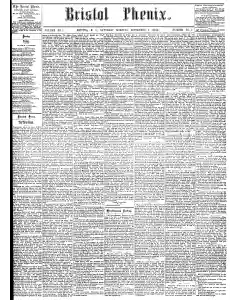
Bristol Phenix
Phenix
Hope Street
Bristol
R. L C. A. Greene
Mes.h C. Gardner
Wilicht
Fily
Terk
Evermore
R. Stamffer
Rose Sebille
Karl Stamffer
Rose Subilla
Stanffer
Plane Tree
Chillon
Alpa
Savoy
Rose Stamffer
Madame Stamffer
Frank C
Rosé Sabille
Mr. Frank
The
Scientific American
Isis
Proserpine
Flecate
Pripe
Buckrom
Bolingbroke

 This is just the beginning! Our collection holds over 300 years of history, including rare newspapers, obituaries, marriage records, birth records, and so much more—most of which you won’t find anywhere else!