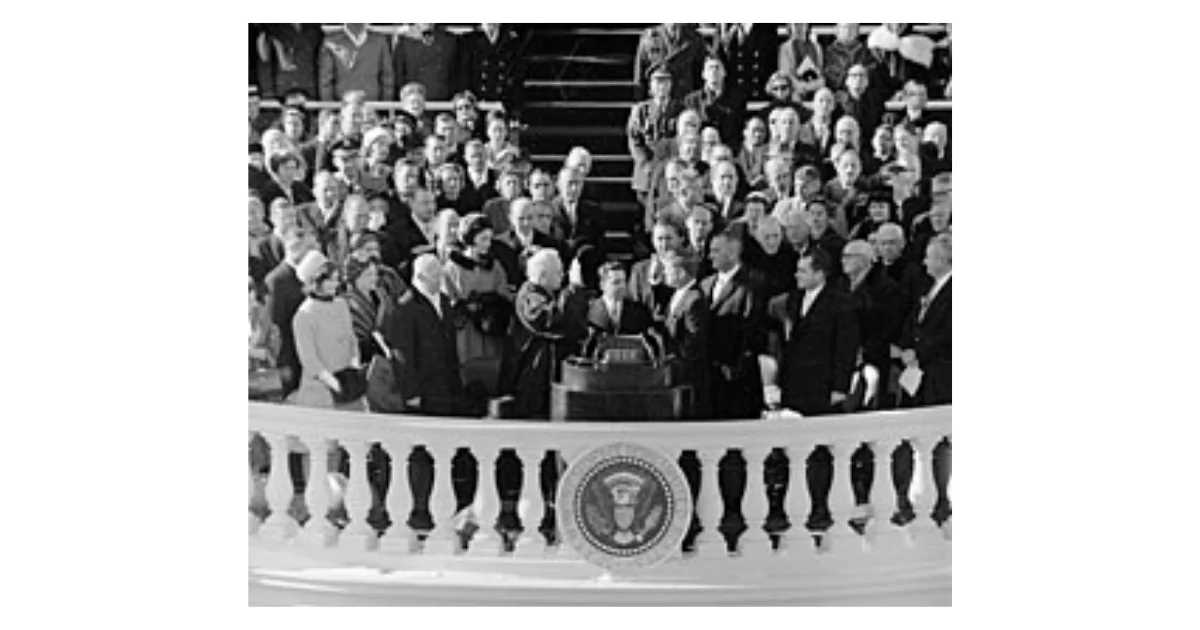
How Small-Town Newspapers Covered Kennedy's Inauguration
Newspapers across the country shared similar wire coverage of Kennedy's 1961 inauguration. Small-town papers added something different: the names of local people it touched.
When President Kennedy was inaugurated in January 1961, national wire services sent very similar coverage of the speech, ceremony, and surrounding events to newspapers across the country. Small-town papers supplemented that coverage with local items, such as a Fort Pierce, Florida paper naming residents invited to the inauguration and a Sinton, Texas paper noting a local couple's trip to Washington. These local items, rather than the widely syndicated wire coverage, are often where family historians find an ancestor's name, making small-town newspaper archives a valuable resource for researching how national events touched individual families and communities.
On January 20 and 21, 1961, newspapers across the country filled their pages with coverage of John F. Kennedy's inauguration. Readers saw highlights from his address, reports of the Washington snowstorm, the official order of ceremony, photographs from the inaugural festivities, and smaller stories about everything from the luncheon menu to Kennedy's silk top hat.
Much of that reporting came through the Associated Press and United Press International. Papers in Phoenix, Corpus Christi, Waco, Raleigh, and towns across the country could therefore publish many of the same stories, even when they had no reporters in Washington.
But two smaller community newspapers added something the wire services could not.
In Fort Pierce, Florida, a local campaign worker showed her daughter an invitation to the inauguration she did not plan to use. In Sinton, Texas, a brief travel notice announced that a local couple had boarded a plane for Washington to attend.
The national stories recorded what happened. The hometown stories recorded who it touched. For family historians, that difference can be everything.
Quick Answer
National wire services sent very similar coverage of Kennedy's 1961 inauguration to newspapers all over the country. Small-town papers supplemented that coverage with local items, naming residents who were invited, who traveled to Washington, and who stayed home. Those local items, not the wire copy, are usually where a family historian finds an ancestor's name.
If you already know roughly where your grandparents were living in January 1961, it's worth searching their hometown paper for that same week and seeing what turns up.
The Story Everyone Got
Open almost any paper from January 20 or 21, 1961, and you'll find some version of the same coverage. The Associated Press and United Press International sent reporters to Washington, and their stories ran, nearly word for word, in papers with no connection to each other beyond a wire subscription.
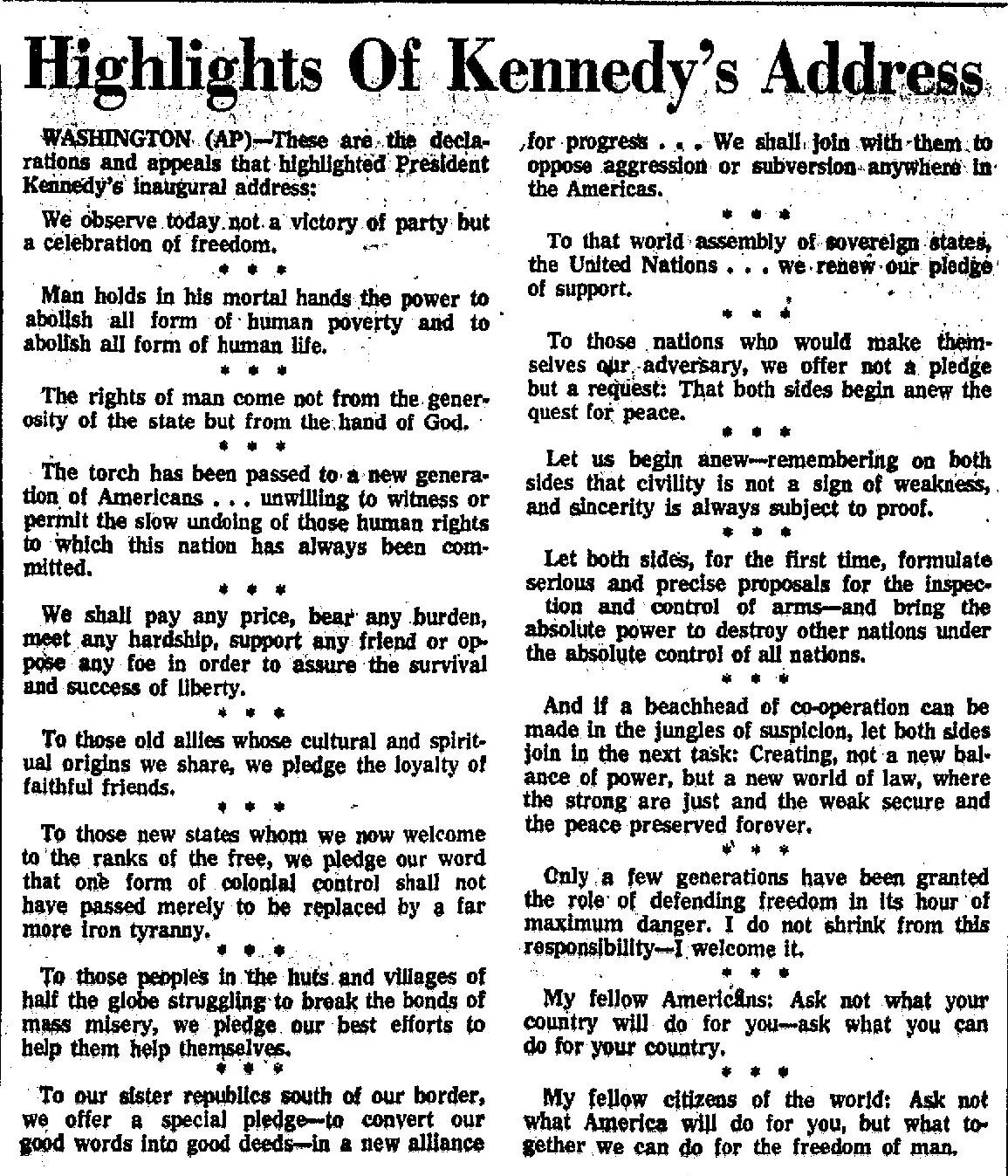
The Arizona Republic ran a highlights package pulling the most quotable lines from Kennedy's address, "ask not what your country will do for you" among them.
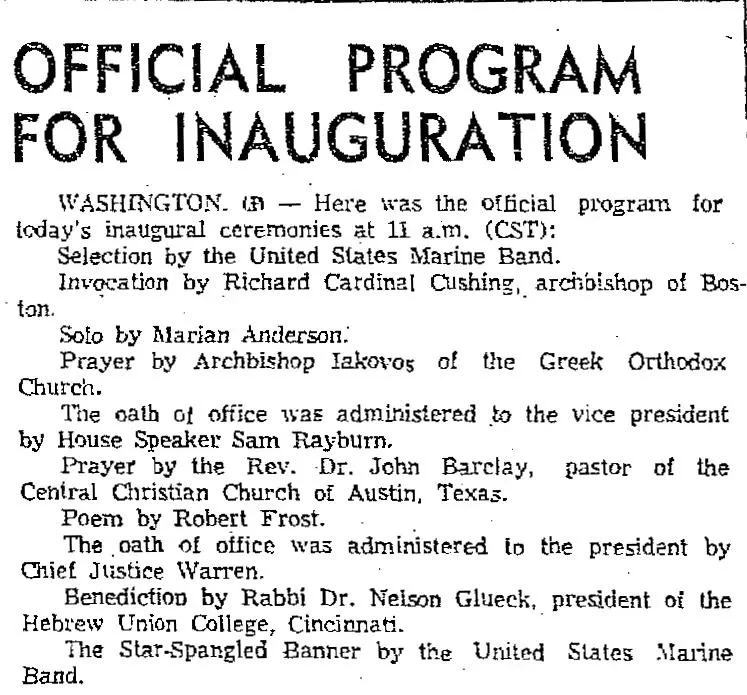
The Corpus Christi Times printed the official order of ceremony: the invocation by Cardinal Cushing, a solo from Marian Anderson, the program's poem by Robert Frost, and the oath administered by Chief Justice Warren.
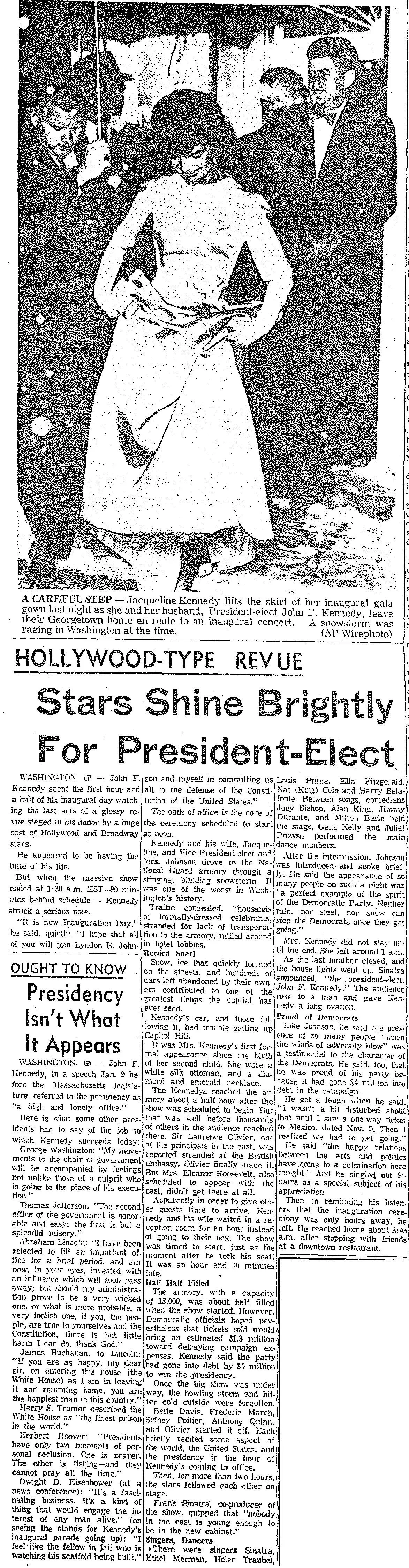
The same Corpus Christi Times page also covered the spectacle surrounding the ceremony: an AP Wirephoto of Jacqueline Kennedy lifting her inaugural-gala gown as she left her Georgetown home during the snowstorm, a report on the inauguration-eve gala produced by Frank Sinatra and featuring stars including Ella Fitzgerald, and a sidebar collecting what past presidents had privately said about the burdens of the office.
The Raleigh Register carried the full text of Kennedy's address separately, wire copy long enough to fill three columns. That poem in the official program is its own small story: blinded by sunlight reflecting off the snow, Frost couldn't read the new poem he had prepared and instead recited "The Gift Outright" from memory.
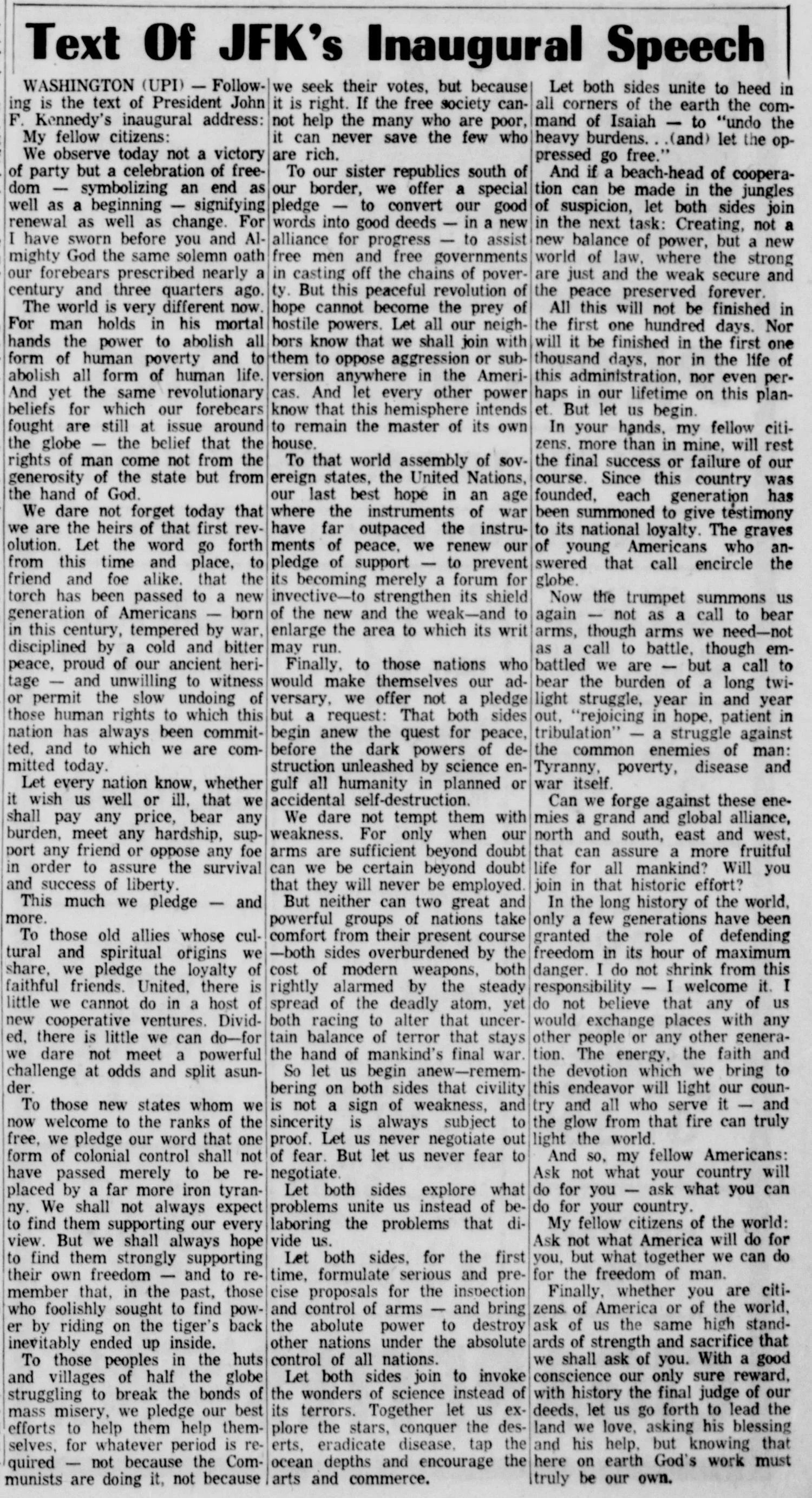
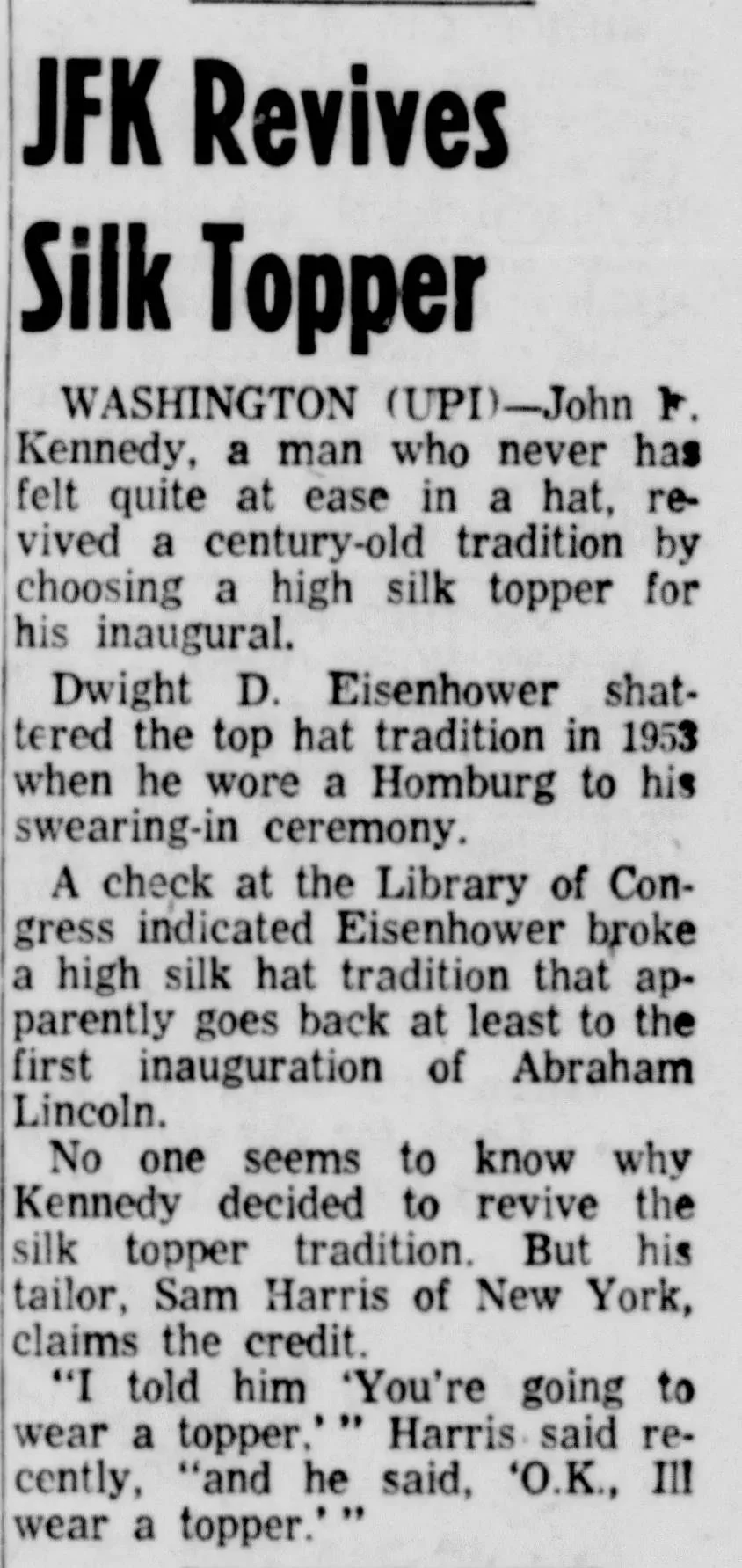
The same Raleigh Register page also explained that Kennedy had revived a decades-old tradition by wearing a silk top hat, a custom Eisenhower had broken in 1953.
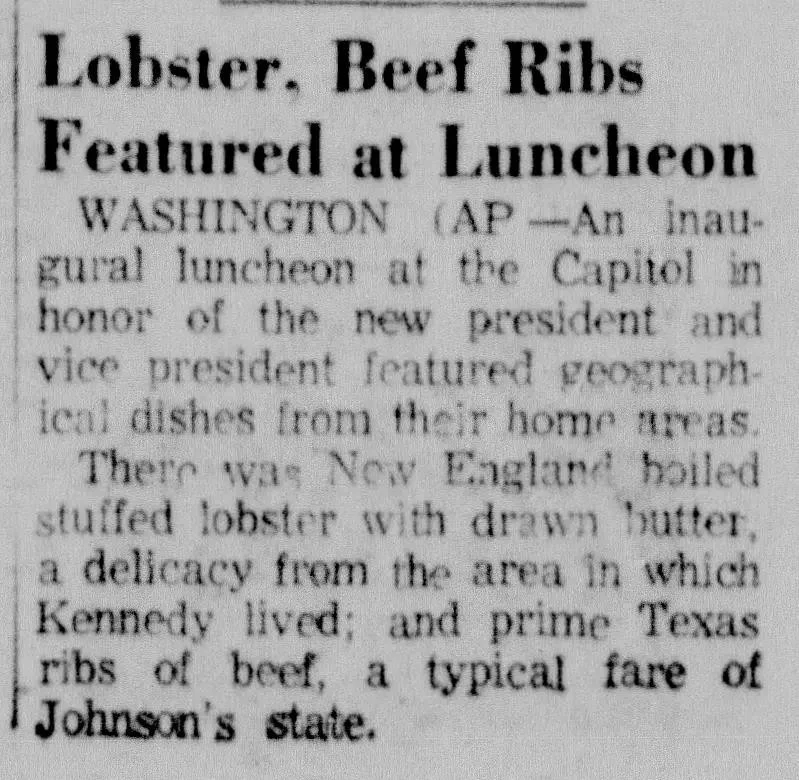
The Waco News-Tribune reported that the official luncheon menu paired New England boiled stuffed lobster with prime Texas ribs of beef, a nod to Kennedy's and Johnson's home regions.
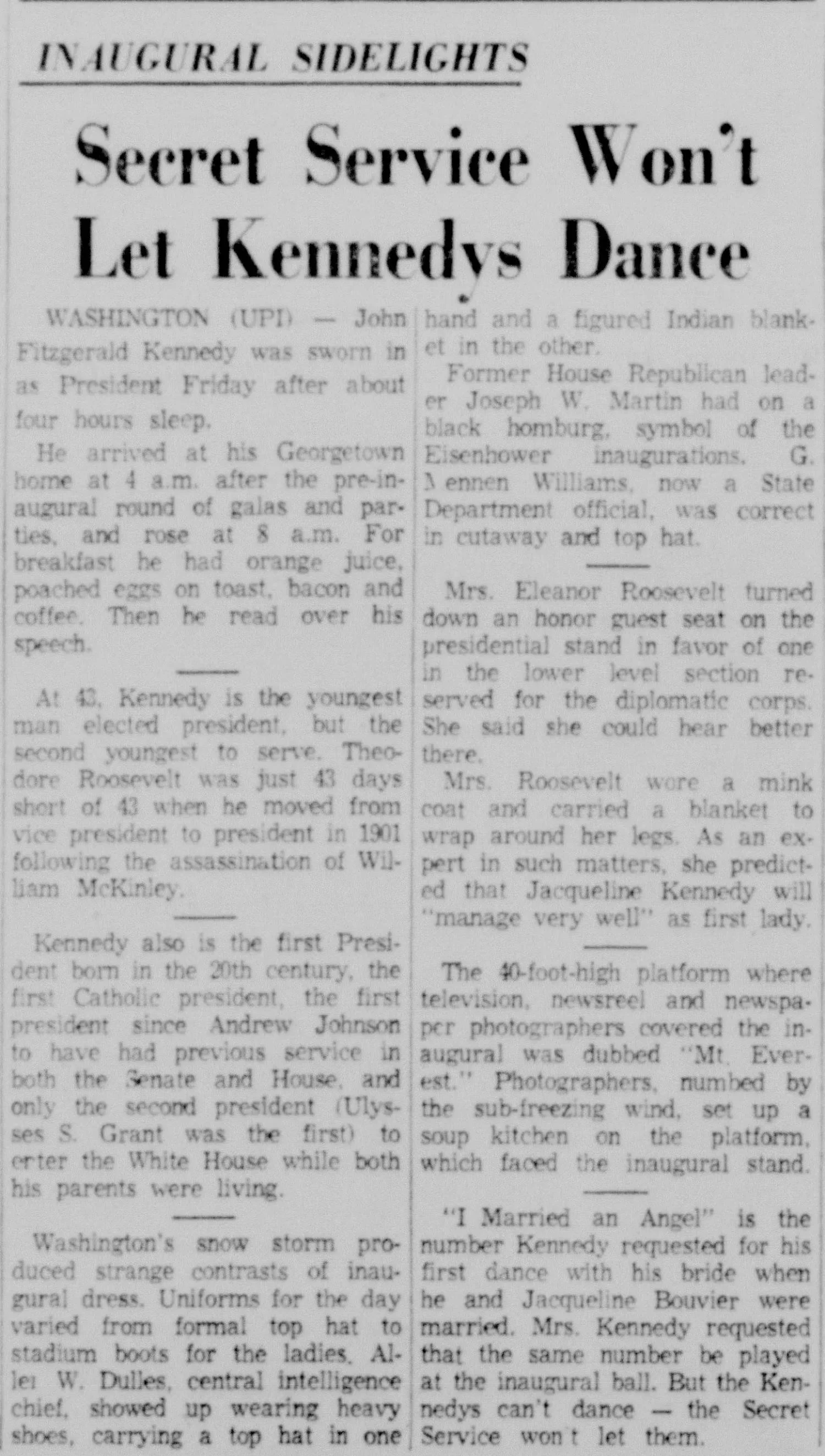
The same Waco page noted that the Secret Service wouldn't let the Kennedys have their first dance at the inaugural ball.
All of it is good reading, and much of it names people readers would recognize: Kennedy, Johnson, Frost, Anderson, Sinatra, Fitzgerald. But none of that syndicated coverage was likely to name an ordinary reader's parent, grandparent, neighbor, or cousin.
What the Local Papers Added
In the days leading up to the inauguration, two community papers ran local items that never appeared in the national wire coverage.
In Fort Pierce, Florida, the News-Tribune published a staff photograph of Mrs. Harold Williams showing her daughter Robyn an invitation to the inauguration. The caption explained that Mrs. Williams had been a key local Kennedy campaign worker and was one of only a handful of area residents to receive an invitation. It also named the John Almonds, the Harry Jenningses, Senator and Mrs. Harry Kicliter, and Representative and Mrs. Rupert Smith. According to the paper, none appeared to be planning to attend.
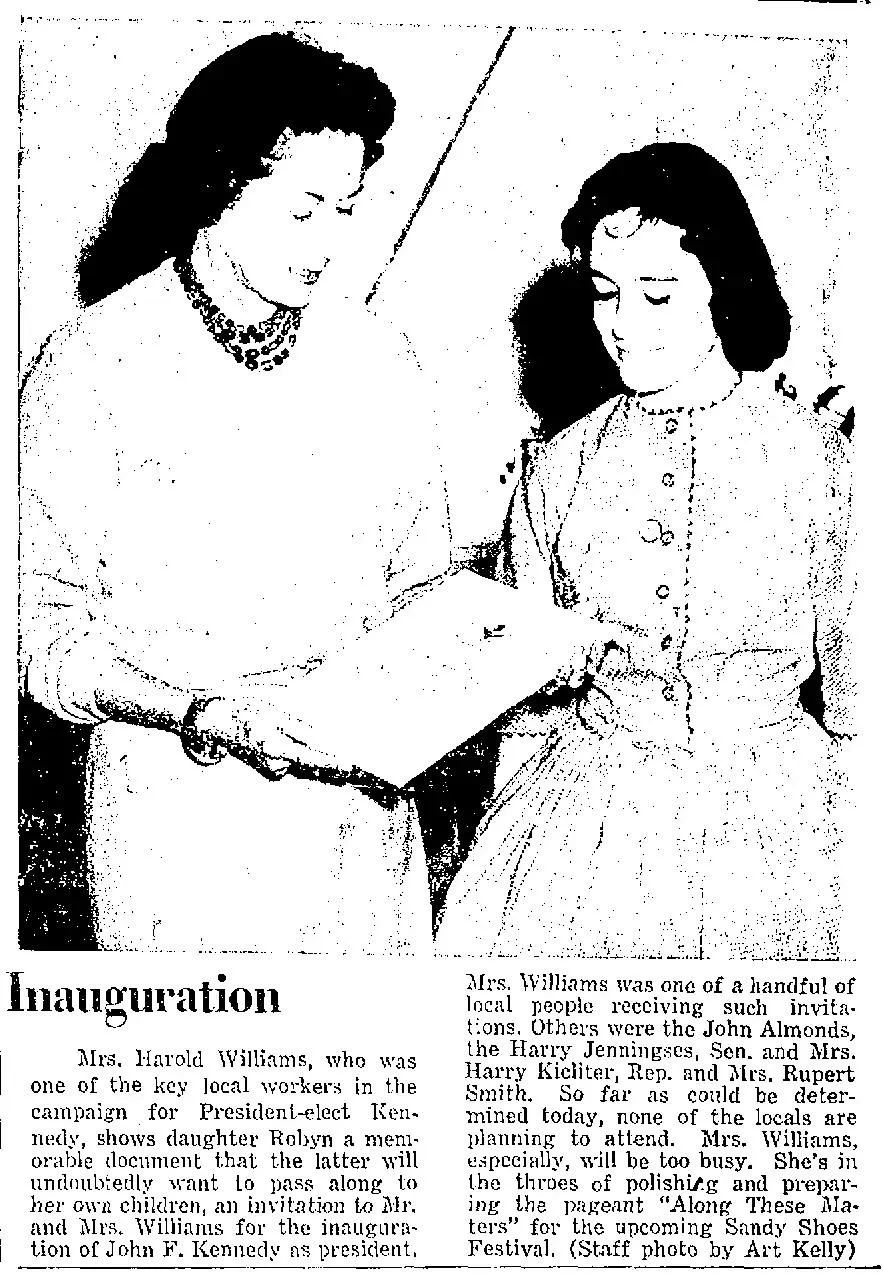
That's not a story about a president. It's a story about a town, its campaign workers, and who did or didn't make the trip.
In Sinton, Texas, the San Patricio County News ran something shorter and simpler: a travel notice announcing that Mr. and Mrs. Casper Gerdes Jr. had left by plane for Washington to attend the inauguration. No photo, no quote, just a name, a date, and a destination.
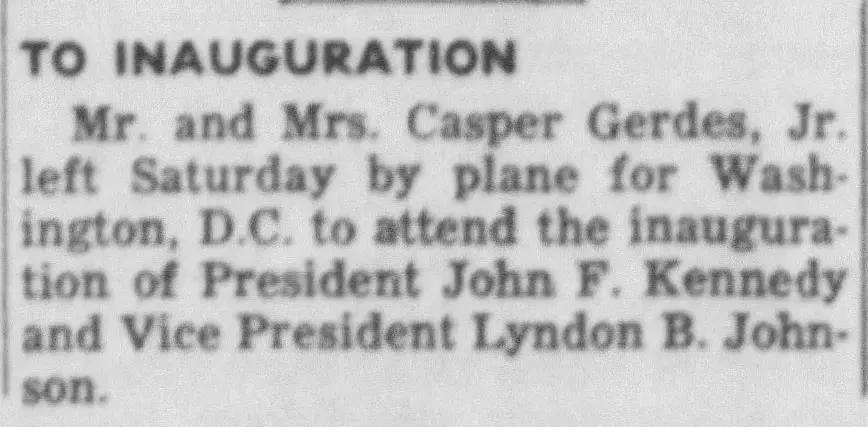
Two towns, two completely different relationships to the same national event, both preserved only because a local editor thought it was worth a few column inches.
Why Small-Town Newspapers Matter in Family History Research
National coverage tells you what happened. Small-town coverage tells you who it happened to.
Local papers often named ordinary residents in ways national wire copy never did: who was invited to what, who traveled where, who stayed home. Those details may be difficult to find in any other surviving source. A courthouse record might tell you where your grandparents lived. A local paper might tell you that your great-grandmother was one of a handful of people in town invited to a presidential inauguration and chose not to go.
Major national events sometimes prompted local papers to look for a hometown connection to the story, and that check-in is often where a name you're looking for finally shows up.
How to Start Your Own Search
Pick a date you already know matters. A wedding, a move, a birth, or a well-known national event your family lived through.
Search the hometown paper, not just the national ones. Local weeklies and small dailies often devoted space to residents whose names would never appear in national coverage.
Widen the date range slightly. Local reaction pieces sometimes ran days before or after the event itself, the way the Fort Pierce piece ran nearly a week ahead of the inauguration.
Watch for travel notices, invitation mentions, and "society" style items. These short pieces are easy to overlook but often name people no other record does.
Expect some OCR rough patches. Older, smaller papers sometimes scan with a few unclear words. If a name or phrase looks off, try a nearby spelling variation.
If spelling is part of the problem, pair this strategy with NewspaperArchive's guide to searching name variants in historical newspapers.
Frequently Asked Questions
What did small-town newspapers say about JFK's inauguration?
Beyond the national wire coverage, some small-town papers ran local items about their own residents' connection to the event, including who was invited to Washington, who actually traveled, and who stayed home.
Did every newspaper cover Kennedy's inauguration the same way?
No. Newspapers frequently relied on the same wire services for national coverage, but some also published locally reported items about their own residents.
How can I find local news from a specific week in the past?
Search a specific newspaper title from the town or county where your ancestor lived, using a date range around the event or moment you're researching, rather than relying on national papers alone.
Why do local papers matter more than national ones for family history?
Local papers often named ordinary residents in ways national coverage did not, including travel notices, invitations, and community reactions that may be difficult to find in vital records.
What if my ancestor's town didn't have its own newspaper?
Look for the nearest county seat or regional paper, which often covered surrounding small towns through community correspondent columns.
Your Grandparents' Hometown Paper Was Watching Too
A wire story can tell you what happened on a given day in history. It takes a hometown paper to tell you who it happened to. Somewhere between the Almonds and the Jenningses of Fort Pierce and the Gerdeses of Sinton, there's a reminder that national moments always land somewhere local first.
Try it with your own family. Search a name and a date in NewspaperArchive and see what the hometown paper had to say.