Winter night at Grandpre ends with fragile bond
In chapter seven Costispep, Blanche tends the German prisoner Hans Hartmann at Grandpre. He speaks of war, family, and letters home. Heuzel’s jealousy and Blanche’s courage shape a tense alliance. Hartmann seeks permission to send a letter and escape risk. He is permitted to remain for 24 hours while an officer questions him. Blanche calms the scene and offers safe companionship, while the keeper fends off suspicion. The scene deepens the emotional stakes as Blanche fears for her father and Hartmann contemplates mercy.
MENTIONED IN THIS ARTICLE
Mademoiselle
Blanche
Houzel
Heuzel
Fraulein
Monsieur
Uhlan Cavalry
France
Hartman
Dr. Huet
Paris
Erea
Hartmann
Grandpre
Huet
Heinrich von Hartmann
19Th Uhlans
Fecamp
Hartmann's dilemma tests Blanche at Grandpre chateau
Hartmann wrestles with loyalty and love while Blanche de Gavrolles faces anxiety over her father’s silence. He contemplates breaking parole to avoid harming her, then shadows Blanche as she leaves the chateau and encounters an elderly woman praying in the chapel.
MENTIONED IN THIS ARTICLE
Hartmann
Blanche
Blanche de Gavrolles
Chateau
Chateau of Grandpre
Blanche Dearrolles
The Best Light in Mills Ditches Shadows
An English manufacturer tested gas jets incandescent lamps and arc lights for illuminating cloth mills. All failed by either dimness glare or heavy shadows. He adopted a continental method placing arc lights with ceiling reflectors to bounce light downward, yielding bright, shadow-free illumination and attracting attention among English weavers.
Canadian Travel Notes Attract A Traveler's Eye
A U S traveler notes three Canadian curios: missing window blinds and bare house fronts, a visible militiaman and police presence resembling English bobbies, and the inability to have shoes blocked outside hotel washrooms. He recalls ten cent shaves and a New York artist whose work he would make redo.
MENTIONED IN THIS ARTICLE
States
Canada
New York
Origin of the dollar sign debated in old coin lore
The article presents several theories for the dollar sign’s origin. One view is a monogram of U and the $ symbol representing the United States. Another links it to the Roman money unit H.$. A third derives from 1 and s from Pesado or peso. A fourth claims the sign represents a piece of eight marked by 8.
MENTIONED IN THIS ARTICLE
United States
Tale of a New York Cat and the clam's forward motion
The article highlights a clam that moves by sinking and rising in the sand traveling about thirty feet a week with its single leg muscle. It also recounts a New York cat's rescue after being trapped on a fourth story window sill, with neighbors calling to aid and the cat escaping with claws embedded in rotted wood.
MENTIONED IN THIS ARTICLE
New York
Widow Wish Sparks Irish Man's Sardonic Reply
After a row with his wife who violently wished he were dead an Irishman retorts with a sharp quip about avoiding widowhood. He warns Pil to take care he stays alive, lampooning the fate with a grim humor characteristic of the period.
MENTIONED IN THIS ARTICLE
London
Poll Parrot Given Away Among Room's Banter
In a playful exchange a woman says she will give away a poll parrot. A young man agrees it would be fair since the bird has been providing for him. The dialogue centers on the lighthearted barter and social humor of the moment.
Lace and Economy Collars for Young Women on Fashion
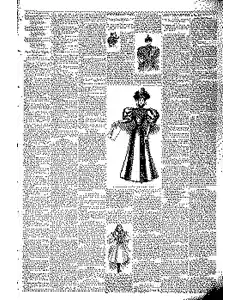
A guide on economical lace collars transforming outfits with heavy lace in Russian thread, worn over dark waists or styled with chiffon, velvet, or suk. Describes shoulder epaulets, ribbon ties, and floral fastenings, plus a net yoke with jet spangles and cream lace accents for brightening bodices.
MENTIONED IN THIS ARTICLE
Webster
Lace Collar Fashion From Historic Textiles
A New York World look asks for a cream white lace collar trimmed with heliotrope ribbons and forget-me-nots, topped by a forget-me-not blue chiffon stock. It suggests refurbishing collars with jets, gold threads, or colored beads to appear new while serving an economical mission.
MENTIONED IN THIS ARTICLE
New York World
Youthful Fashions Describe Gowns for Girls of 1 and 16
The piece details young girls in ankle-length brown or green gowns with gored skirts and stylish bodices. One dress features two broad box plaits, a brown waist with peach silk and dotted net, and a green crepon gown with velvet piping. A sister gown shows golden silk waist and crepon jacket with a lace jabot at the bust.
Royal Trousseau and Fashion Notes from Past Decades
A New York World item discusses the trosseau of Princess Alix, now czarina, totaling 250000 dollars plus vast furs, jewels, and cloths, with court seals and on-site oversight to prevent theft. It also extols crash linen for attractive kitchen aprons, arguing light fabrics stay clean and practical.
MENTIONED IN THIS ARTICLE
Trousseau
Alix
Russia
Trosseau
Preserving Cut Flowers for Longer Life
The New York Morning Journal advises removing all leaves that would sit in water when storing cut flowers. For hard stocked shrubs like Islae, peel the bark too. Water with a scrap of charcoal acts as a preservative to extend freshness.
MENTIONED IN THIS ARTICLE
Islae
New York Morning Journal
Signs of the Season Hallum and Billson exchange winter remark
In a brief exchange, Hallum and Billson discuss the season, noting continued open winter conditions and light attention from book agents who have not yet learned to close doors behind them.
MENTIONED IN THIS ARTICLE
Hallum
Billson
Battle Cry of Freedom and General Grants Iron Will
A long profile spans General Ulysses S Grant's nerve control during war and home life. It recalls his calm in crises from a skylight accident to the awe of crowds singing Dr George F Root's Battle Cry of Freedom in Chicago.
MENTIONED IN THIS ARTICLE
Grant
Washington
Army of the Potomac
Stanton
West
Virginia
Chicago Times
Chicago
George F. Root
Chicago Herald
Fred
Tiger
Congress Street
Jule Lumbard
Frank Lumbard
Dr. Root
Curious anecdotes and Civil War notes from Lancaster to Nashville
A mixed fragment chronicles anecdotes about General Sherman and a New Hampshire regiment, tracing brigade and division assignments from Stone River to Nashville, with casualties and mustering out in 1865. It includes recollections by H. F. Whitcomb of Lancaster and other Civil War reminiscences, plus brief notes on prison life and a German naval woodwork claim after Yalu.
MENTIONED IN THIS ARTICLE
Stone River
Bennett
Chattanooga
Fourth Corps
Lookout Mountain
Sherman
Atlanta
Pulaski
Tenn
Nashville
War Department
H. F. Whitcomb
Lancaster
R. E. Cross
Fifth New Hampshire
Washington
Utah
Joe Johnston
Engineer Corps
Beauregard
West Point
Lincoln
Capitol
Treasury Building
Confederate Congress
Virginia
National Tribune
Yalu
Farahene
Also Mentioned on This Page
Robert Buchanan
General Grant
New York Sun
Shermas
Detroit
Bere
Sherma
Andersonville
Vinalhaven
Maine

 This is just the beginning! Our collection holds over 300 years of history, including rare newspapers, obituaries, marriage records, birth records, and so much more—most of which you won’t find anywhere else!