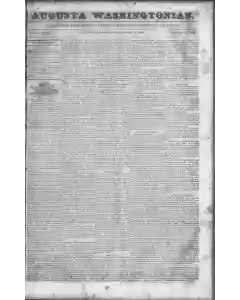
The Washingtonian Publication Notice
The Washingtonian announces weekly Saturday morning issues by James McCafferty at one dollar per year for a single subscriber five dollars for six and ten dollars for twelve with postpaid mail payments. Postmasters may collect subscription money. Advertisements priced by the square with reductions for multiple insertions and early payment.
MENTIONED IN THIS ARTICLE
The
Washingtonian
James McCapferty
Post Office Department
Improvement of Corn and Other Crops by Seed Selection
The editor discusses Gen. T. M. Forman of Cecil County Maryland selecting seed from stalks with the most ears to improve corn. He notes historical examples like Maryland twin corn and Mercer corn, urges cross breeding and seed selection for corn wheat rye and oats, and compares plant breeding to animal breeding, warning against relying only on manure and cultivation.
MENTIONED IN THIS ARTICLE
The
American Farmer
T. M. Forman
Cecil County
Cooper
New Jersey
Maryland
Baden
Forman
Cess
Easy method of propagating Fruit Trees and Crops
A treatise outlines cross breeding and grafting to improve fruit and grain crops. Readers learn selecting best heads and ears in wheat corn and methods to propagate fruit trees through mother grafts and staged transplanting for sustained quality and yield.
The Good Samaritan Herbert Helps a Poor Man
A tale recounts George Herbert aiding a distressed man with a fallen horse and sharing money to refresh both. His friends question the act, but he deems mercy toward beasts and people essential, then returns to music with his companions. A thief’s failed calf heist ends in alarm and retreat.
MENTIONED IN THIS ARTICLE
George Herbert
Salisbury
Mr. Herbert
Iilseelf
The Obstinate Animal Defends Rennes with Hog Ambush
In a tale from James's History of the Black Prince a daring siege at Rennes Brittany ends in relief for the garrison. The Duke of Lancaster feigns withdrawal then releases hogs to lure defenders outside. A captive lion is hung as a scare and the hogs redirect toward the town crowding the streets as relief arrives.
MENTIONED IN THIS ARTICLE
James
Rennes
Britanny
Duke of Lancaster
Notorious 1694 criminal Whitney and calf theft attempt
The notorious 1694 execution case notes that the man, bred a butcher, first tried crime by seeking to steal a calf. He and a companion attempted to buy the calf but arranged a theft when the price proved steep. On a dark morning Whitney agreed to enter the stable to seize the animal after a parley.
MENTIONED IN THIS ARTICLE
Whitney
The True Measure of Politeness and Public Conduct
A feature on politeness grounds manners in kindness over display, noting true civility comes from a good heart and humility. The piece contrasts fake politeness with genuine courtesy and includes an anecdote about Washington freely sharing the communion table with all denominations. A naval vignette ends with Lieutenant O'Brien joking about his damp appearance after a blow.
The Call to Politeness and Honest Speech
The speaker urges avoidance of gossip and scandals about others and stresses early effort by youth to cultivate politeness. He highlights paying attention to others' feelings at table, in the street, parlor, church, and in interactions with both young and old.
Habit and the power of repeated actions
The text explains how repeated behavior forms habits whether good or bad. A boy swears or lies with increasing ease as practice leads to a natural inclination. It emphasizes that daily acts shape character, comparing habits to railroad tracks guiding us toward peace or sorrow. It urges forming right habits to lead a good life.
MENTIONED IN THIS ARTICLE
Reader
Also Mentioned on This Page
Agriculture
Delaware Gazelle
Anon
Noth
James Whitney
Washington
Morristown
N. J
Iamp
Jones
Binigland
O’brien
Edgar

 This is just the beginning! Our collection holds over 300 years of history, including rare newspapers, obituaries, marriage records, birth records, and so much more—most of which you won’t find anywhere else!