Local Gazette Column From Noel Broad Street
A Saturday morning item from Noel Broad Street under the Globe Hotel notes the regular publication cadence. The brief mention reflects a street corner notice style typical of early 20th century editions.
MENTIONED IN THIS ARTICLE
Noel Broad Street
Globe Hotel
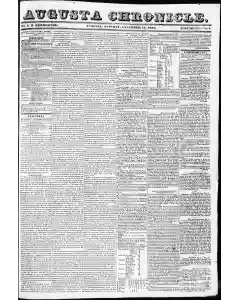
Fragmented colonial ad pricing and legal notices in a late paper
The text outlines subscription rates in advance or on delivery and advertising charges for unpaid papers. It details public sale procedures for land and enslaved people by executors and guardians, including notice periods and posting rules, with varied time frames and penalties.
Office Hours and Sunday Schedule Notice
Public notice outlines office hours with morning and afternoon blocks plus Sunday opening times. It lists times like 11 AM to 1 PM and 2 to 3 PM, with additional references to Sunday hours and a half day or reduced schedule.
MENTIONED IN THIS ARTICLE
Stv
Augusta Week Deaths Reported in City
The Sexion reports the deaths of residents in Augusta for the week ending the 9th, noting one white and one Black person dead.
MENTIONED IN THIS ARTICLE
Halth
Augusta
Tlis City
Chronicle to Return in New Dress with Enlarged Format
The Chronicle will be presented to readers in a larger form after the remaining materials arrive. The first shipment arrived September 1, but quarantine delays in Charleston and later railway issues caused the second batch to be late. The delay is to be expected, and improvements will follow once all materials are on hand.
MENTIONED IN THIS ARTICLE
PHIRI
Tr Hs
Emall
Charleston
Cavacs
Abell
Political Fire Over Nullification Sparks South Carolina Debate
The piece critiques Gov Lumpkin and supporters for advancing nullification and states’ rights against federal actions. It argues that resisting federal requisitions preserves state sovereignty and warns against union disintegration. It notes contrasting views within the governor’s party and references a northern judge’s comment on withheld occupancy surveys.
MENTIONED IN THIS ARTICLE
Lumpkin
Carolina
Jackson
United States
Supreme Court
Ejectment and Indian Lands Cases Referred in Debate
The report notes two cases, one an ejectment action and another related to Indian Lands. No opportunity to question the witness was available, but the discussion confirms two distinct matters presented for consideration.
Governor Lumpkin in Georgia’s Cherokee land dispute clash
A Georgia newspaper derides Governor Lumpkin for his annual message attacking the judiciary and contends the 1833 act on Cherokee lands is unconstitutional. It recounts how the Legislature’s lottery and Indian reserve provisions raised title questions, noting a judge rejected claims based on unconstitutionality and urging citizens to consider state sovereignty separately from party politics.
MENTIONED IN THIS ARTICLE
Georgia
Judicial
United States
Plains
Gov. Lumpkin
Susarior Court
Lumpkin
Controversy Over Cherokee Case and Judicial Powers Explored
A Georgia discussion attacks the Governor and Judge over injunctions and state sovereignty in land cases involving Cherokee claims. It argues the Superior Courts have final jurisdiction on land titles and that injunctions simply ensure a fair jury trial before dispossession.
MENTIONED IN THIS ARTICLE
Georgia
United States
Supreme Court
Uhe
Ile
Supreme Court of the
Cherokeen Circuit
Court of Equity
Pettifogging charges spark heated state response
Readers confront gossip and bold claims about state sovereignty and public rights as critics denounce alleged manipulation by interested parties. The letter urges calm examination and questions the motives behind the move while warning against passion driven judgments.
Georgia House appoints judges and committees in 1834 session
In Mitvepcevore on November 6 1834 the Georgia House discussed journal orders and named numerous committee appointments across Finance Judiciary Public Education and Internal Improvement. Notices announced turnpike and factory bills plus a plan to study state bank assets and congressional redistricting. Seven superior court judges were elected for eight circuits with vote tallies recorded.
MENTIONED IN THIS ARTICLE
Mitvepcevore
State of the Republic
Messes
Burne Young
Oglethorpe
Burnus
Merriweather
Easly
Milton
Floyd
Keean
Clayton
Mitehwll
Carey
Ward
Camden
Rogers
Finance
Nessrs. Day
Cone
Greene Mays
DeKalb
Flournoy
Horris
Pike
Sparks
Solomon
Stroud
Rhodes
McAffee
Harderaan
Swinney
Shick
Messie
Merriwesher
Jordan
Sims
van Landingham
Shaw
Welborn
Brown
Hancock
Moore
Clark
Robinson
Washington
Chandler
McBullin
Marcis
Pulnag
Bracewell
Free Schools
Messrs
Young
Apiathionpe
Uarnie
Richmond
Rutherford
Lawnon
Reid
Pitman
Peddy
McIntyre
Campbell
Davis
Upson
Sharpe
Merriwethar
Hamilton
Columbia
McDonald
Lise
Cartledge
White
Jones
Monroe
Internal Improvement
Gordon
Glynn
Cuffex
Woolfolk
Warner
Romney
Ray
Henry
Redding
Jane
Wilcox
Reynolds
Penticost
Taliferro
Murphy
Herndon
Pepper
Holt
Engrim
Holcombe
McFarland
Moone
Rea
Greene
Dobbs
Lundy
Martin
McLlanan
Stewart
Early
Robson
Harkness
Cole
King
Beker
Lue
Rivers
Randolph
Stansay
Motley
Higdon
Wood
Smith
Morgan
Lowes
Cary
Chastain
Coffee
Marris
Warren
Strickland
Hardeman
Adair
Luckie
Maesrs
Bown
Wilkes
Landrum
Wellboro
Powel
Burnell
Cartsledge
Thames
Wilkinson
Masers
Dismukes
Allen
Goann
Greshaw
Taliaferro
Ran
Greens
Hays
Hall
Mays
Cobb
Pierce
Privileges
Wessrs
Etrickland
Barnes
Rodgers
Burney
Millen
Harris
Putnam
Blackshear
Tarver
Davien
Augusta
Planers
Savannah
Central Bank
Western Circuit
Thomas W. Harrie
Walton County
Garnett Andrews
Omulgee
J. G Puhil
Baldwin
Flint
A. M. D. King
James Pollsill
Pulaski
Ballowny
John Schley
Jefferson
Exetera
John C. Nicoll
Chathas
Harria
Dougherty
Willman
Northern
Andrews
H. Luppkin
J. G. Poltill
M. A. Cooper
Georgia Assembly Elects Attorneys General and Guernsey Officials
The General Assembly met in Mucaiervienne on November 7 1834 to elect Attorney General and Solicitors General for six circuits. Ballots show multiple candidates per circuit with varied totals, while Senate committees were named to draft bills on clerks duties bank note prohibitions and juror compensation. Governor Foyagh and Major-General Taylor resignations were transmitted. House committees planned polling tax reduction.
MENTIONED IN THIS ARTICLE
Twipge
W.H. Sigleaj
Chatham
Starnea
J. Campbell
Scattering
Western
Hillyer
L Franklin
Tripp
Barclay
Chandler
Buroside
Evans
Beton
Sullivan
Ocmulgeo
Inwis
Freeman
Hall
Flint
Stark
Gibson
Harris
Hlewauy
Bailey
Senate
John Foyagh
Senate of
The
United States
David Taylor, Jr
Georgia Hilla
Senate and House Skirmishes Over Governor Message
In Mittengevirrn on November 8 the Senate debated printing the governor’s message and accompanying documents, including a Springer letter and Supreme Court citation, with a House debate following. The Legislature also discussed tribunal establishment for error correction and abolishing state tax collection by inferior courts. Graves faces execution Friday, with sheriff notification due.
MENTIONED IN THIS ARTICLE
Senate
House
Lougas
Supreme Court of the United States
Springer
Dawson
Greene
Doughesty
Troup
Mesera
Dougherty
Wofford
Rease
Liddle
Baxter
Messia
Burns
Young
Oglethorpe
Burney
Gordon
Marsiwather
Clayton
Sims
Graves
Walker County
Mims
Addressing Indian population policy by Wilson Lumpkin
The speaker urges the legislature to consider measures sustaining state policy and faithful execution of previously enacted laws regarding the Indian population. The remarks are attributed to Wilson Lumpkin as a matter of concern and guidance for Georgia citizens.
MENTIONED IN THIS ARTICLE
Georgie
Mnet
Commercial. Late dates from underspecified source
Fragmentary notice records dates from California and another region with unclear events. Names, places, and specifics are garbled, leaving minimal verifiable details about actions or outcomes.
Augusta Market Cotton Prices and Freight Rates Report
The Augusta market shows further cotton price gains amid expectations of a smaller crop in the state and South Carolina. Upland sales mostly at 13 to 15 cents with active brisk demand. receipts light. Rice stocks tight, corn steady, Howard Street flour at $6, freight to Liverpool and New York noted with varied per-bale charges.
MENTIONED IN THIS ARTICLE
Augusta
South Carolina
Liverpool
Savagnan
Howard Street
Hiero
New York
Providence
Boston
Cotton market fluctuations and weekly sales report
Market notes from Levy's Price Current and Mouite Manger recount a week of cotton activity with rising prices on uplands and long cottons, reports of new crop advances, and limited demand. Details include daily sale figures, stock on hand, and regional price ranges across New Orleans and surrounding markets.
Georgia Replies to Federal Overreach in Cherokee Dispute
State executive asserts exclusive Georgia criminal jurisdiction and resists federal intrusion. President cites Supreme Court pressure, warns against dismemberment of the union, and pledges to defend state laws and constitution.
Cotton market shows steady demand and rising prices
The week sees cotton firm with advances of 4d on American and 4d on Brazilian grades. Sales reach 32,300 bales, arrivals 1866, stock at 205,000 bales, compared with last year’s 230,400.
MENTIONED IN THIS ARTICLE
LivesPoon Manet
Cotton and coffee market notes from Havre auction
Havre market reports show sales of cotton and coffee with multiple bale counts and price ranges. Louisiana, Georgia, and Mobile cotton sold at varied rates while Rio and Domingo coffee prices appear adjacent to the cotton figures. Overall stock around 25 000 bales and continued activity in the market.
MENTIONED IN THIS ARTICLE
Havre Manxer
Aredio
Louisiana
Georgis
Mobile
Domingo
Rio
Also Mentioned on This Page
Cuahlestoon Mail
Athens Mail
Northern Mail
A. m
Western Mail
St A. Brees
Ifice
Commercial
Caverpooks
Siti
Fanness
Ivteisays
Cranceeron Manxer
Sea Island
Avery
Cofpfer
New Orleans
Baltimore
North Carolina
Virginia
Georgis Uplana
Orveans Manxer
Mississippi
Milledgeville
House of Representations
General Assembly
Legislaure
Walliam G. Bpringer
William
Ansel
Henry Baldwin
Lily
State of Georgia
Gotton
Seles
Serr
Colton
Salva

 This is just the beginning! Our collection holds over 300 years of history, including rare newspapers, obituaries, marriage records, birth records, and so much more—most of which you won’t find anywhere else!