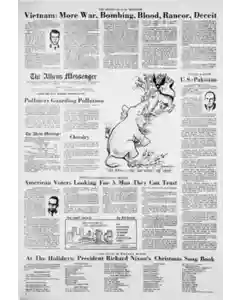
Vietnam War policy and legality questioned in wake of troop withdrawals
The piece critiques six years of war aims in Southeast Asia, noting shifting objectives, declining US casualty talk, and contradictions in Saigon’s actions. It argues democracy in South Vietnam failed, regimes in Cambodia Laos Thailand lack legitimacy, and US legal and moral standards deteriorate while Congress and the Supreme Court retreat from war legality issues.
MENTIONED IN THIS ARTICLE
L.A
U.S
United States
Cambodia
Saigon
Laos
Thailand
America
South Vietnam
Supreme Court
Congress
Opinion on pollution boards and war policy echoes
The piece attacks industry control on anti-pollution boards and condemns government actions in Vietnam. It argues for public interest over corporate influence, cites a New York Times survey, and critiques Congressional oversight, military spending, and prosecutions, warning of moral decay at home.
MENTIONED IN THIS ARTICLE
New York Times
Political Parade: Year Ahead in U S Politics
David S. Broder surveys how uncertain 1972 holds from Nixon’s policies to a possible Muskie nomination. He warns conventional wisdom may fail amid unpredictable crises, with global and domestic shocks possible in the year ahead.
MENTIONED IN THIS ARTICLE
L.A
Nixon
Edmund S. Muskie
George Wallace
Congress
White House
The 1972 Election and Nixon’s Strategic Flexibility
The passage argues that predicting 1972 depends less on events and more on the character of key figures. It highlights Richard Nixon as a highly flexible, politicized leader who will rise above principle to pursue prudent choices, warning against reliance on a fixed game plan.
MENTIONED IN THIS ARTICLE
Richard M. Nixon
1972 Leadership in an Election Year
The piece argues Nixon appears as a tactician rather than principled leadership. It notes voters seek steadiness vision and inspiration, and predicts shocks in primaries will test candidates. It concludes Americans will trust a strong leader to rally the nation in 1972.
MENTIONED IN THIS ARTICLE
Cambodia
Laos
United States
CIA
Nixon
America
Kennedy pledge charge shadows Nixon Pakistan policy
A STANLEY KARNOW analysis questions whether the Nixon White House fabricates a Kennedy era pledge to defend Pakistan in the India Pakistan conflict. Officials dispute any military commitment beyond SEATO CENTO guarantees, noting 1962 weapons usage assurances and a 1954 restraint, with arms embargo in 1965. The piece calls for full disclosure to avoid political manipulation.
MENTIONED IN THIS ARTICLE
White House
Kennedy
Pakistan
United States
Washington
Nixon
William P Rogers
Rogers
SEATO
South Asia
Phillips Talbot
CENTO
U.S
India
Subcontinent
Nixon Christmas Song Book Leaked by Von Creele Satire
A verse laden compilation mocks Nixon era figures and politics. It parodies politicians including Kennedy, Muskie, Spiro, and McGovern with jabs on Gallup, TV, and policy, set in a holiday songbook style during the Nixon years.
MENTIONED IN THIS ARTICLE
Richard Nixon
William H. von Creele
Also Mentioned on This Page
Vietnam
Che Athens Messenger
the Messenger Publishing Company
West Union Street
Athens
Ohio
Frederick W Bush
Gordon K. Bush
Kenner
Fred W Weber
M O W. McDargh
D.J.R. Bruckner
the Athens Messenger
Associated Press
D&s
D&s Eno Woo
Csdees
West Virginia
U.S. & Possessions
Athens Post Office
the Messenger Publishing Co
W. Union St
Eve
Eden
Adam
Senate
House
My Lai
Army
William Caley
Berrigan Brothers
American Catholic Bishops
Southeast Asia
David S. Broder
Latin America
Middle East
New Hampshire
The
Small Society
Brickman
Stanley Karnow
U.s-Pakistan
J. Kenneth Galbraith
New Delhi
State Department
United Nations
William F. Buckley
President Richard Nixon
Mills
Spock
Disraeli
Peking
Ronald Reagan
Oh-h-h Muskie
Chiang Kai-shek
Muskie
Gallup
Wicker
Wenceslaus
Woodstock
Humphrey
Jingle Bells
Teddy
Lindsay
Powell
Rechniquist
Mitchell
Warren
Meany
Spiro
Jim Buckley
Bill Buckley
George McGovern

 This is just the beginning! Our collection holds over 300 years of history, including rare newspapers, obituaries, marriage records, birth records, and so much more—most of which you won’t find anywhere else!