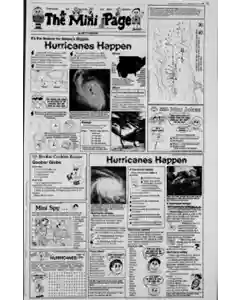
Hurricanes Happen Season for Nature’s Biggies
A concise overview explains hurricanes as large storms with winds of 74 mph or more, forming over tropical waters. It notes the eye as the calm center, the eye wall as the violent ring, and that Atlantic season peaks mid August to October with possible events into November on the East Coast.
MENTIONED IN THIS ARTICLE
Tropics
Atlantic
Caribbean
Gulf of Mexico
Hurricane naming and cyclone stages in the south Indian Ocean
A satellite image shows a hurricane gaining strength in the south Indian Ocean where it is called a cyclone. Weather experts track developments with stages named by wind speed and air pressure. Names are assigned from an alphabetical list, skipping Q U X and Z, with 998 names used.
MENTIONED IN THIS ARTICLE
South Indian Ocean
Weather Safety And Hurricanes For Readers
The Mini Page credits Frank Lepore of the National Hurricane Center for help. It explains storm surges and winds up to 74 mph, warns of tornadoes and inland damage, and outlines hurricane watch and warning meanings. It advises listening to officials, evacuating if told, and keeping gas, water, and food handy.
MENTIONED IN THIS ARTICLE
Frank Lepore
The
National Hurricane Center
Shoe
Ubi
Also Mentioned on This Page
Equator
Andrew
Florida
Mexico
Aars Mimi
Osanenne
Vorite
Mini Spy
Basset Brown
Pacific
RAV
ATLAN
Harri
Soniw
Dane
TYDA
Cos
United States
Nhe
Fema.gov
Noaa.gov

 This is just the beginning! Our collection holds over 300 years of history, including rare newspapers, obituaries, marriage records, birth records, and so much more—most of which you won’t find anywhere else!