Wood substitutes for substitutes in wartime building trend
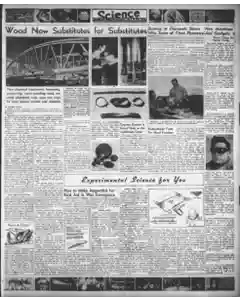
The Forest Products Laboratory at Madison explains wood is replacing metal alloys in war plants hangars ships and bridges owing to steel shortages. new impregnation methods protect timbers from pests and decay and research covers lamination for aircraft propellers decks for naval craft and new resins for shrapnel. the lab notes wood’s peacetime value and vast timber reserves support sustained yield planning.
MENTIONED IN THIS ARTICLE
Forest Products Laboratory
Madison, Wis
All America
United States
du Pont
Madison
Wis
House of Magic
America
Science Service
Cypress Canker Confined To California Coast Strip
Italian cypress trees on the California coast are struck by a serious canker disease found in a four mile wide coastal belt. The pathogen attacks only at low temperatures with a top limit of 72 degrees Fahrenheit and optimum between 60 and 65. Researcher George A. Zentmyer reports in a study to the American Phytopathological Society journal.
MENTIONED IN THIS ARTICLE
George A. Zentmyer
Connecticut Agricultural Experiment Station
New Haven
California
Zentmyer
Official
The
American Phytopathological Society
How to Make Apparatus for First Aid in War Emergency
City and school groups plan improvised first aid gear for emergencies. Guides describe making splints from basswood or plywood and a Queen’s chair carrier for stretcher use. Local Red Cross chapters, civilian defense groups, and schools are urged to coordinate supplies and training.
MENTIONED IN THIS ARTICLE
Science Club
American Red Cross
War Department
Red Cross
L. K. Thompson
Memphis
Science Service
Patrick Did Not Remove Snakes from Ireland
The article argues St Patrick could not have driven snakes from Ireland as claimed. It notes there were no snakes present in the island in his era, and explains Ireland’s lack of a land bridge to the mainland and the ice age history that would have prevented snake migration.
MENTIONED IN THIS ARTICLE
St. Patrick
Ireland
England
Why Some Diamonds Fluoresce Under Ultraviolet Light
Scientists James M. Orr and Jack De Ment of Portland Oregon used an electric arc to burn diamonds and analyze the emitted light with a spectrograph. They found chromium and titanium in blue fluorescing diamonds, aluminum in yellow ones, and nearly pure carbon in non fluorescing stones, with results reported in The Mineralogist.
MENTIONED IN THIS ARTICLE
James M. Orr
Jack de Ment
Portland
Oregon
Home Made Tests For Wood Finishes
Two simple devices for testing wear resistance and scratch hardness of furniture finishes. An abrasive test uses a circular typewriter eraser on a phonograph arm to measure wear by revolutions. A scratch hardness test uses the phonograph needle on a counter balanced arm with sliding weights to find the pressure that pierces the finish.
Science Club Organization Offered by Newspaper
The Science Service invites readers to start a science club in their shop, school, or neighborhood and learn how by writing to the newspaper. Send inquiries to 1719 N St NW Washington DC for guidance and resources.
MENTIONED IN THIS ARTICLE
Science Service
N St
N. W
Washington, D. C
New Machines And Gadgets In Wartime Daily Life
The article describes innovations such as plastic pencil ferrules replacing brass, a sanitary hermetically sealed dual-container garbage can, an exhausted photographic silver bath used to plate objects, new eye protectors with adjustable slits for field and factory use, a waterproof Army ration carton coated with plastic, and blackout candles with pedestal bases for emergency lighting.
Also Mentioned on This Page
Wood
California Coast
Scies of America
N ‘Encannata”Thleben
BY Joseph H. Kraus
Science Clubs of America
Srivet
Sim Ktros
Tnotch
Patrick

 This is just the beginning! Our collection holds over 300 years of history, including rare newspapers, obituaries, marriage records, birth records, and so much more—most of which you won’t find anywhere else!