Red Cross Drive Ends Amid Joy of Success
After a successful Red Cross drive many will celebrate while some individuals who refused to contribute may face social scrutiny and reflection on their choices.
MENTIONED IN THIS ARTICLE
Red Cross

 This is just the beginning! Our collection holds over 300 years of history, including rare newspapers, obituaries, marriage records, birth records, and so much more—most of which you won’t find anywhere else!
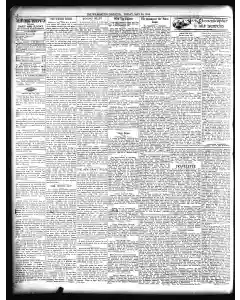
This newspaper page contains 41 articles. Subscribers can read the full text of each article.
Newspaper
Wilmington Dispatch
Location
Wilmington, North Carolina, United States of America
Date
May 24, 1918
Page
11
After a successful Red Cross drive many will celebrate while some individuals who refused to contribute may face social scrutiny and reflection on their choices.
Lawn mower owners report their machines stay at home as neighbors convert front yards into war gardens, changing neighborhood dynamics and outdoor maintenance patterns.
The passage credits African American workers for aiding a Red Cross campaign and urges white residents to acknowledge their patriotic contributions.
The Washington Post notes a slacker’s plan to pay six cents for a five-cent smoke, a price that reflects his idea of value and frugality. He believes the gesture will demonstrate his seriousness about the bargain and a retro flavor of timing.
A historical note laments increasing lynching incidents in Georgia urging authorities to prosecute the perpetrators. The piece claims a belief in the state that lynching escapes legal violation and calls for legal action.
The notice warns that if current reports of German food scarcity are accurate then shortages will worsen in June July and August. It emphasizes that these months typically see the greatest scarcity.
The News and Observer notes that telephone girls may wring their hands under strain yet should avoid ringing the wrong bell as often as they are accused of misplacing calls. The comment mixes humor with a civic portrait of urban switchboard work.
The mass support for the Red Cross appeal demonstrates the nation's determination to wage the war to a successful end. This enthusiasm surpasses even the remarkable success of the third Liberty Bond subscription.
Berlin denies reports that attempts were made on the lives of Generals Von Hindenburg and Von Ludendorff and suggests such claims may be cor five. The denials also refer to possible plots against ten higher ranking German officials.
The article notes Kaiser’s imagined expansion might have overwhelmed European realms before the war. It suggests he planned to install relatives on thrones in the United States and Canada, an audacious idea reflecting his imperial ambitions.
German defense notes that renewed drives failed due to alleged Allied mistrust in attacking with spirit and determination. They claim the heavy German losses in recent assaults have temporarily drained the courage of their own surviving soldiers.
The piece argues that if German agents are truthful about U S troop movements to France the Kaiser may regret earlier assurances that America could not field an effective force. It suggests his foresight would be reversed by hindsight and criticizes the haste to begin operations.
The Red Cross rises in prominence from war and air raids, aided by the Washington Post tribute. It expands operations behind lines and in allied lands, stays nonpolitical, and boosts civilian morale with acts of mercy.
Herr Tyssen, long silent about a 1912 14 deal, reveals how the emperor allegedly promised him thirty thousand acres in Australia in return for backing World War I. He says he kept quiet hoping for land but now discloses secret meetings and similar deals, blaming the emperor for the war to clear Germany’s blame.
The piece argues that buying thrift certificates leads to cheering conversion into buying war stamps as one saves to exchange certificates for stamps. It emphasizes the appeal and progression of thrift saving into wartime support.
An exchange notes Massachusetts has a law allowing boxing in public schools while most states stick to traditional corporal punishment, implying a shift in approach and venue.
The piece condemns a German officer’s admission that bombing British field hospitals and killing wounded soldiers and nurses was part of Germany’s warfare policy. It argues redress is needed yet cautions against retaliatory barbarism, noting accountability will fall on those who began and shaped the war.
General Crowder issues sweeping draft regulations broadening the list of occupations from which men of draft age may be drawn or urged into useful work. The rules aim to reinforce home army production of food and essential goods and align with presidential considerations to curb labor conscription debates.
A khaki uniform is seen by some girls as concealing sins and offering a sense of cover. The remark reflects attitudes toward military attire and its social meaning in youth culture.
The New York Sun argues President Wilson was right to pardon two soldiers sentenced to death for dozing at their post, recalling that the nation slept for two years as enemies threatened attacks during the period.
General Crowder warns all loafers aged 21 to 31 that after July 1 they must work or be sent to fight. The policy sets a clear deadline and enforces productive service as the alternative to idleness.
The News and Observer reports General McAdoo of the railroad administration selected Joseph H. Young of the Norfolk Southern as federal director of the Virginian railroad. Young is described as a capable executive, and the move signals demand for full cooperation from the railroad administration.
The Concord Tribune emphasizes that rights come with duties and calls for renewed focus on citizen responsibility, urging readers to balance demands for freedoms with conscientious duty fulfillment.
The government signals openness to employing German prisoners for beneficial purposes. Georgia’s highway commissioner has proposed using prisoners to build military roads, and discussions with the federal authorities have begun to explore practical plans.
The Ansonian notes a Monroe youth claiming he was commissioned as an officer and jokes that perhaps his promotion came because he failed as a private. The quip reflects modesty and newspaper humor of the era.
In Ireland a conscription officer handles a demanding assignment described as a man-sized job, reflecting the scope and seriousness of duties carried out in the region.
The piece praises young people shop girls and children for selfless Red Cross giving. It notes their deprivations and sacrifices and urges broader generosity from those who can afford to give but do not. The author calls for stronger daily canvassing to support war causes.
A Mullins citizen said yesterday that with friends he rode through the farming section near Mullins and was surprised by the large tobacco acreage, far greater than the cotton, with only small corn patches observed.
Eleven hours of pageantry in Charlotte as the Blue Devils, guests of the city, are feted before boarding a special train at 8 40 p m for Atlanta. Corporal Omerod of Pershing’s American artillery led the visit, once a Washington Star reporter, famed for his two and a half pound steel helmet.
Lincoln county on day one of the Red Cross war fund drive raised 2866 dollars. Chairman McNairy expects the county to double its quota of 2500 dollars by the drive's end.
Seventy officers and privates from the French battlefronts are sent to Haywood White Sulphur Springs hospital near Waynesville after being gassed by German forces. They arrived in Waynesville Saturday, reported by the Asheville Times.
Police in plain clothes responded to a tip and went to Beaucatcher mountain, aiming to seize whiskey in a wagon. The load proved to be barrels of paint, not liquor, according to the Asheville Times.
Sixteen young men were accepted at the Charlotte naval recruiting office in May from 57 applicants, according to Chief Electrician B. F. Best, recruiting officer.
The New York Sinn Fein assembly passed resolutions praising those fighting the suppression of the Irish race as it marked the ban’s closing. The World notes the remarks imply a grim warning: if Germany conquers Europe, there will be no Irish left but Germans.
The Washington Post notes a sardonic sphinx mug expression linked to Kaiser Bill’s rumored promise to Enver Bey of Egypt’s throne, shaping commentary on European intrigues and royal promises.
The federal farm loan board has chartered 5,003 associations in the first year of the twelve land banks. About 50,000 farmers have borrowed nearly a hundred million dollars, with loans averaging 8 to 9 percent in the south and southwest. Texas leads with 259 associations. Washington state has 130. Arizona has four. overall growth continues as more charters are issued and membership expands.
In a downtown job Betty Daly proves capable but self conscious about style and pay. She worries over bosses who talk freely as money flows, yet accepts the wage and keeps to debts with Mary. George Harkness shows interest, raising hopes for a romance amid her social constraints. Betty values modesty while weighing love, work, and future plans.
Officials of the Farm Loan Board report many customers, like a Wichita farmer who repaid his first loan and then had land reappraised to secure a larger loan, prompting expectations that more will return for additional financing.
A travelogue describes Samarkand’s Tamer lane beneath a mosque dome. It notes the tomb of Tamerlane, the jasper stone, and inscriptions. The author discusses Mohammedan alliances, British role in Palestine and Hedjaz railway aims, and calls for constitutional government based on scripture. S. Yeager.
A Dispatch editor explains that the battle is not against true Mohammedanism but against degenerate forces in Germany and Turkey. He argues that genuine Mohammedans fight on the side of the Allies, contrasting them with the Turkish and German states.
The fragment notes a 1918 copyright statement by Dale Drumm, indicating continuation to follow in a future issue. It provides no additional event details, dates, or actions beyond authorship and ownership.
We want people to find what they are looking for at NewspaperArchive. We are confident that we have the newspapers that will increase the value of your family history or other historical research. With our 7-day free trial, you can view the documents you find for free.
People find the most success using advanced search. Try plugging in keywords, names, dates, and locations, and get matched with results from the entire collection of newspapers at NewspaperArchive!
You can also successfully find newspapers by these browse options. Explore our archives on your own!
Browse by location and discover newspapers from all across the world.
Browse by date and find publications for a specific day or era.
Browse old newspaper publications to find specific newspapers.