Ingenious Poultry Barrel Coop From The Farm World
A period style note shows how farmers repurpose barrels for poultry housing. It explains common barrel nests, risks from rats and cats, and the impracticality of tying hens with strings. The piece hints at an improved barrel arrangement demonstrated in the illustration.
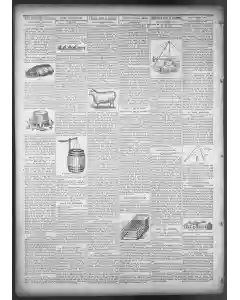
Making two coops from a single barrel
Instructions from Farmers' Review describe splitting a barrel into two by sawing hoops and aligning staves to create two coops. Tips cover where to cut along grain, mounting lath pieces, and positioning openings to control sun, wind, dust, and rats for safer, warmer nesting.
Black Sheepard History and Decline in Wool Market
The Ohio Farmer recounts how pure black sheep existed worldwide but rare in breed history. It describes early American instances circa 1648 to 1865 in eastern states and central Indiana, where black wool required no dye and flocks produced four to six pounds of wool. Decline followed dyeing advances reducing black wool value.
MENTIONED IN THIS ARTICLE
Indiana
Ohio
How Wild Turkeys Forage in Missouri Marshes
A Bee Gleanings writer narrates wild turkeys marching like soldiers through Missouri fields at dawn and dusk. They sweep the marsh and pasture, spotting crickets grasshoppers and worms with keen eyes, then raid cornfields. The fowl at play with hens is treated lightly as comic sport.
MENTIONED IN THIS ARTICLE
Missouri
Handy Slop Feeding for Hogs in Iowa and Ohio
A farmer describes a compact method to feed ground wheat slop to many hogs using a trough carved from a 33 foot log. The plan includes a long trough with crossboards beveled to direct the feed efficiently and avoid waste, noting prior articles on slop feeding methods.
MENTIONED IN THIS ARTICLE
Ohio
Hog Trough System With Feeding Trough and Slop Stirrer
Alex Kennel describes a hog feeding trough built from oak with a 14 inch feeding space per hog and a 51 head capacity. A pine cover on pulleys protects against weather and prevents jumping while a barrel slop system delivers thick feed through a 2 inch faucet into the trough. A wind powered wheat mill and wooden track move the truck, and a hand crank stirrer on the barrel mixes slop to reduce handling and save feed. The design includes a pulley covered lid, a 15 inch high barrel on a truck, and an apparatus resembling a churn to stir the slop, aiming to keep feed clean and cut losses.
MENTIONED IN THIS ARTICLE
Alex
Kennel
Ohio
Hints for horse care and early spring feeds
Advice on weekly brand mash for every horse and colt and gradual grain increases. Notes that many market horses are spoiled by feeding practices rather than underfeeding, and recommends bran mashes during spring appetites drop. Also mentions new sulky design with hub seats and pneumatic wheels claimed to reduce harness work and improve horse motion.
MENTIONED IN THIS ARTICLE
N. Y. World
Many Uses for Mushrooms Across Animals and Arts
Mushrooms delight many species including cows, sheep, squirrels, and birds. They are dried like grandmother’s apples, strung and hung for winter use. European species dye yellow and green, coloring wood to make Tunbridge ware. Franconia’s poor stitch and press mushrooms into garments, Bohemia uses a hollowed toadstool as a wall vase for vines.
MENTIONED IN THIS ARTICLE
Franconia
Germany
Bohemia
St Nicholas
Typical Ryeland Ewe and its long kept breed history
The Ryeland sheep, with roots in England dating back centuries, is praised for its hardy form and fine fleece. The article traces its origin from Hereford and Tyne regions, notes its early dominance, and compares its wool and meat quality to other breeds while detailing Beacons era endurance and the breed’s evolution under farming pressures. It also discusses green food in farming and a humane method for balky horses.
MENTIONED IN THIS ARTICLE
England
William Youatt
Spain
Britain
Winchester
Rome
Bischoff
Herefordshire
Ryeland
Eng
Herbert
Thames
Tyne
Cotswold
Hereford
Shropshire
Staffordshire
Oxford
William Ellis
Hertfordshire
Youatt
Joseph Banks
Saxony
Orange Judd
Clover Hay For Hens A Practical Winter Feed
Clover hay proves to be the cheapest and best winter food for laying hens by supplying mineral matter and bulk, reducing reliance on grain alone. A mixed ration with grain optimizes digestion, egg quality, and hen vitality, balancing essential elements for shell and tissue repair.
How to Move Bees A Practical Guide From Farm and Home
The article explains moving bees by wagon or car with careful steps. Close all exits and cover fly entrances with wire gauze to air the hive. If warm during transit, douse bees with cold water to prevent smothering. Secure frames to prevent jostling and avoid heavy separation inside fixed frames. Load hives crosswise on wagon for safety. in a car lay frames lengthwise. Pack hives tightly with straw and move slowly to destination.
Cheap Chicken Coop From a Dry Goods Box and Lath Yard
A Farmers' Review note describes building a cheap chicken coop using a dry goods box as the nest and a lath yard for the run. It explains options: cut the box in two for two nests and runs, or combine pieces to create multiple nests, and to elevate the box slightly to prevent flood damage during heavy rain. It also mentions a simple horse rest home as a model for animal care and recovery.
Best and Cheapest Hay Derrick Idea for Outdoor Stacks
Farm and Home highlights a 40 foot hay derrick built from two telegraph poles with four guy ropes of galvanized wire. The pole leans over a stack, top over center, secured by a 2x6 base and ground stakes. Cost totals about 1.90 dollars with pulley and hay fork from the barn. Several neighbors report satisfaction after two years of use.
Separated Milk Feeds Calves Costs and Growth Rates
Ohio Farmer reports on using creamery separated skim milk mixed with oats or corn meal and farm feeds to rear calves. Early weight gain averages about one pound per two pounds dry matter. at eight months, one pound per roughly four and a half pounds of dry matter without milk.
MENTIONED IN THIS ARTICLE
C. F. Curtiss
Agricultural College
Ohio
Facts for Farmers on Horses and Horticulture Practices
Farmers in the west find heavy draught horses pay for city work and drays. Emphasize good roads to fields to cut hauling costs and expand growing mangers for winter stock feed. Promote rapid walking horse breeds for farm and road use. Include safe horse care and early transplanting tips for roots and soil around plants.
MENTIONED IN THIS ARTICLE
Farwers
The Horse's Tail as a Health and Character Indicator
A nineteenth century note on horse tails describes how tail position and movement reflect health, vigor, and disposition. It covers tail carriage during plowing and galloping, differences between well bred and coarse tails, shedding tendencies such as rat tailedness, and slang terms like cow tailed and mule tailed for impaired tails.
Simple Wagon Jack Build in Farm and Home Aid
A concise 25 year used jack design uses light strong wood for the slanting piece and upright, a four to five inch wide handle end, and two inch bolts. Slots and holes align to guide the handle lever, with round rod pieces to prevent axle slippage, and a lightening cut to reduce weight.
MENTIONED IN THIS ARTICLE
Ben
L W. Frost
Handy Arrangement for Grain Poultry and Hogs
A described plan combines grain, poultry and hog housing in a single complex. The two wings provide hen and hog pens along a sunny side with a long walk on the opposite side. A central grain building stores grain in bins with chutes to feed the first floor and a cellar would enhance storage.
EES CONVENIENT FARM BUILDING FORPOULTRY AND GARDEN USE
A historic note describes a convenient farm building for storing roots and vegetables to feed fowls and bogs, with cooking in a first floor boiler. It envisions two wings of pens in front of inside pens on well drained ground. The piece on successful plant growing claims a “magnetic attraction” between gardeners and plants, suggesting love enhances growth even in unfavorable settings.
Also Mentioned on This Page
Farming World
ATL

 This is just the beginning! Our collection holds over 300 years of history, including rare newspapers, obituaries, marriage records, birth records, and so much more—most of which you won’t find anywhere else!