Dewey Praised by McKinley and Promoted for Heroic Action
President William McKinley extends gratitude to Rear Admiral George Dewey for his decisive victory and promotes him in recognition of his daring naval achievement during the war.
MENTIONED IN THIS ARTICLE
President McKinley
Dewey’s Pacific Victory Sparks Nationwide Euphoria
Commodore Dewey reports silent batteries at Manila silenced and eleven ships destroyed with no American casualties. The President recognizes the feat with praise and a potential Congressional vote of thanks, while the Pope urges Spain to seek European mediation as the war rages.
MENTIONED IN THIS ARTICLE
Pope Maven
Ueput
Yaven
Spain
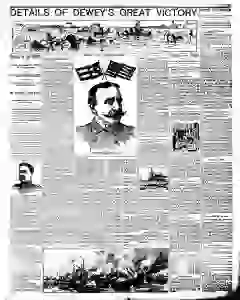
Battle of Manila Bay Greatest Naval Victory Story
A New York correspondent recounts Commodore Dewey’s dramatic entry into Manila Bay aboard the Olympia. The fleet, in near silence, passes Corregidor and Cavite mines, then opens fire as Spanish ships and batteries answer. The action centers on Dewey’s calm command, the Maine cry, and rapid gunfire from Olympia, Baltimore, and Boston against Castilla and Reina Christina.
MENTIONED IN THIS ARTICLE
New York
Hong Kong
Dewey
Manila Bay
Olympia
Corregidor
Baltimore
Raleigh
Petrel
Concord
Boston
Releigh
Bostons
Manila
Montojo
Reina Christina
Cavite
Maine
Admiral Trewey
Oliver Rees
Caulking
Gridley
Gridey
Dons
Castilla
Ballmore
Houston
Conceal
Fred
Ivan
Ulloa
Admiral Deweys Manila Victory Report From Cavite
May 1 4 dispatches from Cavite recount Deweys squadron destroying Spanish ships at Manila Bay including Reina Christina and Castilla. The Olympia Baltimore and Petrel led the attack with minimal American casualties and heavy Spanish losses. Mobilization at Chickamauga for 40 000 volunteers is planned once mustered.
Dewey's Feat Without Parallel By History
Navy officials lauded Admiral Dewey for ashore and sea actions that crushed Spanish batteries and ships at Cavite. The Bay of Manila operations secured a base and communications, with plans to reinforce Dewey from San Francisco as commissions and cables confirm decisive victory and imminent troop relief.
MENTIONED IN THIS ARTICLE
Dewey
Navy Department
Admiral Dewey
Corregidor Se
Manila
Forta
Tong
Alger
Gen. Miles
San Francisco
Government to occupy the Philippines with a strong force
The administration plans to seize the Philippines with a substantial military presence, deploying Pacific slope troops within ten days. The move aims to hold the islands as collateral for a war indemnity from Spain, while officials debate the ultimate disposition and consequences in the Pacific theater. The battle at Manila Bay is noted for heavy shelling by the Olympia and Baltimore, totaling about 140 tons. Eighteen carloads of war materiel were shipped to southern and Atlantic ports, including gun carriages rifles and nearly 3,000,000 rounds.
MENTIONED IN THIS ARTICLE
Concord
Olympia
Baltimore
Manila
Philippine Islands
Wanshington
Haa
Philippines
Pacific Slope
Spain
United States
Rock
Atlantic
Seized and Freed Big Liner Reaches Key West
The French steamer Lafayette, halted near Havana by Annapolis and Wilmington ships, was released after officials learned she had special permission to land in Havana at the French government’s request. Blockade orders had not been updated, allowing her to proceed to Havana.
MENTIONED IN THIS ARTICLE
Ghe
Cube
Canees
Washington
Havana
Navy Department
Thoresay
Lafayette
Gonte
Annapolis
Hivane
Key West
Wilmington
Big Demand For Food Rations From Chicago To Chattanooga
Uncle Sam ordered 2,000,000 rations sent to Chattanooga from Chicago in a single action. The shipment included bacon hard bread and sugar and filled about four trainloads.
MENTIONED IN THIS ARTICLE
Uncle Sam
Chicago
Chattanooga
Wall of Bacon Drives 0,000 Hogs to Fulfill War Ration
The soldier’s bill of fare lists coffee beans salt pepper and vinegar as components. Bacon alone reached twenty seven carloads totaling 900,000 pounds. Ration items were shipped in six figure quantities, totaling 1,600,000 pounds net for 2,000,000 rations. Last week 1,500,000 pounds of bacon required packing houses at Chicago Stock Yard to work nonstop. The order consumed 0,000 hogs.
MENTIONED IN THIS ARTICLE
Chicago Stock
Compliments Exchanged After Defeat at Harbor Battle
On Monday Admiral Montejo sent word through the British consul to Admiral Dewey to compliment American marksmen. Dewey replied with high praise for Spanish courage and resistance, noting the Spanish force was stronger than anticipated. The messages, while courteous, offered Montejo little real comfort.
MENTIONED IN THIS ARTICLE
Montejo
Itill
Invasion Plan for Cuba Reported by Washington Source
A Washington correspondent, citing a high authority, states 60 000 to 80 000 troops will land in Cuba. The first wave includes 15 000 to 18 000 seasoned troops from New Orleans and Tampa, followed by 50 000 volunteers transported by ship. An estimated 600 vessels would be needed to move the force.
MENTIONED IN THIS ARTICLE
War Department
Plana
Washington
Cuba
New Orleans
Tampa
Battle at Cardenas skirmish between American gunboats and Spanish shore batteries
Key West reports a mid harbor clash at Cardenas Cuba as gunboats Wilmington Hudson and torpedo boat Winslow engage masked Spanish batteries. Five Americans killed and many wounded as the Winslow explodes and Wilmington and Winslow are driven from the harbor after a 35 minute duel with heavy cannon fire. Spanish boats observe from distance as casualties mount.
MENTIONED IN THIS ARTICLE
Key West
Wilmington
Hudson
Winslow
Cardenas
Cuba
Wook
Themington
Heory
Battte
BAMPSONS BIG GUNS BOAR AT THE FORTE OF SAN JUAN
A Washington dispatch claims nine American warships bombarded San Juan Porto Rico with heavy shore battery cannonading. Admiral Lampoon’s location and the start of a port occupation campaign were reported to Secretary Long and Secretary Day after private cables from Martinique described the bombardment. The White House, State Department, and Haitian minister moved to confirm the alerts.
MENTIONED IN THIS ARTICLE
San Juan
Washington
White House
Hayti
Admiral Lampoon
Porto Rico
Bey Weat
Long
Navy
Secretary Day
State Department
Martinique
Troops to Cuba Move Gets Cabinet Backing
President McKinley and his advisers voted for an immediate Cuban invasion. About 60,000 troops to be landed as transport and supply arrangements finish. The Army from Chickamauga and units including First and Tenth Cavalry sail to Tampa and New Orleans amid cheers. The transport Gussie carries muskets, rifles, hospital gear, and twenty two Cuban recruits in canvas Union uniforms.
MENTIONED IN THIS ARTICLE
Oral
McKinley
Cuba
Chickeamnauga Pi
New Orleans
Mobile
Tampa
Gussie
Tamspa
United Btstea
Ball Gajore
United States
Massacres in Manila Stir Broad Alarm Abroad
Shanghai advices report mobs in Manila killing Spanish women and residents as Spanish fleet commander Admiral Montejo reportedly slain. Fires set by shells ignite chaos as natives attack foreign figures, with conflicting notes from charity workers and refugees amid Cuban and Spanish trouble abroad.
MENTIONED IN THIS ARTICLE
Shanghai
Manila
Itia
Montejo
Carite
Manilla
Toque
Spa
Ahella
Boston
Sintere
Charity
Also Mentioned on This Page
Rear Admiral Dewey
Bucecesarul
George Dewey
Commodore Dewey
General Audoubtin
McCulloch
Connal Wildman
Hong-Kong
Elong-Kong
Wildman
Secretary Long
Congress
Ticea
Jalo de Cuba
General Lezo
Correo
Velasco
Mindanao
Aetna Coriatina
Foam Sasiating
Ines
Chickamauga
Pintenra Dienntah
U. & Cruiser
Charleston
Seca
Arenlouse
Adomiral Dewey
Bia
Prome
Chisige
Woo
Tiida
Usvana
Canary Islands
Akadrid
London
Vieona Arenes SH P. Wm
Buoday
Moscow
Melbourge
Bampson
BIG Guns
United States Revenue
Estrada Palua
Guta Junta
Don Carlos
Exangelina Cisneros
Havens

 This is just the beginning! Our collection holds over 300 years of history, including rare newspapers, obituaries, marriage records, birth records, and so much more—most of which you won’t find anywhere else!