Fragmentary OCR Capture of a Poetic Line Sample
A torn and garbled OCR fragment discusses a factory scene, a spool, an iris, and a sense of readiness. The text appears as a jumbled, incomplete verse with stray phrases and disconnected words.

 This is just the beginning! Our collection holds over 300 years of history, including rare newspapers, obituaries, marriage records, birth records, and so much more—most of which you won’t find anywhere else!
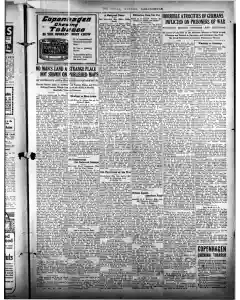
This newspaper page contains 15 articles. Subscribers can read the full text of each article.
Newspaper
Watrous Signal
Location
Watrous, Saskatchewan, Canada
Date
Mar 14, 1918
Page
2
A torn and garbled OCR fragment discusses a factory scene, a spool, an iris, and a sense of readiness. The text appears as a jumbled, incomplete verse with stray phrases and disconnected words.
An essay describes No Man's Land from Switzerland to the sea as a real, changing country marked on no maps. It blends landscape notes with war danger, marsh mud seas and lagoons in Flanders, and the eerie quiet of artillery and ice.
Information from the food ministry warns wheat shortages in France grow more acute. A 50 percent bread ration cut is likely as metal and starch industries face curbs, with coal harvest down about 20,000 bushels vs 1916.
The United Farmers of Alberta and the Grain Growers Association of Saskatchewan plan to attract returned soldiers to farm labor. They expect war veterans to drive teams and perform unskilled tasks for about $75 a month plus board. Provinces seek to farm the harvest shortage and help veterans learn agriculture while considering land settlement.
Fragmented OCR style text laments loss and trauma across a broad horizon. It references dates and emotional states, mentioning Pia and a shared suffering without specifying concrete events. The piece conveys a sense of existential ache and unsettled memory.
A weary senator says the matter deserves inquiry. The exchange contrasts calls for probing action with skepticism about its usefulness.
Sister Terese, a nurse in occupied territory, risked her life aiding a wounded Scottish artilleryman and other patients as German forces shelled a hospital. She guided escapes, endured threats, and was buried under wreckage while tending to victims. Her courage earned Royal recognition as a model nurse under fire.
A fragment from an old editorial argues a theory that war stems from a pig export economy. It suggests Serbia seeks Adriatic access and cites Hoover era economics as supporting context. The text also mentions charitable acts in India and a Maharaj Kumar transferring property.
In the trenches of Prance soldiers suffer shell shock and nervous breakdowns. The article notes a peculiar condition among officers and men returning home, with the term sead Saeem contracted in the text.
An analysis notes that German leaders in Vienna and Berlin weigh the risks of confirming self determination for Poles Lithuanians and Courlanders while seeking to exploit Allied weaknesses. Czernin backs Strassburg over Trieste and Vienna frets over Russian moves as Britain’s Times cites liberal concerns over pacific peace notes.
A garbled 1914 era report notes Britain facing severe shoe shortages while the United States mobilizes, claiming 100000 pairs of service boots and large shoeware stockpiles. It asserts American entry will bolster allies with resources and manpower.
A fragment from a historical page references Canada and America amid unclear context. The readable portion mentions Canada with implied relations to America and a crescent of events surrounding exchanges or gatherings. The text is incomplete and lacks verifiable specifics.
A veteran recalls German cruelty toward British prisoners in 1914 by descriptions of starvation beatings and a burning hut. He cites witnesses including officers and sailors who vowed never to show mercy to German blood, arguing hate can steel resolve in war.
A 1919 era call urges German officials to choose a responsible government to end the outlaw status and resume fair trade with the United States only if Germany renounces militarism. The stance warns German businessmen that economic intercourse with America will be severed while Germany remains an outlaw.
The United States Department of Agriculture reports 1917 totals for cattle hogs sheep and horses across 53 markets. Cattle and hog numbers rose while sheep and horse totals reached into millions, reflecting a busy year despite harsh winter conditions described in Buffalo News dust.
We want people to find what they are looking for at NewspaperArchive. We are confident that we have the newspapers that will increase the value of your family history or other historical research. With our 7-day free trial, you can view the documents you find for free.
People find the most success using advanced search. Try plugging in keywords, names, dates, and locations, and get matched with results from the entire collection of newspapers at NewspaperArchive!
You can also successfully find newspapers by these browse options. Explore our archives on your own!
Browse by location and discover newspapers from all across the world.
Browse by date and find publications for a specific day or era.
Browse old newspaper publications to find specific newspapers.