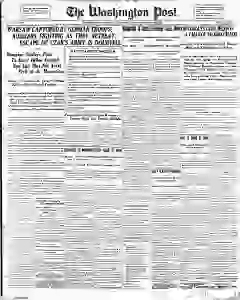
Warsaw Falls to German Troops in Polish Capital Capture
London reports Berlin forces enter Warsaw after skirmishes as Russian retreat accelerates. Bavarians take the city with von Hindenburg’s troops pushing northeast along the Maren, while Austrians cross the Vistula and Narew avenues. Russians, though fighting hard, are pulled back toward new positions as German and Austrian units close in.
MENTIONED IN THIS ARTICLE
Warsaw
Czar
London
Poland
Russian Empire
Baranan
Blonie
Leopold
von Hindenburg
Maren River
Vistula
Joseph Ferdinand
von Mackensen
Bug
Trains Burned by Italian Shelling Kill Troops
Geneva reports from Laibach that Italian artillery set fire to two Borgo Levico trains en route to Rovereto. The first train carried troops with 560 burned to death. the second carried ammunition, eight cars of which exploded. Eight Italian assaults at Polanzo were repulsed before a ninth broke through, seizing miles of trenches. Austrians respond with heavy guns at Corizia.
MENTIONED IN THIS ARTICLE
Geneva
Laibach
Borgo-Levico
Rovereto
Polanzo
Corizia
British Attack Own Ship In Aegean Bay Tale
Report from Overseas News Agency notes a Greek paper claiming a British torpedo boat destroyer in a Chiog Island bay mistook a fellow British destroyer for a German sub and attacked. The item appears amid a miscellany of notices and ads.
MENTIONED IN THIS ARTICLE
Berlin
Sayville
Calri
Athens
Chiog Island
Aegean Sea
Facts About Warsaw City and History
Warsaw, capital of Poland, had 872 478 people in 1911 and is famed as eastern Europe’s most beautiful city. A major iron and steel producer on a fertile plain, it is linked by rail to Vienna, Kiev, Moscow, Petrograd, Danzig and Berlin. Founded possibly in the ninth century with first mentions in 1224, it grew as a trade entrepot for the Pilica Wieprz Narew and Bug valleys. It has seen many conquests and battles under Poles, Sweden, Russia, Prussia, Napoleon’s French, Austria, and Russia since 1813. The University of Warsaw houses 1,500 students and a 500 600‑volume library.
MENTIONED IN THIS ARTICLE
Warsaw
Poland
Europe
Vienna
Kiev
Moscow
Petrograd
Danzig
Berlin
Pilica
Wieprz
Narew
Bug
Western
Sweden
Russia
Prussia
Napoleon
Austria
Petrograd Admits Losing Warsaw and Blowing Vistula Bridges
An official message from Petrograd states that after orders to fall back from Warsaw were issued troops retreated to the right bank of the Vistula and destroyed bridges behind them. Germans moved in the Riga direction while retreating toward the Baku line and Poniewesch district fighting continued with German gains on the Narew front.
MENTIONED IN THIS ARTICLE
Petrograd
Warsaw
Vistula
Riga
Miasa
Bkau
Poniewesch
Narew
Lamza
Refugees in Moscow as Warsaw Falls and Polish Factory Burned
Refugees from Warsaw flood Moscow seeking aid at the American consulate as German occupation tightens. A million dollar Polish sugar plant and other estates are destroyed to prevent use by Germans. Many flee on foot or wagons along highways aiming eastward, with travel hampered by rail deployment to military needs. Officials note Warsaw’s population exodus reflects famine risk and strategic devastation of western Poland.
MENTIONED IN THIS ARTICLE
Prom
Warsaw
Monon
Teutons
Russia
Russiavs
Riga
Gulf
Near East
Galicia
Moscow
Kiev
Vilna
Viadova
Brast‘Litovsk
Eugens Burluk
French War Report Details Fontenelle Launois Action
An official eyewitness account from the French war department describes July 16 counterattacks at Fontenile and July 4 25 French assaults west of Launois. It notes heavy bombardment, stubborn German defense, and French advances capturing houses and prisoners while suffering casualties. The report also covers July 24 actions at Height 627 and Launois including a successful climb from trenches, village penetration, and capture of arms before a German counterattack was repulsed.
MENTIONED IN THIS ARTICLE
Paria
Ban-de-Sapt
Vosges
French War Department
Fontensile
Launois
Oesti
Iam
Fontenelle
Lautre
Launots
Germany
Launols
Car Cers
Launda
Pope convenes peace appeal as European crisis looms
Swiss papers report Pope Benedict plans a solemn consistory at end of September to press for peace in Europe. Polish communities worldwide flood the Vatican with letters urging intervention and urging invitation to Russia to spare Poland further devastation. A large peace manifestation in Rome is hinted for late August into September.
MENTIONED IN THIS ARTICLE
Zurich
Benedict
Europe
Vatican
Poland
Rome
Sentembe
German Capture Warsaw and Moscow Refugees Amid Conflict
Polish refugees report German forces capturing Warsaw as Moscow tensions rise. French advances on the Vosges and Italian-style probes in U 8 indicate broader war activity. A spy threat emerges as Garb of Nun hides intelligence. Mexico faces another chance in regional diplomacy while Haiti teeters near peace talks. Villa meets Juarez to discuss ceasefire prospects as Wilson seeks congressional support.
MENTIONED IN THIS ARTICLE
Warsaw
Moscow
Vosges
Mexico
Austria
Britain
Germany
Neches
Mann
Juarez
Haiti
Wilson
Congress
Butler King of
Almshouse
Fairfax
Concessions Sought on Mail and Cable Censorship in War Era
State Department officials are nearing the view that censorship of American mail and cable through belligerent Europe cannot be forced by treaties. Despite protests from U S citizens and firms, informal negotiations began to seek mitigation as postal conventions fail to bind. Secretary Lansing noted scant results, while business abroad reports ongoing interference with transit via England under convention terms.
MENTIONED IN THIS ARTICLE
Russia
England
France
Belgium
Germany
Dardanelles
Balkan
Bulgaria
Athens
Greece
State Department
Europe
the Department
Lansing
United States
Great Britain
Foreign Office
Diplomats Offer Mexico Chance to End Chaos
Gen. Carranza rejects any Madero cabinet member as provisional president and refuses to meet rival leaders to settle differences. Villa may step aside if others do. Diplomats from six Pan American nations and Secretary Lansing discuss tentative plans and Fuller’s report on Wilson peace efforts. A concerted pan American appeal for peace and constitutional government is expected to be sent to Mexican leaders, with support from other republics. Wilson has urged a strong U.S. lead in this effort.
MENTIONED IN THIS ARTICLE
Carranza
Madero
Villa
Fuller
Wilson
North
South America
State Department
pan-American Legation Corps
Lansing
United States
Mexico
Paul Fulter
New York
Diacusmon
Neon
Argentina da Gama
Brazil
Suares
Chile
Mendez
Guatemala
Calderon
Bolivia
de Pena
Uruguay
Latin-American ‘Legation Corps
Geh Carranza
Vula Herberto Barron
Spy in Garb of Nun Ends Voyage Story of German Spy on Transport
A letter from Lorne Cameron, a Canadian officer, recounts a German spy posing as a nun aboard a troop transport sailing from Canada to England. The English girl under guardianship discovered the ruse, Cameron alerted the captain, and the nun was arrested for espionage. The report forms part of broader wartime intelligence disclosures.
MENTIONED IN THIS ARTICLE
England
Lorne Cameron
Winnipeg
Washington Post
New York
Cameron
Douglas Cameron
Manitoba
Montreal
Fring
Nun
Inj Jrons
Also Mentioned on This Page
Kovuno-Brest-Litovsk
Chelm
von Scholz
von Gallwitz
von Budlow
Dvinsk
Viton Fetrograd
Micholas
Atlantic City
Pennerlvania Alimage
Trainington Gnion Station
Richmond
The
Adv
University of Warsaw
Lodz
Dardaneller
West
Washington
Hague
Venizelos
Constantine
Iow
Asheville
Eetorn
Ekei
Ralfwrays Ady
Volges
Newman
United States District Attorney's Office
Margaret Stout
Stout
Maj Pullman
Pullman
Bis
United States Attorney's Office
United
Pope
Philadelphia
Sea
Chester
Ore & Ohio
Sunda
Poe
Camerons
Baltimors
Rey
wBatimere
Arente Ak Pephulam
Ady
Nlewspar

 This is just the beginning! Our collection holds over 300 years of history, including rare newspapers, obituaries, marriage records, birth records, and so much more—most of which you won’t find anywhere else!