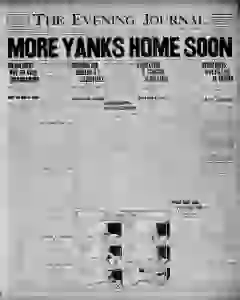
Wilson Seeks Way to Rush Soldiers Home
President Wilson searches for ships and routes to speed the return of American troops. The White House aims to move units abroad swiftly as public pressure grows for prompt troop repatriation.
MENTIONED IN THIS ARTICLE
Wilson
Allies Cancel Charters of Vessels Used by U S in Transporting Troops
Paris December 18 President Wilson conferred with shipping director Edward N Harley on chartered ships for homeward troop movement. Governments canceling charters push vessels back to trade to meet peacetime needs.
MENTIONED IN THIS ARTICLE
U. S
Marshal Foch
Paris
Wilson
Edward N. Harley
United States
Chile Affirms US Aid in Peru Dispute
Chilean foreign minister told the chamber on December 13 that Washington's offer to aid in settling the Peru dispute is friendly and appropriate. He emphasized the United States never proposed mediation, only assistance, and praised past US contributions to regional settlement. The Chilean government expressed full confidence in the friendship of the Washington government.
MENTIONED IN THIS ARTICLE
Washington
State Department
Santiago
Chile
Chamber
United States
Peru
Warh'neton
Berlin Youth Protest for Votes and Reforms
Several hundred children marched to the reichstag in Berlin to press for policy changes. They demanded votes at eighteen, school corporal punishment abolition, and increased child involvement in administration. A seventeen year old warned of consequences if the juvenile program is not adopted.
MENTIONED IN THIS ARTICLE
Berlin
Reichstag
Ah Moens
Ebert Says No Legal Way To Force Surrender Of Former Emperor
London dispatch reports Friedrich Ebert a socialist leader in Germany says he cannot find any legal provision to compel the surrender of the former emperor. He adds the matter does not concern them as they have separated from him and seek guilt for the war to be exposed.
MENTIONED IN THIS ARTICLE
London
Friedrich Ebert
Germany
Willa Hohenwesterns
Build 280 ships for U S emergency fleet program
General Manager Pier of the Emergency Fleet Corporation told the Senate that from August 1917 to November 28, 1918 the organization constructed 260 ships, totaling 1,216,967 tons. The report covers U S wartime shipbuilding progress and planning.
Surrender of German Transport Material Planned
Washington December 18. German surrender of transport material to be carried out by diplomatic advices. From December 8 to 28 the Germans will give up daily 119 engines and 200 cars. For the next 20 days they will surrender 150 engines and 1,200 cars daily.
MENTIONED IN THIS ARTICLE
Washington, der
Allied fleets bombard Russians as Estonian army forms
Dispatches report Russian bols heviks suffer 1 100 prisoners and 20 cannons lost to Don Cossacks in the Voronezh region. English squadron bombs Bolshevik lines on the Gulf of Finland as Estonian army forms and Petrograd prepares to evacuate to Nijni Novgorod amid Baltic operations.
MENTIONED IN THIS ARTICLE
Washington
Vorenes
State Department
Stockholm
Dre
Gulf of Finland
Athens
Smyrna
Mitylene
Petrograd
Nijni- Novgorod
Baltic
Allies Consider Hoover for Global Relief Director
Paris reports that behind the scenes talks focus on forming the allies' conference agenda and peace congress. The central issue is appointing Herbert Hoover, the American food administrator, as director general of relief for all allies and the United States.
MENTIONED IN THIS ARTICLE
Marshal Pech
United States
Herbert ©. Meaver
Foml
Dloover
Paris
Allies’ Conference
Peace Congress
Herbert
Hoover
Four Die in Airplane Collision Near West Point Mississippi
Four men died when two planes collided near West Point Mississippi. Instructors Alvin W. Splane of Old City Pennsylvania and Fred Synnestvedt of Pittsburgh along with Private Fred P. James of Litchfield, Wisconsin and Guy C. Wells of Reynoldsville, Pennsylvania were aboard. The aircraft reportedly flew about 109 feet apart before one lost control and struck the other. All onboard were killed instantly.
MENTIONED IN THIS ARTICLE
West Point
Miss. der
Lients
Alvin W. Splane
Old City
Fred Synnestvedt
Pittsburgh
Payne Field
Fred P. James
Litchfield, W
Guy C. Wells
Reynoldsville, Sr
Bowen Field
Bowen
Yankee Control Occupied Territory Military Memoir
The Third army occupies a German strip of over 4400 square miles supervising hundreds of villages and miles of railways and streetcar lines. An army of 230,000 men completed the occupation with minimal resistance after weeks of hard fighting, marching to the Rhine in disciplined, unwavering fashion.
MENTIONED IN THIS ARTICLE
Third
Germany
Muy Awertena
Rhine
Revolution Sparks in Bulgaria and Berlin Council Congress
Reports from Berlin describe a congress of soldiers and workers councils with a slim Spartacus showing. Independent Socialists gain influence as Karl Liebknecht and Rosa Luxemburg are debated as guests. Bulgaria reportedly experiences a rising revolution as central figures and streets brace for possible turmoil.
MENTIONED IN THIS ARTICLE
Berlin
Germany
Spartacus
Karl Liebknecht
Rosa Luxembourg
Spartacus Group
Deedor
National Assembly
Herr Mueller
Executive Committee
Congress
Pres
German Workers Demand Red Guard and Councils
A representative announced a 250000 strong assembly outside the diet, reading demands aligned with Sparseeus program including worker councils and retention of soldiers power. Meantime in Anhalt elections show 22 majority Socialists, 12 German Democrats and two Conservatives with rising votes aided by lower voting age and women’s participation.
MENTIONED IN THIS ARTICLE
Ent
Diet
National Assembly
Red Guard
Fotruder
Duchy of
Anhalt
Soratiete
Mecklenburg
Copenhagen
Grand Duchy of Mecklenburg
Congress of Soldiers
Berlin
Liberals
Handicraftmen
Peasant Party
Senator Simmons Calls for War Cost Reimbursement From Germany
Senator Simmons of North Carolina urges lightening U S taxation by demanding Germany pay for war costs. He argues reparations should cover civilian destruction and wartime expenses, including advances to the Allies, with potential salvage on government contracts and other incurred costs.
MENTIONED IN THIS ARTICLE
Washington
Deeps
Germany
United States
Simmons
North Carolina
Finance Committee
Senate
United
Leurese
Simimaens
Poe
Units Released in France Report
In France several units were released from confinement or redeployed, with officials noting adjustments to operations and security posture as observers tracked changes across multiple installations.
Ships Arrive in New York as Troops Head Home
British steamships Princess Juliana and Carolina reach New York Harbor with soldiers aboard. General Pershing informs the War Department he designates several units for early convoy home, totaling about 4 500 officers and men including engineers and field artillery units and various squadrons.
Arrival of Allied War Contingents in New York
British steamships Princess Juliana and Caronia arrived with small contingents of American military naval and civilian personnel from England and France. The troopship Maui from Brest arrived two days late due to heavy weather, bringing 64 officers and 2,161 men.
MENTIONED IN THIS ARTICLE
New York
Caronia
England
France
Maui
Brest
Senatorial Debate On War Repercussions Mentioned
The report quotes Senators Simpmons and Sinusens discussing taxation relief and demand that central powers reimburse the United States for wartime losses. They argue citizens will not tolerate escape from accountability and seek proper redress for damages caused by war methods.
MENTIONED IN THIS ARTICLE
Ible
Simpmons
Sinusens
Pershing releases units for early convoy, 4400 officers named
General Pershing notified the War Department he designated additional units for early convoy. About 4400 officers and men to depart, including the Twenty seventh engineers and the Three Hundred and Forty sixth field artillery, plus several other units. British ships Princess Juliana and Catania bring small American contingents from England and France. Meul arrives late from Brest due to heavy seas.
MENTIONED IN THIS ARTICLE
Washington
Pershing
War Department
Twenty Seventh Engineers
Fourth Motor Mechanics Regiment
Aly Service
New York
Catania
England
France
Meul
Brest
American Ranch Raided in Galena by Villa Bandits
Villa bandits raided John B. Hibler’s ranch at Galena in northern Mexico. No one was killed. The raiders seized most of the corn, the stone feed, 26 burros, 16 oxen, four mules, and nattiv goats, along with other cattle. The incident was reported to the state department.
MENTIONED IN THIS ARTICLE
Washington
Villa
John B. Hibler
Galena
Mexico
State Department
Also Mentioned on This Page
Meeta
Marshal Fech
America
Lier George
Ormuande
Lieve George
Riviera
Versailles
Count Macchi TH Cellere
Valy
George Washington
Italy
Countotere
Wehrenbach
Beichstag
Apiistice Jas
Kaiser
Ebert
Fleet Corporation
Miss
Bulgaria
Liebknecht
National Council
Der
Independent Socialist Party of Berlin
Berlingske Tidende
Lokal Angeiger
Hungary
Menantine
Reds
Joan
Sohn
Pancares
Walk Department OF New
Princess Juliana
Carolina
New
York Harbor
Gen. Pershing

 This is just the beginning! Our collection holds over 300 years of history, including rare newspapers, obituaries, marriage records, birth records, and so much more—most of which you won’t find anywhere else!