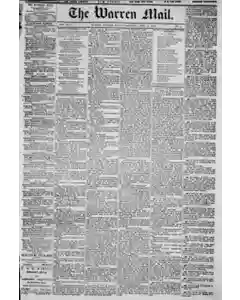
War Poem From Atlantic Monthly Captured In Print
A vivid wartime verse is reproduced from the Atlantic Monthly September issue. The poem is described as a live piece, illustrating the war’s imagery in concise literary form.
MENTIONED IN THIS ARTICLE
Atlantic Monthly
Slavery and Republican Principles in Revolutionary Thought
A historical discussion cites Washington Jefferson Madison and others arguing slavery as a curse and calls for abolition. Letters and speeches from Washington, Madison, Monroe, Randolph, Pinckney, Luther Martin, and Patrick Henry are quoted to show early anti slavery sentiment and tension with constitutional property in man.
MENTIONED IN THIS ARTICLE
Free North
South
Washington
Jefferson
Madison
Lafayette
Patrick Henry
Mr. Monroe
Virginia
John Randolph
Congress
North
Wm. Pinckney
Maryland
Luther Martin
Notable Anti Slavery Quotes From Early American Leaders
A compilation of remarks by Henry Clay John Jay John Q Adams Daniel Webster and others defense of abolition and critique of slavery. Also a note on the Kilkenny Cats tale recounting a Hessian era cruelty anecdote explaining the proverb origin and a prank to avert punishment.
MENTIONED IN THIS ARTICLE
Henry Clay
United States Senate
Mr. Leigh
Virginia
John Q. Adams
Daniel Webster
William Pitt
Dr. Johnson
Lafayette
America
Bishop Horsely
Porteus
John Wesley
Adam Clark
Teach the Children to Pray in Childhood Faith
An exhortation to teach children to pray, recalling a founder’s pious memory of a father figure and the prayer Now I lay me down to sleep. The piece argues that early prayers soften hearts, shield from temptation, and guide souls toward faith through life. It links parental teaching, sacrifice, and moral growth with religious devotion.
MENTIONED IN THIS ARTICLE
John Quincy Adams
Christ
Blessed Father
Quote about nerve, insects, and coral rock perils
A terse reflection on how small irritants and tiny foes can provoke extreme reactions. The text contrasts a tooth’s nerve, a mosquito’s bite, coral rock’s danger, and a warrior’s mortality facing a worm.
The Hottest Day in Twenty Eight Years
Professor Snell of Amherst College reports a 1st August Monday as the hottest day in 28 years, based on a long meteorological register.
MENTIONED IN THIS ARTICLE
Snell
Amherst College
The Schoolmaster Not Abroad
An old local tale recalls Mrs. a Mount Vernon Association agent collecting funds near a house. The householder asks who is Mr Washington and declines, saying they have not yet paid for theirs. The teacher leaves, noting the schoolmaster is abroad in humor.
MENTIONED IN THIS ARTICLE
Ladies’ Mount Vernon Association
Washington
Grant orders immediate furlough for 22 soldiers by General Grant
Ninetieth New York reenlisted as veteran recruits but missed furlough amid business. Twenty two men, detained for a minor offense, were sent to other regiments until their unit returned. At Monocacy one soldier spoke to Grant who, after questions, ordered immediate furloughs so they could go home tonight. A Birmingham paper reports James Buchanan at Regent's Hotel with Mason.
MENTIONED IN THIS ARTICLE
Kilkenny
Ireland
Schumelkettle
Ninetieth New York
Grant
Harper’s Ferry
Birmingham
James Buchanan
United States
Regent’s Hotel
Lemington
Mason
Col Geo Cobham 11th P W Killed Before Atlanta
Poetic tribute by P B Templeton to Col Geo A Cobham 11th P W who died before Atlanta in the Civil War with lines praising his courage learning and honor and expressing personal sorrow and memory.
MENTIONED IN THIS ARTICLE
Col. Geo, A. Cobham
P. W
Atlanta
Sheridan the cavalry chief who never fears a fight
Washington correspondent B I Taylor profiles General Sheridan as a compact, energetic leader with sharp eyes and steady nerve. He praises Sheridan as the top cavalry commander, eager for action, with well trained troopers and keen attention to details, likely to drive a campaign.
MENTIONED IN THIS ARTICLE
B. I. Taylor
Washington
Chicago Journal
Sheridan
Phil
Mission Ridge
Bragg
Cromwell
Jehu
Lawyer and client clash over livery charges
In Court square a client complains that Stokes the livery stable keeper charged extra fees. After Daw the lawyer’s advice, the client hires a horse to Dedham for fifteen shillings, returns and pays another fifteen, then pays thirty to Salem via railroad, claiming the horse was only hired to go to Salem. The stable keeper protests the extra charges and demands the horse.
MENTIONED IN THIS ARTICLE
Dan
Salem
Client
Green Corn Pulping Recipe from Old Cookbook
Take half a dozen ears of green sweet corn with kernels split and scraped. Mix pulp with two beaten eggs two tablespoons sugar butter one salt spoonful salt half pint sweet cream or milk with extra butter and one dozen finely grated crackers. Bake three hours in a pudding dish or two hours in custard cups. Use the raw corn.
General Hooker’s California Heiress Inheritance Revealed
General Hooker once nicknamed fighting Joe is described as on vacation. A Dalton native of Berkshire County, he married a wealthy Mexican widow in California who left her entire fortune to him on her death. The note implies his motive is not wealth but honor.
MENTIONED IN THIS ARTICLE
General Hooker
Joe
Dalton
Berkshire County
California
Pelf
Novel cattle fence prevention method proposed
At the American Institute Farmers club meeting a curious remedy is described to stop steers from jumping fences. Clip off the upper lip eyelashes with scissors and the animal will not jump until they regrow. Samuel Thorne of Duchess County testisted it on breachy oxen and endorses trying it elsewhere.
MENTIONED IN THIS ARTICLE
American Institute Farmers Club
Ublic
Sampson
Samuel Thorne
Duchess County
Cockney Speech on Food Preferences and Phrases
The passage lists Cockney dialect choices with humorous spellings like halfter half and 'am sandwiches. It mentions preferred meals such as eggs, venison, beefsteaks, onions, husters, pepper and salt, and vinegar, reflecting playful culinary slang and speech renderings.
Young minister’s sermon prompts unexpected gift
A pastor preached with lofty phrases noting critics disagreeing. The next morning a poor woman visited with produce in her apron claiming her husband praised the sermon and said the common taters did not agree with him, so he sent Jersey blues as a gift.
Humorous Exchange Over Furniture and Schoolmaster
A town schoolmaster passes a neighbor digging a pig trough and jokes about furniture for boarding him this winter. Lady Franklin funds rebel causes and hosts a dinner for foreign leaders, with remarks about northern philanthropy and returning her husband alive.
MENTIONED IN THIS ARTICLE
Franklin
Sir John
London
North
Bride Declines Guess On Baby’s Sex
An elderly woman questions the bride about keeping house and whether she will have a girl. The bride blushes and replies she does not know if the baby will be a girl or a boy.
Generations of Pshawdee Family Lineage
The text traces lineage from Psnawb of Jonbeel to Jobbah and Hols Ayl through Pedullah Rheet Aylah Kaudphyash to Pshawdee, naming a sequence of forebears and interlinked lineages.
MENTIONED IN THIS ARTICLE
Pshawdee
Psnawb
Jonbeel
Pedullah
Aylah
Rheet Aylah
Jobah
Jobbah
Hols Ayl
Holz Ayl
Kaudphyash
Child’s Church Plate Tale Sparks Moral Lesson
A young girl recounts visiting church where a collection plate was passed for the first time. She notes with innocence that “a man passed around a plate with some money on it, but I didn’t take any,” illustrating a moment of virtue and honesty.
Two Knaves on the Street Questioned
A witty exchange has one man asking his friend how many knaves live on their street. The friend protests, then the first clarifies counting both himself and others, provoking a humorous retort about insult and self-knowledge.
Osceola Sentinel Advice on article editing
The Osceola Sentinel offers guidance to writers not posted in mysteries of composition. Read finished articles three times and trim them by half each pass, then copy the final text.
MENTIONED IN THIS ARTICLE
The
Osceola Sentinel
What woman is mentioned in Scriptures before Eve
Question about biblical names cites a figure referenced before Eve in Scripture and mentions Jenny Sis as part of the inquiry. The source records a reader query on scriptural sequence and feminine figures.
MENTIONED IN THIS ARTICLE
Jenny Sis
Why should the highest apple on a tree be a good one
A humorous line noting that the topmost fruit is a tiptop apple, playing on the phrase tiptop to imply quality.
Also Mentioned on This Page
PUBL
Busi
Ness
Chase Osgood
Sheffield
Warren County
L. A. Pierce
Florence
Edwin Clark
L. D. Crandall
Warren
Charles Dinsmoor
Scofield
Parmlee & Henry
Joseph A. Neill
Johnson's Exchange
No. 5
Brown & M
Kelvy
Liberty Street
Warren, Pa
Cofield
D. Brown
D. M’kelly
Brown & Jamieson
Penna
R. Brown
Commissioner of Pensions
H. A. Jamieson
M.A Jamieson
Wetmore & Clark
Second Street
Johnson & Brown’s
Wetmore
Hackney House
Second and
Liberty Streets
Joan Russent
Gerae Sartor
Oly
Brown’s Hotel
State House and
Public Square
Erie
Philadelphia
H. L. Brown
D. V. Stranatian
Front Street
Postoffice
M. Suaeffer & CO
Yankee Nations, &c
Bysecker Block
Pr. J. Trushel & CO
Warren Pa
Randall's Drug Store
Pierce & Davis
Carver House
E. M. Pierce
W. WH. Davis
Beecher & Colman
R. Coleman
Dewkirk
M. Beecher, JR
Brown Brothers
H. W. Brown
Thos. Brown
John Brown
Nesmith & Keller
Va- Pa
Exchange Building
A. Kirberger
Greenland Brothers
Water Street
George Ball
Central Clothing
O. H. Hunter
WEBB
Kellogg
G Ko F
Kelogg
Erie, PA
W. Martin
Commission Vercants
Cortland Street
Greenwich and
Washington Sts
Peter Martin, WM. Martin
New York
Hazeltine & DO
Vicksburg
George H. Boker
Sherman
Tottering
Kilkenny Cats
P. B. Templeton
Phil’ Sheridan
Europe
Patrick
Chicago Tribune

 This is just the beginning! Our collection holds over 300 years of history, including rare newspapers, obituaries, marriage records, birth records, and so much more—most of which you won’t find anywhere else!