German Vessel Attack Witness Reports Torpedoes Fired
A distinguished parsonage aboard another vessel witnessed the attack on the troop ship. The man said three torpedoes were fired at his own vessel before it turned away late Tuesday night.

08 Feb 1918
Page 1
 This is just the beginning! Our collection holds over 300 years of history, including rare newspapers, obituaries, marriage records, birth records, and so much more—most of which you won’t find anywhere else!
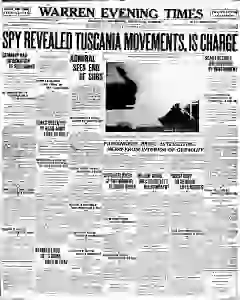
This newspaper page contains 25 articles. Subscribers can read the full text of each article.
Newspaper
Warren Evening Times
Location
Warren, Pennsylvania, United States of America
Date
Feb 08, 1918
Page
1
A distinguished parsonage aboard another vessel witnessed the attack on the troop ship. The man said three torpedoes were fired at his own vessel before it turned away late Tuesday night.
A destroyer chased a submarine to a depth charged area, believed to render the sea terrorless. Survivors and reports describe U boat losses and a lingering doubt over the fate of other subs as Allied ships moved to the scene amid conflicting accounts from observers aboard transport vessels and naval officers.
Eyewitness account recalls women aboard the torpedoed ships at Tuscany being forced to abandon deck via log ropes as distress and panic spread. Survivors describe cold water, a chaotic scene with crew and guards, and efforts to reach lifeboats while under threat from attackers and gunfire. The testimony highlights fear, rescue attempts, and the somber aftermath as the vessel sank with men thrown overboard.
The American press recounts the torpedoing of a ship with survivors aboard. Veterans and officials including a naval group discuss rescue efforts and the broader impact on maritime wartime service. The report notes questions about military post roles and honors for those saved at sea.
The text appears as garbled OCR with misspelled terms about ingredients and roles. It references flour, bread components, and food items but lacks clear context or coherent facts to summarize a specific event or person.
A mangled text fragment references exiting bags and unclear actions. It mentions bags and coats in a bambe, a scale gallery, and queries about where to go, with disrupted phrasing and no clear event or names to identify.
Washington expects the first of Henry Word ie mutating for the Navy as Navy officials announce a keel laying. Secretary Darisls notes the fighter may be given an official designation later by public announcement. Local reaction suggests the name may change.
Forces under the command of the Sheik of Tretta annihilate Turkish troops southeast of Denit Sea near Kay Prisoners and the Commander-in-Chief captured or killed in the decisive engagement.
Dispatches report Turkish casualties surpass 400 amid the Jerusalem sector battle led by General Allenby. Arab forces claim major gains including eight machine guns and substantial booty as rail communications reopen and Turkish columns retreat under bombardment.
A wartime dispatch notes that 16 year old youths labeled as Berman lads are being used in frays. The report indicates government and military officials discuss the issue, with claimed conscription and deployment details under war department scrutiny.
Fragmented text from a war era column mentions naval leaders and a final action against submarines. It references Admirals, August actions, and military units, with unclear names and dates due to OCR damage. The passage hints at a command change and a battle outcome, but readable specifics are sparse.
A United Press report argues that a neutral shipping arrangement worsens Hons, enhances Anistarias and Wares, and would align with American regulation to tighten ports. The briefing notes the move strengthens Allied shipping leverage and could extend conflict, citing naval observers and strategic commentators.
Report from Copenhagen cites Russian army commander Kerensky under arrest in the Moscow region after a dispute over his democratic stance toward arms. Insanoff named successor in June 1947, two months later, as Kornilott opposed Kerensky.
A fragmentary dispatch from Amsterdam reports a cabinet reshuffle in Austria. The article notes ministerial changes and a February date, with unclear lines about a German encounter and a pilot’s fate. Strong entities include Austria, Amsterdam, and Germany. The piece hints at military or diplomatic developments and a planned arrival of French units.
Report from aboard a transport ship details German claims of a submarine campaign its impact on morale and prisoner treatment. Observers note desertions rise in the German army and American prisoners facing harsher conditions. A later transfer of powder and toneh pant, seized during a search, is reported with limited corroboration.
A garbled Washington dispatch reports the fuel administration lifting the Monday closing order with exceptions for certain regions. It notes an January 17 shipment preference and a standing suspension affecting related penalties, asserting conditions remain under review and the order will stand despite limited exemptions.
In Washington Fel today the War Committee reports a surge in men registered since last update. The Defense Commission notes many are reaching the age of 21, urging increased compliance across districts to fulfill breeding quotas and ensure quotas are met.
The Washington press reports a July Fourth celebration plan announced by the Interior Department. The committee will oversee nationwide events and safety controls for the holiday.
United Press dispatch from Washington reports President Wilson sending sympathy to Mrs Roosevelt after Colonel Roosevelt’s illness. It describes Roosevelt’s improving condition and details about medical care, with notes on sleeping patterns and nurses. The item also mentions financial measures and a House vote on prohibition, reflecting a busy federal agenda.
Geddes urges continued sending as Britain faces manpower strains and American support, citing air raids and the need for sustained war effort. Officials warn that both Britain and allies must mobilize manpower through the first half of the year, with Americans needed before and after.
Fragmentary text mentions a library and German vessel with references to the United States and a hospital. Key names, dates, and places are unclear due to OCR errors. no coherent event or outcome can be determined from the readable fragments.
Limited information reached officials about the Tuscania sinking as the United States awaits clarification. The report notes only scant particulars two days after the event, leaving authorities unsure of the scope and consequences.
British anxieties rise as fishermen and townsfolk comb the seas for more Tuscania survivors. Major Ware reports scarce ships and lists 2085 personnel aboard at various ports, with 21 a total crew unaccounted for. Some sailors in hospitals are reported safe.
German shells search terrain for camouflaged American troops amid trench lines and barbed wire. Reports describe shell fragments striking near forward positions while attempts to uncover hidden soldiers amid a windy battlefield.
Unclear text describes military parades and troop movements across Washington and other cities. It mentions guards, training, decrees by officials, and railway disruption plans affecting operations and security measures.
We want people to find what they are looking for at NewspaperArchive. We are confident that we have the newspapers that will increase the value of your family history or other historical research. With our 7-day free trial, you can view the documents you find for free.
People find the most success using advanced search. Try plugging in keywords, names, dates, and locations, and get matched with results from the entire collection of newspapers at NewspaperArchive!
You can also successfully find newspapers by these browse options. Explore our archives on your own!
Browse by location and discover newspapers from all across the world.
Browse by date and find publications for a specific day or era.
Browse old newspaper publications to find specific newspapers.