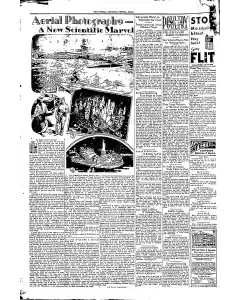
Army Air Corps camera sets long distance photo record
Captain Albert W Stevens and Lieutenant John D Corkille flew at 20000 feet for nearly five hours to photograph Mount Rainier 270 miles away using a high altitude long focal length camera. Night and day shots over New York used magnesium flares for exposures while bomb timing and automatic shutters captured images. The work advances aerial survey and mapping for military and civilian uses.
MENTIONED IN THIS ARTICLE
Elmo Scott Watson
United States Arc
Air Corps of
Army
A W. Stevens
Stevens
Ecamera Eye
Sieut
John D Corkilia
Crater Lake
Oregon
Stevena
White
Lefora
Mount Ralater
New York City
Washington
New York
Mount Rainier
Albert W. Stevene
Army Air Corps
John D Corkill
Mount Hood
Mount Jefferson
Slaters
Diamond Peak
Crescant Lake
Captain Stevens
Corkille
United States Army Air Corps
Tower Manhattan
Corkilla
Statue of Liberty
Fort Wood
Bedtoe’s Island
New York Harbor
United States Army
Alp Corps
Cavera
Thia la
Long Range
Mount Tainter
Advocates Wheat as Substitute for Corn in Hog Ration
Pros say wheat can replace corn in hog feed profitably if price remains near current levels and only costs 10 to 12 cents more per bushel. Walcher at Ohio State notes wheat yields 6 to 8 percent more energy than shelled corn and can fully substitute for corn with a protein supplement. Grinding or crushing is advised, soaking offers slight gains, and wheat's higher protein balance reduces needed tankage compared to corn.
MENTIONED IN THIS ARTICLE
Atates Jay
Walcher
Epectaties
Oho State University
Silage as a Premier Farm Feed and Calf Growth
The article extols silage as a highly useful on farm feed highlighting its low cost and mold-free quality. Experiments at Michigan State College show calves eat more silage and hay early, enabling similar weight gain with less grain compared to self-fed corn. Calves weighing 875 to 1000 pounds gain rapidly in two months, consuming less grain yet same fatness, with similar prices two years later.
MENTIONED IN THIS ARTICLE
Michigan State College Experiment Station
Lack of Protein Causes Rooting by Pigs at Ohio Station
The Ohio experiment station reports pigs on low protein began rooting more as feeding period lengthened. Fish meal emerged as the most economical protein with corn, minerals raised gains by 18 percent. no protein supplement lowered efficiency. Ground oats outperformed whole oats with tankage and alfalfa. cottenseed meal proved a better protein source but cost and mix affected profitability.
MENTIONED IN THIS ARTICLE
Ohio
W L
Robinson
Soot Urged as Means of Destroying Slugs
A historical notice advises using soot to kill slugs. Spread broadside on warm evenings after a Bonn crop and cultivate to disrupt slugs in embryo form. Lime, ashes, and careful soil management are noted as helps in controlling the slug plague.
MENTIONED IN THIS ARTICLE
Bonn
Farm News Notes and Oddities From County Fair
A report from Cartela county Colorado describes baby beeves fattened under county extension supervision fetching about 35 dollars per 100 pounds as beef sales rise in restaurants and markets. A separate note mentions toxic sprays used to combat pests like cabbage worms, noting quick worm mortality after feeding on treated foliage and a successful use of pollinating insects in an apple orchard for profits in North Carolina.
MENTIONED IN THIS ARTICLE
Cartela County
Colorado
Tunder
Spervision
Vance Lough County
Rees
J W Danters
Taylorssille
North Carolina
Winter egg laying profits analyzed by Ohio State expert
KE Cray of Ohio State University extension poultry reports that summer and fall egg production dominates profits while winter eggs are less profitable. He advises February planning for pullet hatching, stressing breeding quality to sustain egg output through winter and predicts higher production per bird in coming years due to rising costs and declining egg prices.
MENTIONED IN THIS ARTICLE
KE. Cray
Husveuiry
Ohio State Universy
Cray
Rearing and Fattening Young Cockerels for Breeding and Meat
Guidelines from Derby Winton at Missouri College of Agriculture advise keeping male chicks in bachelor quarters at ten to twelve weeks, then removing them to fattening crates two weeks before sale. Birds weighing 1 1/4 to 1 1/2 pounds are ready to fatten, fed a 14 day program with a seven to three cornmeal middlings batter mixed with buttermilk.
MENTIONED IN THIS ARTICLE
Derby Winton
Missouri College of Agriculture
No Profit in Keeping Weak Pullets in Flock
Quote heavy piece on disposing of weak pullets after incubation. Notes inherited tendency for poor feathering and using banding to identify bare backs. Advises keeping young birds separated to prevent disease and rotating housing near alfalfa with ample water.
MENTIONED IN THIS ARTICLE
Leon Todd
Purdie University
Elover
Poultry Hygiene and Public Health Goals
The task of poultry hygiene is twofold: to promote health by enabling vital functions with minimal hindrance and maximum efficiency, and to defend it by warding off disease, interrupting its spread, or destroying it.
Avoid Worm Troubles In Poultry Flocks
Advice stresses worm problems in poultry flocks mainly stem from dirty premises. Cleaning roosting areas, disinfecting, and removing droppings to unused farm sections are essential before chasing losses with worm treatments.
Delousing Fowl Care Described in Historic Text
The piece details an old method of delousing fowls using lard and kerosene to saturate nit clusters and prevent hatching. It mentions applying powders and substances to skin and leathers, aiming to kill nits as they hatch and expose them to destruction.
The Case for Less Arithmetic in Schooling
The author laments wasted time in childhood spent on arithmetic arguing that most arithmetic concepts are unnecessary for daily life. He notes losing arithmetic ability yet retaining other practical memories like telephone numbers and contemplates the value of math education.
Howl Okuidle-Chat Boy Faces Job Search Challenge
A fragmentary exchange in New Bedford notes Howl Okuidle-Chat as a boy prone to making noise in the world while Muddle-Oh doubts him until he tries to find work, signaling a local character study from the Stanjard column.
MENTIONED IN THIS ARTICLE
New Bedford
Stanjard
Mayor Lays Foundation Stone for Hospital Wing
The mayor places the foundation stone for a new hospital wing and speaks as spectators watch. He asks his wife, What can I do, Wary, as the moment is marked by ceremony and anticipation.
Smallpox Patients Benefit From Red Glass Light Rooms
Report notes smallpox patients confined in rooms with light filtered by red glass hare lenses experience less scarring than those in ordinary light. The article highlights potential therapeutic effects and ongoing observations in patient care settings.
And He Doesnt How Do You Keep Such A Fine Polish
A fragmentary exchange describes a method for maintaining polish on a floor by placing Wille on it and asking him to keep still. The quirky line captures a humorous moment in a casual setting.
MENTIONED IN THIS ARTICLE
Wille
Fragmented exchange hints at tender moment
A brief, partly garbled dialogue fragment shows a character asking if the other ever loved another girl like her. The reply asserts such love would break them, due to the strength of tact in restraint.
MENTIONED IN THIS ARTICLE
Earugh Ter
Fryery Sweet Girl Graduate Seeks Reform Of Man
A young graduate from Fryery signals a resolve to reform a man she knows or admires. She aims to influence his habits and choices through guidance and example, reflecting post graduation ambitions and social expectations of personal reform.
MENTIONED IN THIS ARTICLE
Fryery
Also Mentioned on This Page
Newape
Mosqui
Sever
Donald Lose
Gapi
Polytechnic College of Engineering
Madsen
Oakland
Califo Sia
Technet
Eraliter. Inc
God Testing Laboratories
Staabeerte
Ft. Woop
WIN U
Sal Lake City

 This is just the beginning! Our collection holds over 300 years of history, including rare newspapers, obituaries, marriage records, birth records, and so much more—most of which you won’t find anywhere else!