British Smash Through Nazi Defenses In Italy Drive
Allied reports say the British Eighth Army pierced German lines beyond Sangro ridge with heavy air support as American Fifth Army advances three miles in the central front. German resistance remains fierce with very heavy losses. signs point to a broad Allied push toward Rome.
MENTIONED IN THIS ARTICLE
Algiers
Eighth Army
Sangro
Fifth Army
Rome
Victory at Tarawa Costs U.S. 1 026 Dead and 2 557 Wounded
The Tarawa battle proved the bloodiest in Marine history with 1 026 Americans dead and 2 557 wounded. Navy figures cover Makin and Abemama losses at 65 killed 12 wounded and 1 killed 2 wounded respectively, total casualties 3 772 across Gilbert Island operations in 76 hours. Secretary Knox had warned losses would be heavy.
MENTIONED IN THIS ARTICLE
Washington
Tarawa
Marine Corps
Atoll
Japan
Central Pacific
Navy
Gilbert Island
Makin
Abemama
Secretary of the Navy
Knox
Weather Forecast for Montana West and East Provinces
Weather forecast notes cloudy conditions with showers or snow flurries west of the continental divide on Thursday and Thursday night with little temperature change. East of the divide expects partly cloudy skies, warmer in the northwest and west regions Thursday and Thursday night.
MENTIONED IN THIS ARTICLE
Montana
Continental Divide
Northwest
U S Naval Vessels Carry War to Japan Front Door
American light naval craft shelled Gasmata New Britain and Madang New Guinea during the night of November 29 30 in the first sea bombardment of these enemy outposts. Coastal targets and Japanese shore installations were hit while a small enemy vessel was sunk in Dallman passage. The action reflects policy directions of Vice Admiral Thomas C Kinkaid new head of naval forces in the southwest Pacific.
MENTIONED IN THIS ARTICLE
Southwest Pacific
Japan
Gasmata
New Britain
Madang
New Guinea
Astrolabe Harbor
Dallman Passage
Thomas C. Kinkaid
Kinkaid
Allied chiefs affirm Europe top priority at London conference
The London meeting shows unity among Roosevelt Churchill Chiang Kai-shek and Stalin potential future talks, with hope that Marshall may lead a western Europe invasion. British observers note Europe remains the main news and warn against wavering after Hitler's defeat.
MENTIONED IN THIS ARTICLE
London
Japan
Chiang Kai-shek
Roosevelt
Churchill
Britain
Hitler
Joseph Stalin
George C. Marshall
Europe
Negotiation Period Is Extended For Yellowstone River
The Senate public lands committee approved S1388 to extend until June 1, 1947 the negotiating period for Montana North Dakota and Wyoming to reach a water distribution agreement for the Yellowstone river. An agreement proposed in 1941 failed to gain state approval. The panel also approved HR 3428 for leasing coal mines.
MENTIONED IN THIS ARTICLE
Washington
Senate Public Lands Committee
Montana
North Dakota
Wyoming
Yellowstone River
Nazis Strike With New Vigor on Russian Front
London reports Germany renewed effort across the Russian front with as many as 15 counterattacks in one area. Moscow cites limited gains by the Red army and lists heavy German casualties, including 26 tanks lost at Cherkasy bridgehead as fighting continues toward Smela.
MENTIONED IN THIS ARTICLE
London
Red Army
Moscow
Dnieper
Cherkasy
Smela
Axis Propaganda Experts Overestimate Cairo Conferences
Axis propaganda outlets claimed a four power meeting with Russia was under way at Teheran. German radio suggested a tripartite talk in Teheran with Roosevelt, Churchill, Chiang Kai-shek and Stalin, but there was no direct Axis comment on North Africa declarations.
MENTIONED IN THIS ARTICLE
North Africa
Russia
Teheran
Cairo
Iran
Persia
Roosevelt
Churchill
Chiang Kai-shek
Berlin
Stalin
Allied Pledge Hailed by Korean Leaders
The Sino-Korean People’s League hailed the Allied pledge to restore Korea’s independence with enthusiasm. Spokesman Kilsop K. Haan praised the Roosevelt Churchill Chiang statement as timely and effective, saying 26 million Koreans would be grateful. Korea lies 138 miles from Japan, having been seized by Japan over three decades ago.
MENTIONED IN THIS ARTICLE
Washington
Korea
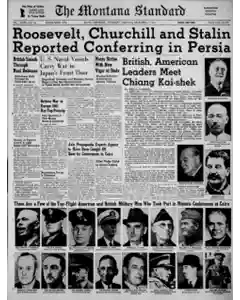
British American Leaders Meet Chiang Kai-shek
Roosevelt Churchill and Chiang Kai-shek concluded a five day wartime conference binding their nations to force Japan to uncondi tional surrender and strip its imperial gains. A plan of operations outlined aims to disgorge Pacific islands, restore Chinese territories, free Korea, and expel Japan from further lands. The Moscow Teheran meeting with Stalin was anticipated as a follow up.
MENTIONED IN THIS ARTICLE
John F. Chester
Cairo
Roosevelt
Churchill
Chiang Kai-shek
Japan
Washington
Joseph Stalin
Russia
Reuters
Lisbon
Portugal
Teheran
Iran
Stalin
United Nations
Berlin
United States
Britain
China
British Empire
Pacific
Germany
Marshall, Caroline
Mariana
Manchuria
Formosa
Pescadores
Form
Also Mentioned on This Page
By Noland Norgaard
U.S
U. S
South Pacific
By Lewis Hawkins
Reds
Gomel
Pripet River
Dnieper River
Associated Press
Pearl Harbor
Gody
Wyo
George T. Beck
Wyoming Territorial Council
Cody
of China
U.S. Army Chief of Staff
Admiral Cunningham
British Naval Staff
H. H. Arnold
U. S. Army Air Forces
Sir Alan Brooke
Imperial General Staff
Dwight D. Eisenhower
Mediterranean
British Air Staff
E. J. King
U. S. Fleet
Tedder
W. H. Leahy
Admiral Mountbatten
Southeast Asia
J. W. Stillwell
Burma
India
Field Marshal Dill
Combined Chiefs of Staff
C. L. Chennault
Anthony Eden
Brehon Somerville
U. S. Army Service of Supply
DE Wiart

 This is just the beginning! Our collection holds over 300 years of history, including rare newspapers, obituaries, marriage records, birth records, and so much more—most of which you won’t find anywhere else!