
 This is just the beginning! Our collection holds over 300 years of history, including rare newspapers, obituaries, marriage records, birth records, and so much more—most of which you won’t find anywhere else!
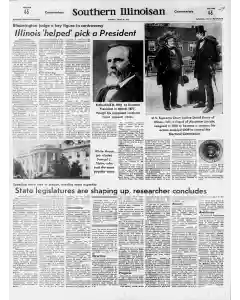
Bloomington judge in 1876 election shaped by Illinois moves
A Bloomington figure, U.S. Supreme Court Justice David Davis, played a pivotal role in the 1876 presidential controversy. The Illinois General Assembly elected Davis to the U.S. Senate after long balloting, with Democrats backing him amid a heated clash over Hayes versus Tilden. Davis’s election influenced the Electoral Commission dynamics and the outcome that made Hayes president.
MENTIONED IN THIS ARTICLE
David Felts
Lindsay-Schaub
U. S. House of Representatives
Alabama
George C. Wallace
House of Representatives
Wallace
Richard Nixon
Hubert Humphrey
Rutherford B. Hayes
Samuel J. Tilden
Illinois General Assembly
U. S. Supreme Court
David Davis
Bloomington
Tilden
South Carolina
Florida
Louisiana
Confederacy
Congress
Hayes
United States
Supreme Court
Commission
Samuel F. Miller
Iowa
William Strong
Pennsylvania
Nathan Clifford
Maine
Stephen J. Field
California
Illinois
Abraham Lincoln
Davis
St. Louis
Electoral Commission
Washington
Springfield
U. S
Greenbacks
John A. Logan
Murphysboro
Senate
John J. Palmer
Judge Davis
New York
Gramercy Park
Willard L. King
Lincoln
Harvard University Press
Chicago
Grant
Joseph P. Bradley
New Jersey
U. S. Grant
U.S. Supreme Court
GOP