The Convict's Daughter Ends With a Shattered Family
Linley faces news of his daughter Nitty’s fragile recovery while Sydney Westerfield and Mrs. Linley confront betrayal and guilt. Catherine accuses Linley, Sydney confesses love, and the couple’s future collapses as legal divorce and custody unfold. Sydney returns seeking reconciliation, while Linley reads the damning press and faces an empty, solitary path.
Hidden marriage secret tears at a hotel reveal Herbert's heartbreak
Herbert and Sydney settle in at a hotel while he grapples with a broken marriage and a forgotten keepsake. He discovers a book inscribed to Catherine on their anniversary, exposing his past and testing Sydney's trust as she confronts his truth.
MENTIONED IN THIS ARTICLE
Herbert
Sydney
England
London
Sandyseal
Catherine
Kitty
Irather
The Peculiar Cuban Dance From Leslie's Weekly
Leslie's Weekly describes a Cuban dance seen by Americans as having a single mixed Indian Turkish and Chinese step. Dancers occupy little space and perform continuously with brief rests as two orchestras alternate musicians. The sound includes tomtoms kettle drums and a gourd like instrument producing a rhythm likened to a barrel swathe on a fence.
MENTIONED IN THIS ARTICLE
Arizona
New Mexico
Leslie’s Weekly
His Greatest Blunder Convict Reflects On Politics Over Private Theft
A convict muses that his gravest error was shifting theft from a private company to state corruption, noting many mistakes but arguing the switch had broader consequences. He quips about starting at the top of a ladder and preferring slow anger to quick gunfire.
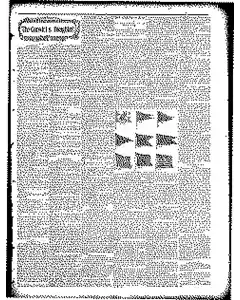
The Admiral's flag and its evolving naval meaning
The piece traces the admiralty flag from the Continental era to Farragut and Dewey. It notes Hopkins's pine tree flag, the blue, red, and white pennants for flag officers, the 1864 to 1867 reforms, Farragut's four star blue flag, and the eventual restoration of the blue four star standard. It ends with Admiral Dewey receiving Farragut’s cherished standard as symbol of achievement and duty.
MENTIONED IN THIS ARTICLE
Dewey
Farragut
United States Navy
Continental Congress
Esek Hopkins
George Washington
Admiral Hopkins
Philadelphia
Alfred
Hopkins
John Paul Jones
Franklin
Secretary of the Navy
Parragut
Rise of the American flag rank and Commodore titles in U S Navy
The article traces early naval ranks and ensigns from the adoption of the thirteen star flag in 1777 to 1862 when rear admirals received formal flags. It notes shifts from British practice to American conventions, the use of commodore titles, and the 1862 act establishing legal admiral ranks and flag hoist locations.
MENTIONED IN THIS ARTICLE
United States
Union
Congress
Toucey
Navy Yards
Charles Stewart
Farragut
Hartford
Mizzen
Richard H. Dana
Ancient Cannons Made From Unusual Materials Throughout History
The article surveys early artillery materials from leather and wood to stone and gold, noting coarse powder and small ranges. It mentions ice guns used for a 1740 winter fete in Petersburg with sixty yard range and no bursts, and reports ideas like paper guns by Krupp.
MENTIONED IN THIS ARTICLE
Gustavus Adolphus
Scotland
Alexander Hamilton
Sweden
India
Cortez
Mexico
Krupp
Petersburg
Rubbers save money by protecting shoes and health
The Churchman argues rubbers are a thrifty invention saving shoe leather and medical costs. It notes that 8 shoes with rubbers outwear expensive nonrubber shoes in rain, snow, and slush, and a 50 cent pair could prevent costly doctor bills and illnesses like pneumonia or consumption.
Labeled Children and Social Quirks in Japan
A passage contrasts labeling of poor children with names and addresses in Japan with a jokey view of a man who plays cards online and a businesswoman who falls in love and acts coy. The tone blends cultural critique with light social commentary.
MENTIONED IN THIS ARTICLE
Japan
Also Mentioned on This Page
Rie Collins
Linley
Mr. Linley
Nitty
Catherine Linley
Bhlerbert Linley
Sydney Westerfield
Mrs. Linley
Miss Westerfield
Lealing
Sea Side
Admiral Dewey
Preble
Porter
Thompson
Isaac Toucey

 This is just the beginning! Our collection holds over 300 years of history, including rare newspapers, obituaries, marriage records, birth records, and so much more—most of which you won’t find anywhere else!